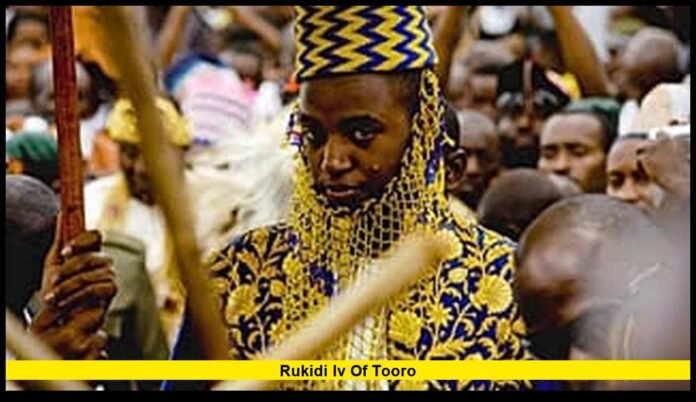

Rukidi IV of Tooro has been laid to rest in western Uganda, bringing an extraordinary 31-year reign to an end while opening a new and contested chapter for the Tooro Kingdom. King Oyo Nyimba Kabamba Iguru Rukidi IV died at age 34 after receiving cancer treatment in the United States. His burial on September 12 in Fort Portal followed nine days of official mourning and drew thousands of mourners.
The death of the longtime monarch has also created an intense dispute over the future of the throne. Members of the Babiito royal clan selected Prince Edward Rukidi Kijanangoma as the next king. He was formally presented during the ceremonies surrounding Oyo’s final send-off.
The succession decision has faced opposition from members of Oyo’s immediate family. They maintain that the late king left a son who should inherit the throne and have pointed to a reported will as part of their argument.
The competing claims have made the transition one of the most closely watched moments in the modern history of Tooro.
King Oyo’s Remarkable Beginning as a Child Monarch
Oyo was born on April 16, 1992, into the royal family of Tooro. His father, King Patrick Matthew Kaboyo Olimi III, died in 1995.
Oyo was only three years old when he succeeded his father.
His coronation quickly attracted international attention. Images of the young monarch wearing royal clothing and participating in traditional ceremonies made him a familiar figure far beyond Uganda.
His age became one of the defining details of his early public identity.
Yet Oyo’s reign lasted far longer than the period when he was known simply as a child king. He remained on the throne as he attended school, entered adulthood and gradually assumed more responsibilities.
That transition gave his reign an unusual character.
Few modern traditional rulers have been followed by the public from early childhood through adulthood in the same way.
Oyo eventually became closely associated with the cultural identity of Tooro and with youth-focused advocacy.
A 31-Year Reign Comes to an End
Oyo spent almost his entire life as the king of Tooro.
His reign began in 1995 and ended with his death in August 2026.
For residents of the kingdom, his death represented more than the loss of a traditional ruler. Many people had grown up knowing only one monarch.
The king became part of Tooro’s modern identity.
As an adult, he took part in cultural activities and public events while also supporting initiatives involving young people and health.
His international visibility also remained unusually high.
Oyo’s story had started with the global fascination surrounding a three-year-old monarch. Over time, that attention shifted toward his public work and role within Uganda’s traditional leadership structure.
His death therefore marked the end of a personal journey that had been closely watched for more than three decades.
King Oyo Dies While Receiving Treatment in the United States
Oyo died in the United States in late August while receiving treatment for cancer.
The news shocked people in Uganda and members of the Tooro community abroad.
His death was formally announced after the monarch passed away during treatment.
The circumstances surrounding his illness had not dominated his public profile before his death. Instead, much of the attention following his passing centered on his legacy, funeral arrangements and the future of the throne.
His remains were later returned to Uganda.
The body arrived at Entebbe International Airport on September 4. President Yoweri Museveni and senior officials were among those present.
From there, the remains were transported toward Tooro for the period of public mourning.
The government played a significant role in organizing the funeral and supporting the logistics surrounding the return of the king’s body.
Nine Days of Mourning in Tooro
The arrival of Oyo’s remains began an official period of mourning.
His body lay in state at Karuziika Palace in Fort Portal, giving members of the public and visiting dignitaries an opportunity to pay their respects.
The mourning period also included religious services and traditional observances.
Security preparations were extensive because large crowds were expected in Fort Portal for the final ceremonies.
The government deployed security personnel and provided logistical support for the funeral.
Health services were also arranged to assist mourners during the period of public gatherings.
The arrangements reflected the significance of the event for the kingdom and Uganda more broadly.
The funeral was ultimately scheduled for September 12.
That date held special importance because it coincided with the anniversary of Oyo’s coronation.
He had become king on September 12, 1995.
Thirty-one years later, the same date became the day of his burial.
The Final Funeral in Fort Portal
Oyo’s final funeral service took place at St. John’s Cathedral in Fort Portal.
The ceremony brought together members of the royal family, religious leaders, cultural leaders, government representatives and ordinary mourners.
The service reflected both Oyo’s Christian faith and the cultural traditions surrounding the Tooro monarchy.
After the service, a procession carried the coffin through Fort Portal toward the Karambi Royal Tombs.
Thousands of people gathered along the route.
Royal guards accompanied the coffin as it moved toward the burial grounds.
The procession became one of the most visible public moments of the mourning period.
At Karambi, Oyo was buried among his royal ancestors.
His burial formally ended his reign and began the next phase of the kingdom’s history.
Why the Karambi Royal Tombs Matter
The Karambi Royal Tombs are closely associated with the history of the Tooro monarchy.
The site serves as the final resting place for members of the royal lineage.
Oyo’s burial there placed him alongside previous rulers and connected his 31-year reign with the longer history of the kingdom.
The location also gave the funeral a strong symbolic meaning.
Oyo had entered the monarchy as a child. His final ceremony placed him within the royal line that he had represented throughout his life.
The burial was therefore both a farewell and a transition.
It closed the public chapter of Oyo’s reign while traditional authorities prepared to recognize a successor.
Edward Rukidi Kijanangoma Chosen as Successor
The succession process moved quickly during the mourning period.
A 21-member committee associated with the Babiito royal clan was established to consider the next monarch.
The committee eventually selected Prince Edward Rukidi Kijanangoma.
Kijanangoma is a cousin of Oyo and has a professional background in journalism and broadcasting.
He has worked as a news anchor and editor with Uganda Broadcasting Corporation.
His selection came as a surprise to many people who expected the succession question to become more complicated after Oyo’s death.
The committee’s decision was announced before Oyo’s burial.
The selection immediately became controversial.
Members of Oyo’s immediate family objected to the decision and questioned the process used to choose the successor.
Despite those objections, Babiito elders proceeded with the traditional transition.
A New King Emerges During Oyo’s Burial
The succession became official during the final ceremonies on September 12.
Kijanangoma was presented as the new monarch of Tooro.
He assumed the regnal name King Edward Rukidi Nyabongo I.
One of the traditional elements of the transition involved the new king casting nine coffee berries into Oyo’s grave.
The act carried deep ceremonial meaning.
It marked the transfer of royal authority from the deceased monarch to his successor.
The timing was especially significant because Oyo’s funeral and the installation of his successor occurred during the same historic transition.
The Tooro Kingdom therefore moved from mourning its longtime ruler to recognizing a new king within a matter of days.
The Dispute Over Oyo’s Alleged Son
The biggest challenge facing the succession is the claim that Oyo left behind a biological son.
The issue became public after his death.
Oyo was not known to have married, and details about his alleged child had not been publicly established during his lifetime.
After his death, however, senior figures associated with the kingdom said that he had left an heir.
The identity of the child has remained the subject of intense public attention.
Members of Oyo’s family have argued that the son should have priority in the succession.
They have also pointed to a reported will in which Oyo addressed the succession of the throne.
The family has criticized the Babiito committee’s decision to select Kijanangoma instead.
That disagreement has created a direct conflict between the royal family’s position and the decision of the clan leadership.
Queen Mother and Princesses Challenge the Decision
Queen Mother Best Kemigisa has objected to the succession process.
Princess Ruth Komuntale, Oyo’s sister, has also criticized the decision.
The family has argued that the late king’s wishes should be considered before the throne is permanently transferred to another branch of the family.
The disagreement became public even before Oyo was buried.
That timing generated concern among cultural and religious leaders, who urged the royal family to focus first on honoring the deceased king.
The dispute has nevertheless continued because succession is central to the future of the institution.
For the Tooro royal family, the issue is not simply about selecting a new ceremonial figure. It also involves questions about lineage, tradition, inheritance and the interpretation of the late king’s wishes.
What the Babiito Clan Says
The Babiito clan holds a central role in the traditional succession process.
The clan is the royal lineage from which Tooro kings are drawn.
Its elders backed the committee that selected Kijanangoma.
The committee’s decision established him as the successor despite objections from some members of Oyo’s immediate family.
The Babiito position has effectively placed traditional clan authority behind the new king.
The disagreement means the coming period will be important for determining whether the royal family can reach an internal settlement.
The issue could also become a legal matter if competing claims are formally taken to court.
For now, the clearest confirmed development is that Kijanangoma has been selected and formally presented as the new king.
Oyo’s Role Beyond the Throne
Oyo’s public legacy extended beyond traditional ceremonies.
As he grew older, he became associated with youth advocacy and health initiatives.
He served as a United Nations goodwill ambassador connected with efforts against HIV and AIDS.
His public work helped broaden his image beyond that of a ceremonial monarch.
He was also recognized for supporting education and opportunities for young people.
Those activities became particularly important because of his own unusual childhood.
Oyo had experienced international attention from a very young age. As an adult, he used that visibility to speak about issues affecting younger generations.
His advocacy became one of the more significant elements of his adult public life.
The Significance of Oyo’s Death for Tooro
Oyo’s death represents a major generational change for Tooro.
A large portion of the kingdom’s population knew him as their monarch for most or all of their lives.
His reign began when Uganda’s traditional institutions were being re-established and continued into an era of rapid social and technological change.
The king grew from a globally recognized child monarch into an adult cultural leader.
That long transition made him an unusually familiar figure.
His successor now faces the difficult task of establishing a new identity for the monarchy.
Kijanangoma does not inherit the same childhood history.
Instead, he enters the role as an adult with professional experience and a connection to the royal family.
His ability to build acceptance across the kingdom will be closely watched.
The Tooro Monarchy Enters a New Era
Uganda’s traditional monarchs do not hold the political authority of elected national leaders.
Their role is primarily cultural and symbolic.
Even so, traditional kingdoms remain important institutions for identity, heritage and community life.
Tooro is one of the country’s major traditional kingdoms.
That makes the succession especially important for the people connected to the kingdom.
The transition after Oyo’s death now involves two simultaneous developments.
The first is the formal installation of Kijanangoma.
The second is the unresolved disagreement over whether Oyo’s alleged son should have been considered for the throne.
Those two issues will shape the next chapter of Tooro’s royal history.
What Happens After the Burial
With Oyo now buried, attention will shift toward the new king and the unresolved succession claims.
The royal family has an opportunity to address the dispute through traditional discussions, legal processes or a combination of both.
The most immediate challenge will be preserving unity.
Oyo’s funeral showed how strongly people remain connected to the monarchy. Thousands attended the ceremonies, while national and cultural leaders joined the mourning.
That public support creates pressure on the royal institution to resolve disagreements peacefully.
Kijanangoma’s role will also become more visible as he begins his responsibilities as king.
The new monarch inherits a kingdom that has just lost a ruler who spent 31 years on the throne.
His first challenge is therefore not simply taking the title.
It is establishing continuity after an unusually long and emotionally significant reign.
The Legacy of a King Who Grew Up in Public
King Oyo’s story remains unusual because his entire life was tied to the Tooro throne.
He became king at three.
He grew up under international attention.
He later became an adult monarch, cultural representative and advocate for young people.
His death at 34 ended a reign that had lasted more than three decades.
His burial at Karambi Royal Tombs now places him among the ancestors of the kingdom he represented for most of his life.
At the same time, his death has created a succession dispute that will likely remain an important issue for Tooro.
The selection of Edward Rukidi Kijanangoma establishes a new direction for the monarchy, but questions surrounding Oyo’s alleged son and reported will have not disappeared.
The future of Tooro will depend in part on how those competing claims are addressed.
For now, Oyo’s reign has officially ended, the new king has been presented, and the kingdom has entered a new era after one of the most remarkable royal stories in modern Uganda.
What are your thoughts on the end of King Oyo’s 31-year reign and the new chapter for Tooro? Share your views and stay updated as the royal transition develops.