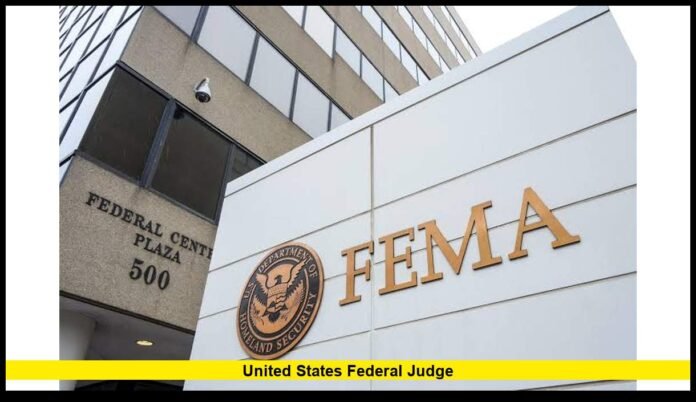

The latest United States federal judge rulings are putting several major Trump administration policies under renewed legal scrutiny, with important decisions involving federal hiring, FEMA staffing, voting rules and other government actions.
Federal courts have remained at the center of several high-profile disputes in September. Recent decisions have affected federal employees, government agencies and election-related policies. Some cases are still moving through the appeals process, while others are heading toward additional hearings that could determine the final remedies.
Among the newest developments, a federal judge in Massachusetts has blocked the administration from using a controversial question for applicants seeking federal civil service positions. In California, another judge ruled that the administration acted unlawfully when it directed major reductions in FEMA’s workforce.
These decisions arrived alongside other significant federal court disputes across the country. Together, they provide a clear picture of how the federal judiciary is reviewing executive actions and agency decisions.
Federal Judge Blocks Question Used in Government Job Applications
One of the most closely watched recent rulings came from U.S. District Judge George A. O’Toole Jr. in Boston.
O’Toole issued an order blocking the Trump administration from continuing to require a political-policy question for applicants seeking federal civil service positions.
The disputed question asked applicants to explain how the president’s policies were personally significant to them and how they would help advance those policies if they were hired.
The question had appeared across federal job listings covering a wide range of positions.
Those positions included jobs such as air traffic control specialists, crane operators and nuclear materials couriers.
Three federal employee unions challenged the practice in court.
The unions argued that the question transformed the federal hiring process into a political test. They maintained that career government positions should remain based on qualifications rather than an applicant’s political views.
O’Toole agreed that the unions had demonstrated sufficient grounds for preliminary relief.
His order prevents the administration from continuing to use the disputed question in federal job applications while the lawsuit proceeds.
The ruling is especially significant because federal civil service hiring is governed by laws intended to protect merit-based employment.
Why the Federal Hiring Decision Matters
Federal employment has traditionally operated under rules designed to limit political influence over career positions.
Applicants compete for government jobs based on qualifications, experience and the requirements of individual positions.
The recent lawsuit raised concerns about whether applicants could be asked to demonstrate support for a president’s political agenda before obtaining a career position.
The administration defended the question as an optional tool rather than a direct political loyalty test.
The unions took a different position. They argued that even asking applicants to explain their support for presidential policies could discourage qualified people from applying and undermine the nonpartisan nature of federal employment.
O’Toole found that the unions were likely to succeed on claims involving the First Amendment and federal administrative law.
The judge’s order is not the final resolution of the lawsuit. It is a preliminary ruling that prevents the challenged practice from continuing while the legal case develops.
That distinction is important.
The court has not issued a final judgment resolving every issue raised by the parties. Further proceedings could determine whether additional relief is necessary.
For now, however, the administration cannot continue using the disputed question in the manner challenged by the unions.
More Than 70,000 Job Listings Were Affected
The scope of the hiring policy made the case particularly significant.
The disputed question appeared in more than 70,000 federal job listings.
That meant the issue was not limited to a small group of applicants or a single government department.
The question appeared in applications for positions throughout the federal government.
Its broad use also increased concerns among unions representing federal employees.
The court’s intervention therefore affects a large pool of prospective government workers.
The ruling also adds to the ongoing debate over how much control a president should have over the federal workforce.
Presidents have substantial authority over executive agencies. Career employees, however, operate under federal civil service laws that establish protections intended to prevent political considerations from controlling employment decisions.
The lawsuit will now continue under the court’s preliminary order.
Federal Judge Rules Against FEMA Workforce Cuts
Another major federal court decision came from U.S. District Judge Susan Illston in San Francisco.
Illston ruled that the Trump administration violated federal law when it directed FEMA to reduce its workforce substantially.
The decision centers on efforts to cut thousands of FEMA positions, including temporary disaster-response reservists.
Those reservists provide an important part of FEMA’s ability to respond to disasters and emergencies.
The case was brought by unions challenging the administration’s approach to reducing FEMA staffing.
The unions argued that the cuts threatened the agency’s ability to perform responsibilities assigned to it by Congress.
Illston agreed that the Department of Homeland Security exceeded its authority.
FEMA operates within the Department of Homeland Security, but federal law places specific limits on efforts to substantially reduce FEMA’s authorities, responsibilities or functions.
Congress adopted those protections after Hurricane Katrina.
The legislation was intended to ensure that FEMA could maintain the capacity necessary to prepare for and respond to major disasters.
Illston concluded that DHS had acted unlawfully when it moved to stop FEMA from renewing contracts for thousands of temporary disaster-response workers.
FEMA Staffing Decision Could Have Broader Consequences
The FEMA ruling is important because the case goes beyond a disagreement about the number of federal employees.
The central issue involves the authority of one federal agency to direct major operational changes at another agency.
FEMA has a specific statutory mission.
That mission includes preparing for disasters and coordinating federal assistance when emergencies occur.
Illston found that the administration’s workforce reduction did not have an adequate legal basis.
The judge noted that FEMA had projected staffing at roughly 11,383 employees for the upcoming fiscal year, about half of earlier staffing levels.
The court questioned the reasoning behind that target.
Illston also examined how DHS and FEMA officials communicated about the workforce reductions.
The ruling addressed the use of Signal messaging on personal devices and the deletion of relevant messages.
The judge determined that the deleted communications were relevant to the lawsuit. The court said it would presume that the missing messages would have been unfavorable to the government.
That finding adds another important dimension to the case.
FEMA Case Still Needs a Remedy
Although Illston ruled against the administration on the legality of the workforce cuts, the decision did not establish the final remedy.
The judge indicated that the question of relief would be addressed in a separate proceeding.
The parties can submit arguments about what corrective action should follow the ruling.
That could make the next stage of the case important for FEMA employees and the agency itself.
The administration could also pursue further legal options.
As with other federal cases, a district court decision can move through the federal appeals system.
The current ruling therefore represents a major legal setback for the workforce reduction plan, but it does not necessarily mark the end of the dispute.
Mail Voting Restrictions Face Continued Court Challenges
Another important federal court dispute involves new U.S. Postal Service rules affecting mail voting.
U.S. District Judge Indira Talwani in Massachusetts extended an injunction blocking parts of the administration’s effort to impose new requirements connected with mail voting.
The case involves Democratic-led states and voting rights organizations challenging the Postal Service rules.
Talwani’s order prevents the administration from implementing specified mandatory provisions ahead of the November 2026 congressional elections.
The legal dispute focuses on the balance between federal authority and the states’ constitutional role in administering elections.
The administration has sought emergency relief from the Supreme Court.
That development means the district court’s decision remains part of an active legal process.
The final outcome could depend on action by higher courts.
For voters, the case is important because changes to mail-ballot procedures can affect how election officials prepare ballots and how voters return them.
Missouri Congressional Map Dispute Reaches Supreme Court
Federal court action has also played a major role in an ongoing dispute over Missouri’s congressional districts.
Chief U.S. District Judge Stephen R. Clark ordered Missouri to use a redrawn congressional map for the November elections.
The decision came after a separate ruling by Missouri’s highest court concerning the same map.
Opponents of the redistricting plan subsequently asked the U.S. Supreme Court to intervene.
The dispute is particularly significant because the new map changes the boundaries of a congressional district in the Kansas City area.
The legal battle demonstrates how federal and state courts can become involved in the same election dispute.
It also shows why a federal district court order does not necessarily settle a major election case.
Higher courts can review the decision, and emergency applications can quickly change the legal landscape before an election.
Federal Courts Continue to Review Executive Authority
The recent cases share a broader legal theme.
Federal judges are being asked to determine whether executive agencies have acted within the authority granted by Congress and the Constitution.
That question appears in the federal hiring case.
It is also central to the FEMA workforce dispute.
The same principle appears in litigation over election administration and other federal policies.
Executive agencies have significant authority to implement presidential priorities. That authority is not unlimited.
Federal statutes can establish specific requirements that agencies must follow.
Courts can review agency decisions when individuals, unions, states or organizations claim that the government exceeded those legal boundaries.
A judge may issue temporary relief when the legal requirements for an injunction are met.
The government can then appeal.
That process allows higher courts to review the district court’s reasoning.
Why Recent Federal Court Rulings Matter
The latest cases have practical consequences for Americans.
The federal hiring ruling affects people seeking employment with the federal government.
The FEMA decision affects the agency responsible for major aspects of federal disaster response.
The mail-voting litigation could influence election procedures before the November midterm elections.
The Missouri redistricting case could affect congressional representation.
These cases also demonstrate the importance of understanding the difference between preliminary orders and final judgments.
A preliminary injunction can immediately stop a government action, but the underlying lawsuit may continue for months or longer.
An appeals court can modify or overturn a lower-court decision.
The Supreme Court can also intervene in emergency proceedings.
As a result, the current legal status of a case can change quickly.
What to Watch Next
The federal hiring lawsuit remains an important case to watch as the unions and administration continue their legal arguments.
The FEMA dispute is also expected to generate another significant ruling when the court addresses the appropriate remedy.
The mail-voting case could see further action from the Supreme Court as the November elections approach.
Meanwhile, the Missouri congressional map dispute remains active at the highest level of the federal judiciary.
Those cases could produce additional orders that affect federal agencies, government employees and voters.
The broader pattern is clear: federal courts continue to serve as a major check on executive and administrative action.
Recent decisions have stopped or challenged government policies in several areas, while appeals and higher-court proceedings determine whether those decisions will remain in place.
The Bigger Picture for Federal Court News
The latest rulings highlight the importance of the federal judiciary during a period of significant government policy changes.
Federal judges are not responsible for creating executive policy. Their role is to determine whether challenged government actions comply with the law.
That responsibility can place district courts at the center of major national disputes.
The recent hiring ruling shows how civil service protections can become the focus of constitutional litigation.
The FEMA decision demonstrates how federal agencies must operate within statutory limits.
Election-related cases show how federal courts can become involved when government actions affect voting procedures or congressional district boundaries.
Each case follows its own legal path.
Some could be resolved through settlements or later district court orders. Others may proceed to federal appeals courts or the Supreme Court.
For Americans following government and legal developments, the most important point is that these cases remain active.
The September rulings represent significant developments, but several legal questions have not yet reached their final resolution.
Federal court decisions will continue shaping major government policies in the weeks ahead, so share your thoughts in the comments and stay informed as these cases develop.