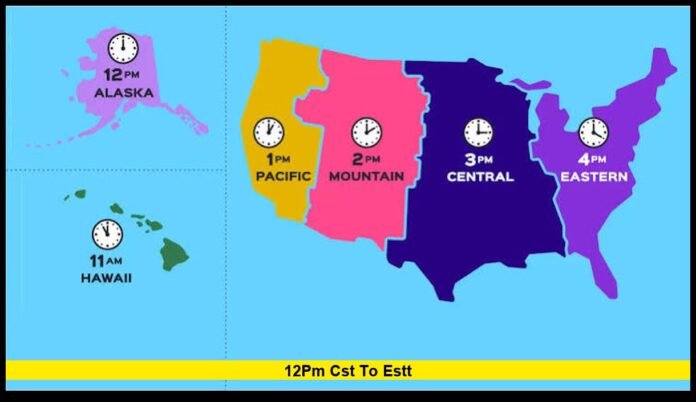

If you are searching for 12pm cst to est, the straightforward answer is 1:00 PM EST when both Central Standard Time and Eastern Standard Time are in effect. The Eastern Time Zone is one hour ahead of the Central Time Zone, making this one of the simplest U.S. time-zone conversions. However, daylight saving time can change the abbreviations used during part of the year, so understanding the difference between CST, CDT, EST, and EDT is important when checking a schedule.
Time-zone conversions are especially useful for people coordinating meetings, appointments, online events, television programs, business calls, travel plans, and deadlines across different parts of the United States. A one-hour difference may seem small, but it can make a significant difference when an event has a fixed starting time.
What Is 12 PM CST in EST?
When both locations are observing standard time, noon in the Central Time Zone corresponds to 1 PM in the Eastern Time Zone.
The conversion is:
12:00 PM CST = 1:00 PM EST
CST stands for Central Standard Time, while EST stands for Eastern Standard Time. Central Standard Time is six hours behind Coordinated Universal Time, or UTC−6. Eastern Standard Time is five hours behind UTC, or UTC−5.
Because Eastern Standard Time is one hour closer to UTC, the Eastern clock is one hour ahead of the Central clock.
The easiest rule to remember is:
Central Time + 1 hour = Eastern Time
So if the clock reads 12 PM in Central Standard Time, someone following Eastern Standard Time should see 1 PM.
Why Is Eastern Time One Hour Ahead?
The continental United States is divided into several major time zones. From east to west, the primary zones are Eastern, Central, Mountain, and Pacific.
Each major zone is generally one hour behind the zone immediately to its east.
That means:
- Eastern Time is one hour ahead of Central Time.
- Central Time is one hour ahead of Mountain Time.
- Mountain Time is one hour ahead of Pacific Time.
This arrangement makes Central-to-Eastern conversions relatively easy.
For example:
| Central Time | Eastern Time |
|---|---|
| 9:00 AM | 10:00 AM |
| 10:00 AM | 11:00 AM |
| 11:00 AM | 12:00 PM |
| 12:00 PM | 1:00 PM |
| 1:00 PM | 2:00 PM |
| 2:00 PM | 3:00 PM |
| 3:00 PM | 4:00 PM |
| 4:00 PM | 5:00 PM |
| 5:00 PM | 6:00 PM |
The relationship remains one hour apart even when the seasonal time designations change.
Is 12 PM Noon or Midnight?
One of the most common problems with time-related searches is confusion between 12 AM and 12 PM.
12 PM means noon.
12 AM means midnight.
Therefore, a schedule showing 12 PM refers to the middle of the day rather than the beginning of a new day.
For example:
- 12:00 AM — midnight
- 6:00 AM — morning
- 12:00 PM — noon
- 6:00 PM — evening
This distinction is particularly important when reading event schedules. If a meeting is listed for 12 PM Central, a participant in the Eastern Time Zone should generally expect it at 1 PM Eastern.
CST and CDT: Why the Abbreviation Changes
CST is not the abbreviation used by most Central Time locations throughout the entire year.
During standard time, the Central Time Zone uses Central Standard Time (CST).
During daylight saving time, it uses Central Daylight Time (CDT).
The difference is one hour:
- CST = UTC−6
- CDT = UTC−5
When daylight saving time begins, clocks move forward by one hour. When it ends, clocks move back.
This creates an important distinction for people searching for a conversion based on a particular date. Someone may describe a Central Time event as “CST” even when the location is technically using CDT.
For general scheduling, Central Time (CT) is often a better choice because it avoids seasonal abbreviation confusion.
EST and EDT Explained
The Eastern Time Zone follows a similar system.
During standard time, the zone uses Eastern Standard Time (EST).
During daylight saving time, it uses Eastern Daylight Time (EDT).
Their UTC offsets are:
- EST = UTC−5
- EDT = UTC−4
Consequently, the Central and Eastern zones maintain their normal one-hour relationship.
During standard time:
CST → EST = one-hour difference
During daylight saving time:
CDT → EDT = one-hour difference
So although the abbreviations change, the basic conversion between Central and Eastern Time does not normally change.
What Happens During Daylight Saving Time?
Daylight saving time is the main reason time-zone abbreviations can become confusing.
During the daylight-saving period, many U.S. locations move their clocks forward by one hour. Central locations that observe the change use CDT, while Eastern locations use EDT.
The practical conversion becomes:
12:00 PM CDT = 1:00 PM EDT
That is still a one-hour difference.
The mistake people sometimes make is assuming that because the letters have changed, the difference between the time zones has also changed. It has not. Both zones generally shift together, preserving the one-hour difference.
For current schedules, it is therefore useful to identify whether an event is being described in standard time or daylight time.
12 PM Central Time to 1 PM Eastern Time
Many businesses, websites, broadcasters, and event organizers use “Central Time” and “Eastern Time” rather than CST and EST.
This is generally clearer because Central Time includes both CST and CDT, while Eastern Time includes both EST and EDT.
If a website says:
12 PM Central Time
the corresponding time for someone in the Eastern Time Zone is normally:
1 PM Eastern Time
This format is particularly useful for recurring events because it remains understandable regardless of whether daylight saving time is currently active.
Why Time-Zone Conversion Matters for Businesses
Businesses operating across multiple states frequently need to coordinate employees and customers in different time zones.
A company headquartered in a Central Time location may schedule a conference call at noon. Employees working from Eastern Time locations need to know that the meeting starts at 1 PM locally.
This affects:
- Staff meetings
- Job interviews
- Sales calls
- Customer appointments
- Webinars
- Training sessions
- Product announcements
- Conference presentations
- Internal deadlines
- Virtual events
A simple one-hour error can cause someone to miss a meeting or arrive too early.
For this reason, professional scheduling systems often display the time zone alongside the event.
Time Conversion for Online Events
Virtual events have made time-zone awareness more important than ever.
A webinar advertised as starting at noon Central may attract viewers from across the country. Participants in the Eastern Time Zone need to join at 1 PM.
A clear event listing might therefore display:
12 PM Central / 1 PM Eastern
Adding multiple time zones is especially helpful when an event has a national audience.
For larger events, organizers may also include Mountain and Pacific times:
- 12 PM Central
- 1 PM Eastern
- 11 AM Mountain
- 10 AM Pacific
This gives attendees an immediate reference point without requiring them to calculate the difference themselves.
Time-Zone Conversion for Travel
Travelers crossing between Central and Eastern Time should also account for the one-hour difference.
For example, someone traveling east from Chicago to New York moves from the Central Time Zone to the Eastern Time Zone. The local clock in New York is generally one hour ahead.
If it is noon in Chicago, it is 1 PM in New York.
The difference can affect:
- Flight departure planning
- Airport arrival times
- Hotel reservations
- Rental-car pickup times
- Restaurant reservations
- Business appointments
- Tour schedules
- Train connections
Travelers should rely on the local time displayed by airlines, transportation providers, and reservation systems because some routes may cross time-zone boundaries.
12pm cst to est Conversion Chart
For quick reference, the standard Central-to-Eastern relationship can be summarized as follows:
| CST | EST |
|---|---|
| 12:00 AM | 1:00 AM |
| 1:00 AM | 2:00 AM |
| 2:00 AM | 3:00 AM |
| 3:00 AM | 4:00 AM |
| 4:00 AM | 5:00 AM |
| 5:00 AM | 6:00 AM |
| 6:00 AM | 7:00 AM |
| 7:00 AM | 8:00 AM |
| 8:00 AM | 9:00 AM |
| 9:00 AM | 10:00 AM |
| 10:00 AM | 11:00 AM |
| 11:00 AM | 12:00 PM |
| 12:00 PM | 1:00 PM |
| 1:00 PM | 2:00 PM |
| 2:00 PM | 3:00 PM |
| 3:00 PM | 4:00 PM |
| 4:00 PM | 5:00 PM |
| 5:00 PM | 6:00 PM |
| 6:00 PM | 7:00 PM |
| 7:00 PM | 8:00 PM |
| 8:00 PM | 9:00 PM |
| 9:00 PM | 10:00 PM |
| 10:00 PM | 11:00 PM |
| 11:00 PM | 12:00 AM |
This chart assumes the two locations are using their corresponding standard-time designations.
12 PM CST to EST in 24-Hour Time
Some readers prefer the 24-hour clock because it removes ambiguity between AM and PM.
In 24-hour notation:
12 PM = 12:00
One hour later is:
13:00
Therefore:
12:00 Central = 13:00 Eastern
The 24-hour format is particularly useful for international communication, technical systems, transportation schedules, and business operations.
It also avoids confusion about whether “12” refers to noon or midnight.
Common Mistakes When Converting Central and Eastern Time
Forgetting to Add an Hour
The most basic mistake is subtracting an hour instead of adding one.
Eastern Time is ahead of Central Time.
Therefore, converting from Central to Eastern requires adding one hour.
Confusing 12 AM With 12 PM
12 PM is noon, not midnight.
Always verify whether a schedule refers to AM or PM.
Ignoring Daylight Saving Time
CST and EST are standard-time abbreviations. During daylight saving time, the appropriate abbreviations are generally CDT and EDT.
Using CST for Every Date
Some people use CST as shorthand for Central Time all year. While this may be common in casual conversation, it is not technically accurate during daylight saving time.
Assuming Every Location Follows the Same Rules
Time-zone rules can differ by location. Most of the United States follows the standard federal daylight-saving schedule, but there are exceptions.
When accuracy is important, use the specific city or location rather than relying only on an abbreviation.
How to Avoid Time-Zone Confusion
The easiest way to avoid confusion is to include the full time-zone name or use CT and ET.
For example, instead of writing:
12 PM
write:
12 PM Central Time / 1 PM Eastern Time
For a standard-time date, you can use:
12 PM CST / 1 PM EST
For a daylight-saving date, use:
12 PM CDT / 1 PM EDT
This is particularly helpful when communicating with people who live outside your local time zone.
Does the Date Change?
A conversion from noon Central to Eastern does not normally change the date.
For example:
Monday at 12 PM Central = Monday at 1 PM Eastern
The conversion moves the clock forward by only one hour, so the calendar date remains the same.
Date changes become more relevant when converting late-night times. For example, a late-evening Central Time event can become a midnight or early-morning Eastern Time event.
This is another reason to include both the date and time zone when publishing important schedules.
Central and Eastern Time for Popular U.S. Cities
Several major U.S. cities fall within these two time zones.
Examples of cities generally associated with Central Time include:
- Chicago
- Dallas
- Houston
- New Orleans
- Minneapolis
- St. Louis
- Kansas City
Examples of cities generally associated with Eastern Time include:
- New York City
- Boston
- Philadelphia
- Atlanta
- Miami
- Washington, D.C.
- Detroit
Therefore, when a Central Time event begins at noon, people in these Eastern Time cities would generally see the local start time as 1 PM.
Local exceptions and daylight-saving rules should always be considered when precise scheduling is required.
A Simple Formula for Future Conversions
You do not need a complicated calculation to convert Central Time to Eastern Time.
Use this formula:
Eastern Time = Central Time + 1 hour
Examples:
9 AM Central → 10 AM Eastern
10 AM Central → 11 AM Eastern
11 AM Central → 12 PM Eastern
12 PM Central → 1 PM Eastern
1 PM Central → 2 PM Eastern
2 PM Central → 3 PM Eastern
Once this pattern is understood, most Central-to-Eastern conversions can be completed immediately.
Final Takeaway
The Central and Eastern U.S. time zones are separated by one hour. When standard time is in effect, noon in Central Standard Time corresponds to 1 PM in Eastern Standard Time.
For daylight-saving dates, the equivalent terminology is generally 12 PM CDT and 1 PM EDT.
The most important points are simple: Eastern Time is one hour ahead of Central Time, 12 PM means noon, and the abbreviations change seasonally.
For meetings, appointments, travel, online events, and business schedules, using “Central Time” and “Eastern Time” can be clearer than relying exclusively on CST and EST.
Once the one-hour difference is remembered, converting between the two zones becomes straightforward and reliable.