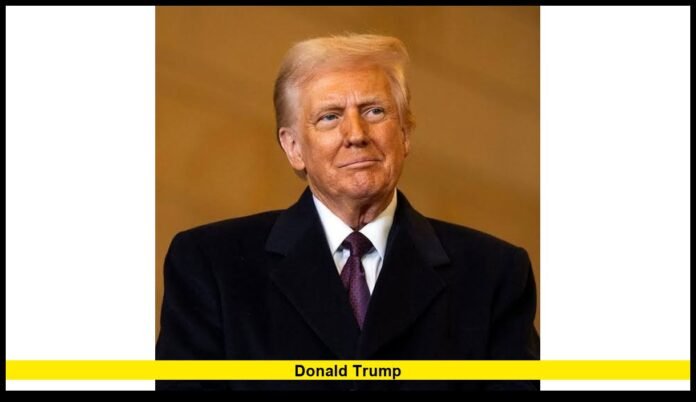

The phrase 270 million x 5000 has gained attention after President Donald Trump proposed a $5,000 “Trump dividend” for American adults if Republicans retain control of Congress in the November 2026 midterm elections. The basic calculation is straightforward: 270 million multiplied by $5,000 equals $1.35 trillion. However, that figure represents the potential scale of the proposal rather than an approved federal payment program. Trump has not provided a finalized distribution system, eligibility rules, funding legislation or payment schedule.
The proposal was announced during Trump’s remarks at the Republican Party’s midterm convention in Dallas on September 9. Trump said every adult citizen would receive $5,000 if Republicans win control of both the House of Representatives and the Senate. He also said the money would have to be spent in the United States.
That announcement immediately raised questions about the size of the program, how the federal government would finance it and what Congress would need to do before payments could actually reach Americans.
270 million x 5000 Equals $1.35 Trillion
The central calculation behind the discussion is simple.
| Calculation | Amount |
|---|---|
| Estimated adult population used for the calculation | 270 million |
| Proposed payment per adult | $5,000 |
| Estimated total | $1.35 trillion |
The arithmetic is 270,000,000 × $5,000 = $1,350,000,000,000.
That equals $1.35 trillion.
The 270 million figure is being used as an approximate measure of the adult population in the United States. It should not automatically be treated as the final number of people who would qualify for the proposed dividend. Trump described the proposed recipients as adult U.S. citizens, while population estimates of roughly 270 million adults do not represent a precise count of adult citizens.
That distinction matters because the final cost would depend on the eligibility rules ultimately written into any legislation.
If Congress created a narrower eligibility standard, the total cost could be below $1.35 trillion. If the government used a broader population definition, the amount could differ.
For that reason, the 270 million x 5000 calculation is best understood as a headline estimate showing the enormous scale of the proposal.
What Trump Actually Proposed
Trump introduced the idea during a speech at the Republican Party’s first-ever midterm convention in Dallas.
The proposal was not presented alongside a detailed federal program.
Trump did not announce a formal application process. He did not provide a payment date. He also did not identify a finalized mechanism for determining eligibility.
The president additionally said recipients would have to spend the money inside the United States. The announcement did not explain how that requirement would be enforced or tracked after the money reached individual households.
That leaves several basic questions unanswered.
Americans would need to know who qualifies, when payments would begin, how payments would be delivered and whether income limits would apply.
Those details have not been established as part of an enacted federal benefit program.
Why the $1.35 Trillion Figure Matters
A $5,000 payment may sound relatively limited when viewed at the individual level. Multiplying it across hundreds of millions of potential recipients produces a dramatically different number.
A $1.35 trillion gross cost would make the proposed dividend one of the largest federal cash-transfer concepts discussed in recent years.
The figure also explains why the proposal has attracted immediate attention from budget analysts and economists.
The Associated Press reported that the proposal could cost more than $1 trillion and would require congressional approval. Reuters similarly reported that the proposal could cost more than $1 trillion and lacks clear implementation details.
The final amount cannot be confirmed because the government has not established the number of eligible recipients.
For example, if 240 million people ultimately qualified, the calculation would be:
240 million × $5,000 = $1.2 trillion.
That is why estimates reported by different outlets can vary even while describing the same $5,000 proposal.
The difference comes from assumptions about eligibility rather than a disagreement over basic multiplication.
The Payment Is Not Currently an Approved Federal Check
One of the most important points for Americans following the proposal is its current status.
The $5,000 dividend is a political proposal. It is not an enacted federal payment program.
There is currently no announced payment schedule that tells eligible Americans when a $5,000 check or direct deposit would arrive. There is also no finalized federal application process associated with the proposal.
Trump’s announcement alone cannot create a new federal spending program.
The Constitution gives Congress authority over federal appropriations. Article I, Section 9, Clause 7 states that money cannot be drawn from the Treasury without an appropriation made by law. Congress’s Constitution Annotated explains that federal money generally cannot be paid from the Treasury without an appropriation enacted by Congress.
That constitutional requirement is central to understanding the proposal.
Even if Republicans retain control of the House and Senate, lawmakers would still need to address the legislation, funding mechanism and administrative structure necessary to distribute such payments.
Winning an election does not itself authorize the Treasury to begin sending $5,000 payments.
How the 270 Million Estimate Relates to the Proposal
The phrase 270 million x 5000 is useful because it illustrates the potential size of the proposed program.
It does not establish that exactly 270 million people would receive money.
Trump referred to adult citizens. The approximate 270 million figure commonly cited in reporting represents the scale of the adult population rather than a finalized list of eligible recipients.
That means the calculation should not be interpreted as an official government budget estimate.
Instead, it provides a straightforward way to understand the financial challenge.
If every one of 270 million adults received $5,000, the gross amount would reach $1.35 trillion.
If the eligible population were smaller, the cost would fall accordingly.
For example:
- 250 million recipients × $5,000 = $1.25 trillion
- 240 million recipients × $5,000 = $1.20 trillion
- 220 million recipients × $5,000 = $1.10 trillion
- 200 million recipients × $5,000 = $1 trillion
These calculations demonstrate why even a smaller eligible population would still create a program measured in trillions of dollars.
Where Would the Money Come From?
Funding remains one of the biggest unanswered questions surrounding the proposal.
Trump has linked his economic argument to tariff revenue. Reporting from the convention indicated that tariff revenue was discussed as a potential source for the payments. However, the proposal does not currently include a finalized funding plan capable of establishing how the full cost would be covered.
The scale of the revenue question becomes clear when compared with the proposed cost.
A program costing approximately $1.35 trillion would require an exceptionally large funding source if the government intended to cover the entire amount without additional borrowing.
The New York Times reported that Trump has previously suggested tariffs could help finance payments, while also noting that actual tariff revenue has not reached the “trillions” claimed in Trump’s remarks.
This does not mean that tariff revenue could not contribute to a future program. It means that the administration has not established a complete financing structure for the $5,000 dividend.
Until Congress acts and a funding mechanism becomes law, Americans cannot assume that tariff collections will automatically become $5,000 payments.
Could Wealthier Americans Be Excluded?
Another unresolved issue involves eligibility based on income.
Trump’s initial description referred broadly to every adult citizen. However, subsequent reporting indicated that Vice President JD Vance suggested wealthy Americans might not receive the payment.
That creates an important difference between the original headline and a possible final program.
If Congress imposed an income threshold, the number of recipients could fall significantly below the approximate 270 million adult population figure.
A lower number of eligible recipients would also reduce the total cost.
For example, a program limited to lower- and middle-income households could have a substantially different budget from a universal payment.
No final income threshold has been established as of September 10, 2026.
Americans should therefore avoid treating claims about specific income limits as confirmed eligibility rules unless Congress or the administration formally announces them.
Would Everyone Receive $5,000 Automatically?
There is currently no confirmed answer.
Trump’s public proposal describes a $5,000 payment for adult citizens if Republicans retain control of Congress. But the announcement did not establish whether payments would be automatic, whether Americans would need to apply or which federal agency would administer the program.
Federal payments can use different delivery systems depending on how Congress structures a program.
Past federal benefits have used direct deposits, mailed checks, prepaid cards and other distribution methods. However, no specific delivery method has been established for the proposed Trump dividend.
The same uncertainty applies to taxation.
There has been no enacted legislation establishing whether a future $5,000 dividend would be taxable income, exempt from federal income tax or treated under another tax rule.
Americans should not assume a tax treatment until formal legislation or official guidance establishes it.
The Proposal Depends on the 2026 Midterm Elections
Trump tied the dividend to Republican control of Congress.
The 2026 federal midterm elections are scheduled for November 3, and the proposal specifically depends on Republicans retaining control of both the House and Senate.
That condition makes the proposal different from an ordinary federal benefit announcement.
It is not currently available to Americans regardless of election results.
Trump presented the $5,000 payment as something that would follow a Republican victory in both chambers. The proposal therefore remains connected to a future congressional outcome and subsequent legislative action.
Even if the stated political condition occurs, the payment would still require a workable legal and financial structure.
Why the $5,000 Dividend Has Raised Budget Questions
The federal government already operates with a substantial budget deficit.
The Associated Press reported that the annual federal deficit is approaching $1.8 trillion and said a program of this scale could add pressure to the government’s finances.
That comparison helps put the proposed payment into perspective.
A $1.35 trillion program would represent a major federal expenditure. It would not be comparable to a small tax credit or limited benefit adjustment.
The ultimate fiscal effect would depend on how Congress funded the payments.
If lawmakers used existing revenue, the program would compete with other federal spending priorities. If the government borrowed to finance the payments, the proposal could increase federal borrowing and debt.
If lawmakers used a combination of revenues, spending reductions and borrowing, the fiscal impact would depend on the details of that package.
At this stage, those choices have not been finalized.
What Americans Should Know About the Proposal Right Now
The clearest facts as of September 10, 2026 are relatively straightforward.
- Trump has proposed a $5,000 payment for adult U.S. citizens.
- He tied the proposal to Republicans retaining control of both chambers of Congress.
- Trump called the proposed payment the “Trump dividend.”
- He said the money would have to be spent in the United States.
- No payment date has been announced.
- No application process has been announced.
- No final eligibility rules have been established.
- No enacted law currently creates the proposed $5,000 dividend.
- The commonly cited 270 million-adult figure produces a $1.35 trillion calculation.
- The actual cost could be lower if eligibility is restricted.
- Congressional action would be required to authorize federal spending for a new program.
These points separate the confirmed announcement from details that remain unresolved.
270 Million x 5000 Is a Cost Calculation, Not a Payment Announcement
The search for 270 million x 5000 largely comes down to understanding the scale of Trump’s proposal.
The multiplication produces $1.35 trillion, but that number should not be mistaken for an official federal appropriation.
The 270 million figure is an approximate adult population measure used to demonstrate the potential size of a universal $5,000 payment. The actual number of eligible recipients would depend on the definition Congress ultimately adopts.
Likewise, the $5,000 amount remains a proposed dividend rather than a currently authorized payment.
The proposal would face several steps before Americans could receive money: determining eligibility, establishing a funding source, passing the necessary legislation and creating an administrative process for distribution.
Until those steps occur, there is no confirmed $5,000 payment that Americans can claim.
The Constitution’s appropriations requirement is especially important because the executive branch cannot simply withdraw new federal funds for an unapproved program based only on a presidential announcement.
For now, the most accurate way to describe the situation is that President Trump has made a $5,000 dividend proposal tied to Republican control of Congress, while the funding, eligibility, timing and legal implementation remain unresolved.
As more official details emerge about the proposed dividend, Americans should focus on confirmed legislation and government announcements rather than treating the $1.35 trillion calculation as proof that payments have been approved.