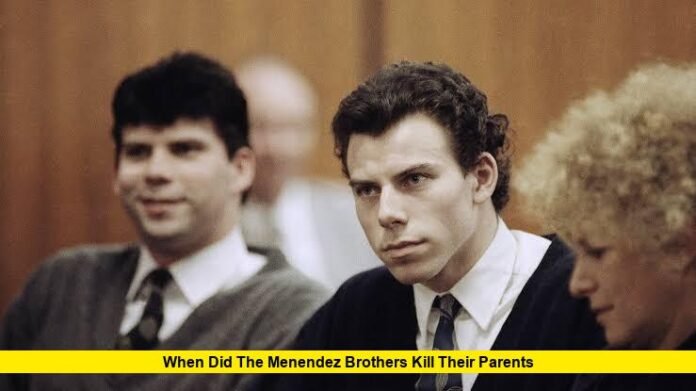

Many people search for when did the Menendez brothers kill their parents, and the answer is fixed in history even as their legal case keeps evolving.
Erik and Lyle Menendez shot and killed their parents, Jose and Mary Louise “Kitty” Menendez, on August 20, 1989, inside the family’s Beverly Hills mansion. That date has never changed. What has changed, dramatically, is the brothers’ path toward possible freedom, and this week brought another major development.
On September 7, 2026, the California Board of Parole Hearings granted Erik and Lyle an early parole suitability hearing. The hearing is now tentatively scheduled for March 2027, more than a year sooner than their previously expected 2028 date.
The Night That Started It All
Jose Menendez, a wealthy entertainment executive, and his wife Kitty were shot multiple times with shotguns in the family room of their home. Erik was 18 years old at the time, and Lyle was 21.
Prosecutors initially argued the brothers killed their parents for financial gain, pointing to the family’s estimated $14 million estate. The defense told a different story.
Erik and Lyle claimed they acted out of fear after enduring years of physical, emotional, and sexual abuse at the hands of their father, with their mother allegedly aware and complicit in the silence.
From Arrest to Conviction
The brothers were not arrested immediately. Investigators initially treated the case as a possible organized-crime hit, given Jose Menendez’s business ties.
Months later, incriminating statements Erik made to his therapist surfaced, and both brothers were arrested in March 1990.
Here is a quick timeline of the major legal milestones:
| Year | Event |
|---|---|
| 1989 | Jose and Kitty Menendez killed in Beverly Hills home |
| 1990 | Erik and Lyle arrested and charged with murder |
| 1993–1994 | First trial ends in hung juries for both brothers |
| 1996 | Second trial results in convictions on two counts of first-degree murder |
| 1996 | Both sentenced to life in prison without parole |
| 2024 | Los Angeles DA George Gascón announces resentencing review |
| May 2025 | Brothers resentenced to 50 years to life |
| Aug. 2025 | Both denied parole at first hearings |
| Sept. 2025 | Judge denies habeas petition for a new trial |
| Sept. 2026 | Parole hearing moved up to March 2027 |
Their first trial, held separately for each brother, ended without verdicts after juries could not reach agreement. A second, joint trial followed in 1995 and 1996, and this time the outcome was different.
Jurors convicted both Erik and Lyle of first-degree murder, and the court sentenced each to life in prison without the possibility of parole.
Why the Case Resurfaced Decades Later
For nearly three decades, that sentence appeared final. Then new attention arrived through documentaries, podcasts, and renewed public interest in how the justice system treats abuse survivors who commit violence.
In late 2024, Los Angeles County District Attorney George Gascón said his office would ask the court to resentence the brothers after reviewing new evidence supporting their long-standing abuse claims.
That request moved forward under a new district attorney administration, and in May 2025, a judge resentenced both men to 50 years to life. The change made them eligible for parole under California’s youth offender parole laws, since both were under 26 at the time of the killings.
Parole Denials and the Road to 2027
Eligibility did not mean immediate release. Erik faced his first parole hearing on August 21, 2025, and Lyle faced his the following day.
Separate parole panels denied both men, citing disciplinary issues during their incarceration, including reported cellphone violations, and expressing concerns about their readiness for release.
Those denials initially pushed the next possible hearing out to August 2028. This week’s decision changes that outlook significantly.
What Happened This Week
According to the family’s statement to CBS News, California parole officials approved administrative reviews for both Erik and Lyle, advancing their next suitability hearings by more than a year.
The California Board of Parole Hearings pointed to a provision within Proposition 9, a 2008 law amending the state constitution to expand certain rights for crime victims and, in this context, allow adjustments to hearing schedules.
The brothers’ family expressed gratitude in a statement, saying Erik and Lyle have spent almost 40 years working to take responsibility for their actions and to heal from what the family describes as unimaginable abuse and trauma.
The family also noted the brothers have started programs while incarcerated, including a hospice initiative and a prison beautification project, efforts their supporters point to as evidence of rehabilitation.
The Habeas Petition Setback
Not every recent ruling has favored the brothers. In September 2025, a Los Angeles Superior Court judge rejected a separate habeas corpus petition.
That petition argued two pieces of new evidence proved Jose Menendez had sexually abused other people, which the defense said corroborated Erik and Lyle’s own abuse claims. The judge’s denial closed off, at least for now, the possibility of a new trial on those grounds.
With that avenue foreclosed, parole remains the brothers’ primary path toward release.
What Comes Next
The March 2027 hearing date remains tentative, and the California Board of Parole Hearings has said its official schedule is subject to updates.
Victim advocates, family members on both sides, and legal observers are expected to weigh in before any hearing takes place. Some relatives of Jose and Kitty Menendez have publicly supported release, while others have raised objections in the past.
For now, both brothers remain incarcerated in California under their 50-years-to-life sentences, with parole board commissioners set to decide whether decades of behavior and rehabilitation outweigh the severity of the original crime.
The question of when did the Menendez brothers kill their parents has one fixed answer, August 20, 1989, but the question of when, or if, they walk free is still being written.
What do you think should happen at the March 2027 hearing? Share your take in the comments below.