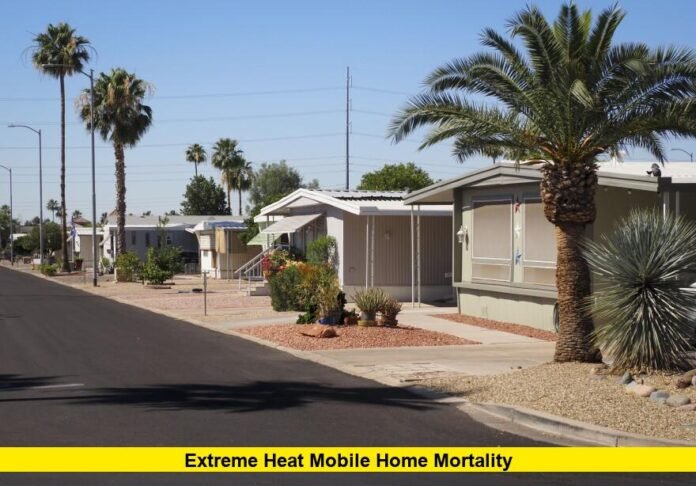

Extreme heat mobile home mortality is drawing renewed attention in the United States as 2026 research and newly released reporting show that manufactured-home residents can face disproportionate indoor heat exposure and death risk. The strongest current evidence comes from Arizona, where mobile and manufactured homes represent only about 5% of Maricopa County’s housing but accounted for about 23% of indoor heat-related deaths in 2025.
The issue has also gained national attention. A September 2026 investigation reported that heat deaths in the United States are substantially undercounted, while researchers continue to identify manufactured housing as a particularly vulnerable setting. New studies published in 2026 add evidence that indoor temperatures, cooling limitations, housing age and neighborhood conditions can combine to increase heat exposure inside mobile homes.
Why Mobile Homes Are Especially Vulnerable to Extreme Heat
Mobile homes are not automatically unsafe during hot weather. Modern manufactured homes can include improved insulation, efficient windows and effective air-conditioning systems.
The greatest concerns involve older or poorly maintained homes and households that cannot consistently operate their cooling equipment.
Research has identified several factors that can increase indoor heat exposure:
- Poor insulation and air sealing
- Aging or malfunctioning air-conditioning systems
- High electricity costs
- Limited electrical capacity in older homes
- Lack of shade around homes
- Large areas of pavement around mobile-home communities
- Limited access to affordable home repairs
- Older residents living alone
- Health conditions that increase sensitivity to heat
- High outdoor temperatures that continue overnight
These factors can reinforce one another. A home that heats rapidly during the day may remain dangerously warm after sunset. If an air conditioner fails or cannot operate continuously, residents may have difficulty escaping the heat.
A 2026 study of three mobile-home communities in Boulder, Colorado, provides new evidence about this problem. Researchers monitored indoor and outdoor temperatures and examined cooling systems, housing conditions and social factors.
The study found elevated heat vulnerability among residents, particularly when effective cooling was unavailable. It also found that nighttime temperatures remained an important concern, showing that the danger does not necessarily end when the sun goes down.
Maricopa County Remains a Key Case Study
Maricopa County, Arizona, has become one of the most closely studied areas for understanding heat mortality inside manufactured housing.
The county’s final 2025 heat report recorded 430 confirmed heat-related deaths. Of the indoor heat-related deaths, approximately 23% occurred in RVs, trailers or mobile homes, even though those structures account for only about 5% of housing structures in the county.
The disparity is significant because it shows that indoor heat mortality does not simply reflect the number of homes in a community.
Manufactured housing represents a relatively small portion of the county’s housing stock, yet it represents a much larger share of indoor heat deaths.
The county’s 2025 report also found another important warning sign involving air conditioning.
An air-conditioning unit was present in 94% of indoor heat-related death cases. However, among cases where an air conditioner was present, the equipment was not functioning in 72% of cases.
That distinction matters.
Simply having an air conditioner does not guarantee protection from extreme heat. Equipment can break, fail to cool an entire home, lose power or remain unused because operating costs are unaffordable.
The 2026 Heat Season Is Still Underway
Maricopa County’s current data show that the problem remains active in 2026.
As of August 22, 2026, the county had confirmed 113 heat-related deaths. Another 584 deaths remained under investigation at that point. County officials noted that 2026 had started with an early heat season and higher-than-normal overnight temperatures.
Those figures are not a final 2026 mortality total.
Heat-related death investigations can take time because medical examiners must determine whether heat caused or contributed to a death. Maricopa County explains that its preliminary and confirmed totals can change as investigations are completed and death certificates are amended.
For that reason, the current 2026 numbers should not be compared with a completed annual total as though they represent the entire season.
The continuing investigations nevertheless demonstrate why indoor heat remains an immediate public-health concern in Arizona.
New Research Connects Mobile Homes With Heat Mortality
Research published in 2026 has strengthened the evidence connecting housing characteristics with heat-related mortality.
A study published in JACC: Advances examined county-level vulnerability to cardiovascular mortality associated with extreme heat. Researchers found that social, demographic, health and housing characteristics explained a substantial portion of the differences between counties.
Among the housing factors associated with higher heat-related cardiovascular mortality were the prevalence of mobile homes and the age of housing. The researchers’ statistical model explained 68% of the variation in the county-level vulnerability measure.
The study does not mean that living in a mobile home directly causes cardiovascular death.
Instead, it demonstrates that housing characteristics can form part of a broader combination of environmental and social conditions associated with heat mortality.
That distinction is important when discussing manufactured housing. The housing category includes a wide range of structures, from older units with significant thermal problems to newer manufactured homes built to substantially higher standards.
Older Manufactured Homes Can Face Greater Thermal Stress
The age of a manufactured home can be an important factor.
Federal construction standards for manufactured housing were introduced in the 1970s. Homes built before those standards can have substantially different insulation and energy-efficiency characteristics from newer units.
Older homes can also develop additional problems over time.
Roof deterioration, damaged seals, aging windows, electrical problems and failing cooling equipment can make it harder to maintain a safe indoor temperature.
The combination can become particularly dangerous during prolonged heat waves.
A home may cool down overnight under normal summer conditions. During an extended heat event, however, outdoor temperatures can remain elevated for long periods. The structure can retain heat, while an inefficient cooling system struggles to remove it.
This creates cumulative heat exposure rather than a brief period of discomfort.
Nighttime Heat Is an Important Part of the Risk
The newest Boulder research highlights why nighttime temperatures deserve more attention.
Researchers found that some mobile homes continued experiencing elevated indoor temperatures even when cooling systems were available. Homes without effective cooling experienced particularly high indoor temperatures.
Nighttime recovery is important because the human body needs an opportunity to cool after prolonged daytime exposure.
When indoor temperatures remain high through the night, residents can begin the following day without fully recovering from the previous day’s heat.
This can be especially concerning during consecutive days of extreme temperatures.
Air Conditioning Helps, But Access Is Not Enough
Air conditioning remains one of the most important defenses against dangerous indoor heat.
The Maricopa County data, however, show why access must be considered more broadly.
A household may technically have an air conditioner but still face serious heat exposure if the unit is broken or cannot provide adequate cooling.
Repair costs can create another barrier. Electricity costs can also discourage continuous operation during extreme heat.
Older mobile homes may present additional challenges because electrical systems may limit what cooling equipment can safely operate.
The result is a gap between having cooling equipment and having reliable cooling protection.
Shade and Mobile Home Park Design Also Matter
Heat exposure does not depend solely on the structure itself.
The surrounding environment can affect how much heat reaches a home.
Research into manufactured housing in arid urban areas has found that mobile-home properties can have less vegetation than other residential housing types. Homes located within parks can have particularly limited vegetation.
Trees and vegetation can provide shade and reduce exposure to intense solar radiation.
By contrast, extensive pavement and other impervious surfaces can contribute to hotter surroundings.
This means heat protection can require more than replacing an air conditioner. The broader design of a mobile-home community can influence exposure.
The Risk Is Not Limited to Arizona
Arizona provides some of the clearest mortality data, but the underlying housing concerns extend beyond the Southwest.
The 2026 Boulder study shows that mobile-home heat vulnerability can also occur in a region with a very different climate from Phoenix. Researchers found that indoor heat exposure remained a concern in three Boulder communities and that lack of effective cooling was an important risk factor.
National research also points toward broader disparities in manufactured housing.
A 2025 study examining thermal conditions across U.S. manufactured housing found that residents of manufactured homes are more likely than residents of other housing types to require medical attention because of heat exposure at home.
The findings reinforce an important point: heat vulnerability is not determined by outdoor temperature alone.
Housing quality, cooling access, energy costs, neighborhood design and household circumstances all influence the level of risk.
Why the Latest Mortality Evidence Matters
The most important development in 2026 is the growing amount of evidence linking housing conditions to indoor heat outcomes.
Maricopa County’s mortality data provide a direct example. Academic research provides broader evidence about housing and heat vulnerability. New temperature monitoring in Colorado demonstrates how heat can accumulate inside mobile homes.
Together, these findings point to a consistent pattern.
Manufactured housing is not inherently dangerous. However, vulnerable homes and vulnerable residents can face substantially greater exposure during extreme heat.
The distinction is critical for public policy and heat-prevention efforts.
Programs that focus only on outdoor exposure may miss residents who are struggling inside their own homes.
What Can Reduce Heat Risk Inside Mobile Homes
Current evidence points toward several practical measures that can reduce indoor heat exposure.
Important interventions include:
- Repairing or replacing failed cooling systems
- Improving insulation and air sealing
- Addressing electrical problems that prevent cooling equipment from operating
- Reducing the cost barrier to essential cooling
- Increasing shade and vegetation around mobile-home communities
- Improving access to cooling centers during dangerous heat
- Checking on older or isolated residents during prolonged heat
- Identifying high-risk mobile-home communities before major heat events
- Using indoor temperature monitoring to identify homes that become dangerously hot
The emphasis should be on reliable protection rather than simply installing equipment.
A functioning air conditioner, adequate electricity, reasonable energy costs and a home capable of retaining cooled air all contribute to effective protection.
The Latest Picture of Extreme Heat Mobile Home Mortality
The evidence available as of September 8, 2026, shows a clear and continuing concern.
Maricopa County’s final 2025 data found that about 23% of indoor heat-related deaths occurred in RVs, trailers or mobile homes, while those structures represented only about 5% of county housing.
New 2026 research in Boulder found significant indoor heat vulnerability across mobile-home communities, particularly among homes without effective cooling.
National cardiovascular research has also identified the prevalence of mobile homes and older housing as important factors associated with differences in heat-related mortality between U.S. counties.
Meanwhile, Maricopa County’s 2026 heat season remains ongoing, with hundreds of deaths still under investigation as officials continue tracking the effects of prolonged heat.
The evidence does not support treating every manufactured home as a dangerous residence. Instead, it identifies a specific and measurable vulnerability involving older housing, ineffective cooling, energy barriers, limited shade and prolonged heat exposure.
Final Takeaway
The latest evidence shows that indoor heat mortality deserves the same attention as outdoor heat exposure, particularly in older and poorly cooled manufactured homes. As extreme heat continues affecting communities across the United States, identifying vulnerable mobile-home residents and improving reliable access to cooling could play an important role in preventing avoidable deaths.
What do you think communities should do to better protect mobile-home residents from extreme heat? Share your thoughts and stay updated as new heat-mortality data emerge.