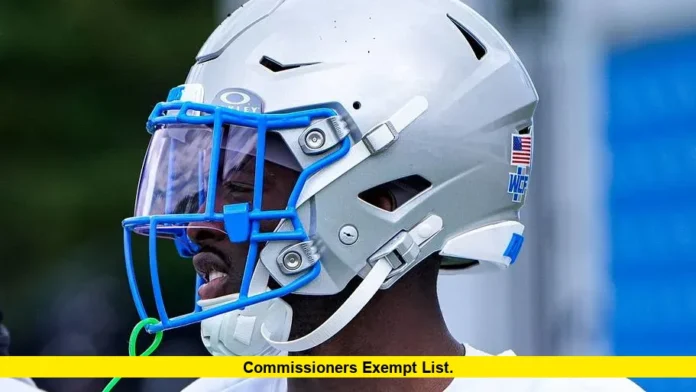

The commissioners exempt list is drawing major attention as three NFL players entered the designation just before the 2026 regular season. Green Bay Packers running back Josh Jacobs, Denver Broncos outside linebacker Jonathon Cooper and Seattle Seahawks cornerback Terrion Arnold are the latest players affected. The NFL confirmed that the designation prevents the players from practicing or appearing in games while their respective matters remain under league review.
The developments arrived during one of the most important roster periods of the NFL calendar. Teams finalized their initial 53-man rosters on Aug. 30, while the regular season is scheduled to begin in September.
The exempt designation does not itself establish that a player violated league rules. Instead, it allows the NFL to keep a player away from practices and games while a matter involving potential discipline is reviewed.
Who Is Currently on the Commissioners Exempt List?
As of the latest confirmed NFL updates on Aug. 31, 2026, three players have been placed on the list in connection with legal matters.
| Player | Team | Position | Current status |
|---|---|---|---|
| Josh Jacobs | Green Bay Packers | Running back | On Commissioner’s Exempt List |
| Jonathon Cooper | Denver Broncos | Outside linebacker | On Commissioner’s Exempt List |
| Terrion Arnold | Seattle Seahawks | Cornerback | On Commissioner’s Exempt List |
The three situations developed separately during the offseason, but all involve matters being reviewed under the NFL’s personal conduct process.
The league has stated that each player cannot practice or participate in games while on the designation. Certain team activities, including meetings and other permitted activities at a club facility, can remain available under the applicable rules.
Josh Jacobs Joins the List
Josh Jacobs became one of the most prominent additions to the list on Aug. 30.
The Packers running back was placed on the designation after prosecutors filed two misdemeanor charges stemming from a May incident in Wisconsin. The charges are battery and criminal damage to property. Jacobs was initially arrested on five counts, including a felony strangulation charge, before prosecutors announced the misdemeanor charges that ultimately remained.
The NFL’s decision immediately created uncertainty around Green Bay’s backfield.
Jacobs has been one of the Packers’ most important offensive players since joining the team. He was also projected as a major part of Green Bay’s rushing attack heading into the 2026 season.
While the league reviews the matter, Jacobs cannot practice or play in games. The designation is administrative and does not represent a final league disciplinary ruling.
Jacobs’ legal representatives described the designation as an administrative procedure while the NFL reviews the situation. The league has not announced a final suspension or other disciplinary penalty for Jacobs.
Green Bay also moved quickly to add depth at running back.
The Packers acquired Pittsburgh Steelers running back Kaleb Johnson on Aug. 30. The move gives Green Bay another option as the team deals with uncertainty surrounding Jacobs’ availability.
That transaction underscores the practical impact of the exempt designation. Even without a final suspension, a player cannot take part in practices or games while the status remains in effect.
Jonathon Cooper Added by the NFL
Denver Broncos outside linebacker Jonathon Cooper was also placed on the list on Aug. 30.
Cooper is facing several domestic violence-related charges connected to two June arrests in Colorado. NFL.com reported that he is not permitted to practice or attend games while on the designation, although he can be present at the Broncos’ facility for meetings and other permitted activities.
The charges include a felony count of second-degree assault by strangulation and three misdemeanor allegations, including an allegation involving violation of a protection order.
Cooper’s situation is especially significant for Denver because he has been an important defensive contributor.
The 28-year-old linebacker was selected by the Broncos in the 2021 NFL Draft. He established himself as a regular defensive player and recorded a career-high 10.5 sacks during the 2024 season.
He signed a four-year contract extension with Denver in 2024. His absence therefore creates a notable personnel issue for the Broncos as the regular season approaches.
The NFL’s designation does not constitute a final finding of wrongdoing. Cooper’s legal proceedings and the league’s review remain separate processes.
His current status means Denver must prepare without him while the NFL determines what happens next.
Terrion Arnold’s Situation Is Different but Also Under Review
Terrion Arnold became the third major addition to the current list.
The Seattle Seahawks officially signed Arnold on Aug. 29 after reaching an agreement with the cornerback earlier in the offseason. The NFL then confirmed that Arnold would be placed on the exempt list after the league received his contract.
Arnold, 23, was arrested in June in connection with a February robbery and kidnapping case in Tampa, Florida. He faces eight felony charges.
The Detroit Lions released Arnold following the arrest. Seattle later agreed to bring him into the organization despite the unresolved legal matter.
NFL.com reported that Arnold cannot practice or play while on the exempt list. He can, however, attend meetings and be present at the Seahawks’ facility as the legal process continues.
Arnold entered the NFL as the No. 24 overall pick in the 2024 NFL Draft.
He played 24 games and made 22 starts for Detroit before his release. During that span, he recorded 91 tackles, 18 passes defended, one interception and one fumble recovery.
Seattle’s decision to sign Arnold came with a clear understanding that the league could restrict his availability.
The Seahawks therefore added a talented young cornerback while also accepting that he would not immediately be available for football activities on the field.
What the Commissioners Exempt List Means
The NFL uses the Commissioner’s Exempt List as a special status for unusual circumstances.
It is not the same thing as a traditional suspension. A player on the list is temporarily prevented from participating in practices and games while the league reviews the circumstances surrounding his case.
The designation can be used in situations involving potential violations of the NFL’s Personal Conduct Policy.
Current reporting on the league’s policy identifies circumstances such as a formal felony charge or crime of violence, as well as situations in which the commissioner determines that additional investigation is necessary.
A player placed on the list generally remains under contract.
The designation also allows the league to conduct its review without having the player participate in football activities during the process.
Importantly, being placed on the list does not automatically mean the NFL has reached a final disciplinary conclusion.
That distinction matters in the cases involving Jacobs, Cooper and Arnold.
Their legal cases and the NFL’s internal reviews can continue separately. The league can later determine whether additional discipline is appropriate under its personal conduct rules.
Can Players Practice or Play While on the List?
No.
The NFL has specifically confirmed that Jacobs and Cooper cannot practice or attend games while they remain on the list. The same restriction applies to Arnold.
Players may still have limited access to team facilities.
Permitted activities can include meetings, individual workouts, therapy, rehabilitation and other non-football activities, subject to club approval and the applicable league rules.
That creates an important distinction between being completely separated from a team and being unavailable for football competition.
The player remains connected to the organization, but cannot participate in the activities that directly prepare him to play.
Does the Exempt List Mean a Player Has Been Suspended?
Not necessarily.
The exempt designation is generally an administrative step during the league’s review. A later NFL disciplinary decision can result in a suspension or another penalty, but the exempt designation itself is not automatically a final suspension.
This distinction has been emphasized in previous NFL cases.
The league has historically used the status while conducting investigations into potential violations of its Personal Conduct Policy. In past cases, players have later been removed from the list while league investigations continued.
That means fans should not treat a player’s appearance on the list as proof that the league has determined he committed the alleged conduct.
The legal process also remains separate from the NFL’s disciplinary process.
Why the List Matters for NFL Teams
The timing of the latest additions makes the situation particularly important.
NFL teams entered the regular season with roster decisions already largely complete. Losing a starter or key contributor at this stage can force a team to change its depth chart quickly.
Green Bay’s decision to acquire Kaleb Johnson illustrates the effect.
The Packers had to strengthen their running back group after Jacobs became unavailable under the league designation.
Denver faces a similar challenge with Cooper.
His role on the Broncos’ defense means the team must plan for games without one of its established pass rushers.
Seattle’s situation is different because Arnold had only just signed with the Seahawks. The team knew he would face league restrictions when it completed the agreement.
What Happens Next
There is no announced timetable for the three players to return to game action.
The NFL can continue reviewing each case before making further decisions. The ultimate outcomes can differ because the circumstances surrounding each player are different.
For Jacobs, the league is reviewing the circumstances surrounding the Wisconsin charges.
For Cooper, the NFL is examining a series of allegations and charges connected to incidents in Colorado.
For Arnold, the league is reviewing his situation following his arrest and felony charges in Florida.
None of the three players should be described as suspended solely because of the exempt designation.
The current confirmed status is that all three are unavailable for practices and games while they remain on the list.
Current Commissioners Exempt List at a Glance
The latest confirmed information can be summarized simply:
- Josh Jacobs — Green Bay Packers: placed on the list Aug. 30 following misdemeanor battery and criminal damage charges.
- Jonathon Cooper — Denver Broncos: placed on the list Aug. 30 while facing domestic violence-related charges.
- Terrion Arnold — Seattle Seahawks: placed on the list after officially signing with Seattle amid an ongoing legal case involving eight felony charges.
- All three players: cannot practice or play while on the list.
- No final NFL suspension has been announced for these players based solely on the exempt designation.
The list could change if the NFL removes a player, adds another player or announces a disciplinary decision.
For now, these three names represent the latest confirmed group receiving the designation as the 2026 NFL regular season approaches.
The commissioners exempt list has become an important NFL roster-status story ahead of the 2026 season, and the next league decisions will determine when these players can return to football activities.