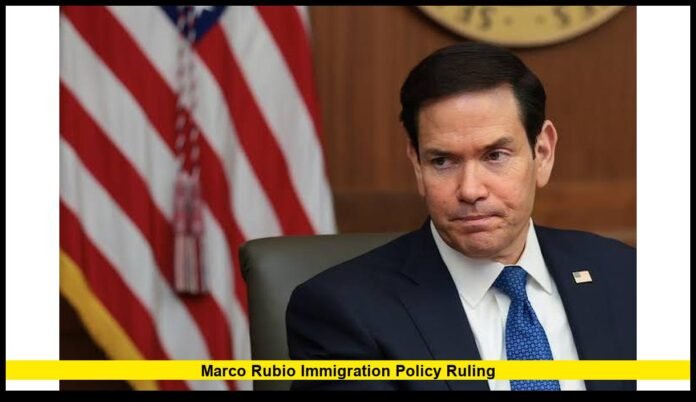

The marco rubio immigration policy ruling has overturned a major Trump administration policy that suspended immigrant visa issuance for nationals of 75 countries. A federal judge in New York ruled on August 21 that the State Department policy exceeded Secretary of State Marco Rubio’s legal authority and conflicted with federal immigration law. The State Department has since confirmed that the January 2026 pause is no longer in effect.
The decision represents a significant legal development for thousands of people seeking to immigrate to the United States. It also places limits on how the State Department can use nationality as a basis for restricting immigrant visa issuance.
However, the court ruling does not mean every affected applicant will immediately receive a visa. Individual eligibility requirements remain in place, and a separate temporary pause affecting immigrant visa appointments worldwide has created another layer of uncertainty for applicants.
Why the Court Ruling Matters
The dispute centered on a State Department policy announced in January 2026. The policy suspended immigrant visa issuance for nationals of 75 countries that the administration considered to have a higher risk of future reliance on public benefits.
The policy was scheduled to begin on January 21.
Consular officers were instructed to continue processing certain parts of applications but were directed to refuse immigrant visas covered by the new policy. The nationality of the applicant became the decisive factor for the suspension.
That approach became the central issue in the federal lawsuit.
Judge Jeannette Vargas of the Southern District of New York ruled that the government had gone beyond the authority granted to the secretary of state. The court also found that the policy conflicted with provisions of federal immigration law governing immigrant visas.
The ruling vacated the policy rather than simply placing a temporary hold on it.
That distinction is important because the government cannot continue treating the January policy as an active blanket suspension.
What the 75-Country Policy Did
The policy affected nationals of countries across several regions.
The list included Afghanistan, Albania, Algeria, Brazil, Colombia, Cuba, Egypt, Ethiopia, Haiti, Iran, Iraq, Jamaica, Lebanon, Libya, Morocco, Nepal, Nigeria, Pakistan, Russia, Somalia, Sudan, Syria, Tanzania, Thailand, Uganda, Uruguay and Yemen, among many others.
In total, 75 countries were covered.
The administration said the policy was connected to concerns about immigrants potentially becoming public charges. The government relied on information about public-benefit use among immigrant households when explaining the policy.
But the court focused on a different question.
The issue was whether the secretary of state could order consular officers to categorically refuse immigrant visas based on nationality when an applicant otherwise met the legal requirements for a visa.
Judge Vargas concluded that the secretary did not have that authority.
The court found that Congress had assigned consular officers the responsibility for making individual visa decisions under the applicable immigration laws.
The Court’s Main Finding
The judge’s decision directly challenged the government’s interpretation of executive authority.
Under the policy, consular officers were instructed to refuse covered immigrant visa applicants even when the applicant had not been found otherwise ineligible under the applicable immigration provisions.
The court determined that this effectively predetermined the result of visa applications for nationals of the designated countries.
That became a central reason for the ruling.
The judge concluded that the policy exceeded the secretary of state’s authority under federal law. The court also found violations involving provisions governing immigrant visa issuance and nationality discrimination.
The formal judgment entered August 24 confirmed the result.
It set aside and vacated the policy that categorically suspended immigrant visas for nationals of the 75 countries.
It also addressed visa refusals that were based solely on that policy.
Visa Refusals Based Only on the Policy Must Be Reconsidered
One of the most important parts of the decision concerns applicants whose immigrant visas were refused because of the January suspension.
The court ordered that refusals based solely on the invalidated policy be set aside and returned to the government for further proceedings.
This does not mean those applicants automatically receive immigrant visas.
Instead, their cases must be handled under the applicable immigration rules without relying on the now-invalid nationality-based suspension.
An applicant could still face another legally valid reason for refusal. Additional security checks, documentation requirements, medical requirements or other immigration standards can still apply.
The difference is that the January 75-country policy can no longer serve as the sole basis for refusing the immigrant visa.
For families waiting for reunification, that distinction could be especially important.
Why Nationality Became the Key Legal Issue
The lawsuit challenged the government’s use of nationality as the basis for a blanket immigrant visa suspension.
Federal immigration law contains specific rules governing visa eligibility and inadmissibility. Those rules generally require an evaluation of the individual applicant and the circumstances relevant to that person’s case.
The January policy created a separate nationality-based barrier.
That meant two otherwise similarly situated applicants could face different treatment simply because they held passports from different countries on the 75-country list.
The court determined that this approach conflicted with the statutory framework.
The judge emphasized the role of consular officers in making visa decisions based on individual applications.
This was not merely a disagreement about whether the administration’s immigration goals were reasonable. The ruling focused on whether the government had the legal authority to impose the particular policy it created.
The State Department Confirmed the Pause Has Ended
The State Department’s current public notice confirms that the January 2026 immigrant visa pause affecting nationals of the 75 countries is no longer in effect as of August 21.
That confirmation is important for applicants because it removes uncertainty over whether the original policy remains active.
It does not, however, mean that all immigrant visa processing is moving normally.
A separate development in late August has affected immigrant visa appointments around the world. The State Department announced a temporary pause involving immigrant visa appointments while consular officers undergo additional training connected to screening and public-charge assessments.
As a result, applicants may still experience delays even though the 75-country suspension has been vacated.
The two developments should not be confused.
The court invalidated the nationality-based suspension.
The later worldwide appointment pause is a separate administrative action.
What the Ruling Means for Families
Family-based immigration is one of the areas where the court decision could have a direct practical effect.
U.S. citizens and lawful permanent residents may have spouses, parents, children or other qualifying relatives pursuing immigrant visas from outside the United States.
When the 75-country policy was active, applicants from designated nations faced a broad additional obstacle.
The court’s decision removes that particular obstacle.
However, the normal immigration process remains.
A family petition must meet the relevant requirements. The beneficiary must qualify for the appropriate immigrant visa category. Required documents must be submitted, interviews must take place when scheduled, and applicants must satisfy applicable admissibility standards.
The ruling does not create a new visa category.
It also does not eliminate existing requirements.
Instead, it restores the legal framework that existed before the challenged blanket suspension.
Employment-Based Applicants Are Also Affected
The dispute was not limited to family immigration.
Employment-based immigrants from the affected countries were also covered by the January suspension.
That included people who had qualifying employment petitions and were progressing through the immigrant visa process.
For these applicants, delays can have consequences beyond the visa itself. Employment arrangements, relocation plans and family travel decisions may depend on the timing of permanent immigration.
The court’s ruling means an applicant cannot be denied an immigrant visa solely because the person is a national of one of the 75 countries under the invalidated policy.
The individual case must instead be evaluated under the applicable law.
This does not guarantee approval, but it changes the legal basis on which the case must be considered.
Brazil Was Among the Affected Countries
Brazil was one of the countries included in the January policy.
That made the ruling particularly significant for Brazilian nationals pursuing U.S. immigrant visas.
A Brazilian family involved in an employment-based investor case also became part of litigation challenging the administration’s approach. Their case highlighted concerns about applicants who had already satisfied major immigration requirements but encountered a nationality-based suspension.
The broader federal ruling now invalidates the 75-country policy itself.
The effect extends beyond Brazil because the court’s decision applies to the challenged policy covering all 75 designated countries.
The Decision Does Not End Other Immigration Restrictions
The ruling should not be interpreted as a broad cancellation of the Trump administration’s immigration policies.
The federal court addressed a specific policy involving immigrant visa issuance to nationals of 75 countries.
Other restrictions remain subject to separate legal authorities and challenges.
That includes other visa limitations, screening measures and immigration policies adopted by the administration.
The State Department continues to emphasize stricter screening and vetting of visa applicants.
The government has also continued reviewing how potential public-benefit reliance should factor into immigration decisions.
The key legal difference is that individual assessment remains important.
The court rejected the idea that the government could simply impose a categorical immigrant visa suspension on nationals of specified countries through the challenged policy.
The Latest Appointment Pause Creates Another Complication
The timing of the ruling is particularly important because the government has introduced another temporary measure affecting immigrant visa appointments.
In late August, the State Department paused immigrant visa appointments at U.S. embassies and consulates worldwide as part of a training initiative for consular officers.
The administration says the training is intended to improve the consistency of public-charge assessments and screening.
This means some applicants who benefited from the court’s ruling may still be waiting for an appointment or a new appointment date.
The end of the 75-country suspension therefore should not be mistaken for an immediate return to normal processing.
Applicants need to distinguish between the invalidated January policy and the newer administrative pause.
The former has been vacated by the court.
The latter is a separate government action.
What Happens to Pending Cases
The practical outcome for a particular applicant depends on the status of that person’s case.
Someone whose application was refused solely because of the 75-country policy may have grounds for further processing following the court’s order.
Someone whose application was refused for another legal reason may not receive the same result.
Applicants who were scheduled for interviews may also need to wait for instructions from the relevant U.S. embassy or consulate because of the separate worldwide appointment pause.
The court did not order automatic visa issuance.
Instead, it required the government to stop relying on the invalidated policy and reconsider actions that were based exclusively on it.
That creates an important legal pathway without guaranteeing a particular immigration outcome.
What the Ruling Says About Executive Power
The broader significance of the case involves the limits of executive authority in immigration administration.
Presidents and executive agencies have substantial power over immigration enforcement and visa administration. But that authority operates within the boundaries established by Congress.
The court found that the January policy crossed those boundaries.
The decision specifically addressed the secretary of state’s authority and the statutory role of consular officers.
The judge concluded that the secretary could not use the challenged directive to predetermine immigrant visa decisions that Congress had placed within the consular process.
That reasoning could become important in future disputes involving immigration policies that attempt to create broad categorical restrictions without a specific statutory basis.
The Case Is Not Completely Finished
Although the court vacated the 75-country suspension, other claims in the lawsuit remain.
Judge Vargas directed the parties to submit proposals by September 11 on how the remaining claims should proceed.
That means further developments are possible.
The August ruling resolved the central dispute over the challenged suspension, but the broader litigation has not necessarily reached its final stage.
Any future proceedings could clarify additional questions about the government’s immigration practices.
For now, however, the legal status of the 75-country policy is clear.
It has been vacated.
What Applicants Should Watch Next
Affected immigrants and their families should pay close attention to official communications from the State Department and the U.S. embassy or consulate handling their cases.
The most important developments to watch include:
- How previously refused cases are reconsidered.
- Whether affected applicants receive new interview instructions.
- How the worldwide appointment pause changes processing times.
- Whether the government appeals or otherwise challenges the ruling.
- What happens to the remaining claims in the federal case.
- Whether the administration introduces a replacement policy.
The court decision changes the legal position of applicants from the 75 designated countries, but immigration processing remains dynamic.
Applicants should not assume that a vacated policy means every other requirement has disappeared.
Current Status of the Case
As of August 30, 2026, the January suspension of immigrant visa issuance for nationals of 75 countries is no longer in effect.
The federal court ruled that the policy was contrary to law and exceeded the secretary of state’s statutory authority. The formal judgment also vacated visa refusals that relied solely on the policy and sent those cases back for further proceedings.
The State Department has confirmed the end of the January suspension.
At the same time, a separate temporary worldwide pause in immigrant visa appointments means some applicants may still face delays.
For people affected by the original 75-country policy, the court’s ruling is therefore an important legal victory, but it is not an automatic path to a visa.
Each applicant must still satisfy the requirements of U.S. immigration law.
The next major developments will likely involve the handling of previously affected cases, the status of the worldwide appointment pause and the government’s response to the federal court’s decision.
The immigration landscape is changing quickly, so share your thoughts below and stay informed as new developments emerge.