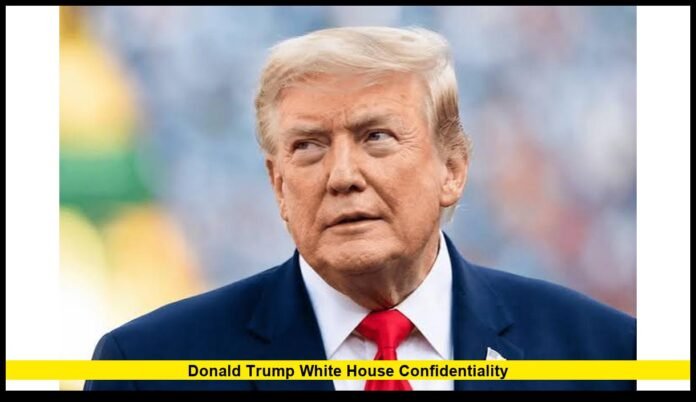

Donald Trump White House confidentiality is facing renewed scrutiny after the Justice Department issued a legal opinion supporting executive privilege for certain communications between the president and private advisers. The opinion, issued August 10, says the protection can apply even when an adviser does not work for the federal government, provided specific conditions are met.
The development is significant because presidential advisers are not always government employees. Presidents can seek information, strategy and advice from people outside the formal administration. The Justice Department’s latest position argues that those conversations can still deserve protection when they directly support official presidential decision-making.
The issue has quickly become a major point of debate over presidential power, congressional oversight and the boundaries of executive privilege.
What the New DOJ Position Says
The Justice Department’s Office of Legal Counsel issued its opinion after the White House asked whether presidential communications with advisers outside the executive branch could receive executive privilege.
The answer was yes, but the opinion did not create an unlimited protection.
The legal analysis identified three central conditions.
A communication may qualify when it:
- Relates to official presidential decision-making
- Involves or reflects communication with the president or his direct advisers
- Remains confidential
Those conditions are important because the opinion does not state that every conversation between Trump and a private citizen automatically receives protection.
Instead, the nature and purpose of the communication matter.
A conversation about a personal matter would not become protected simply because the president participated. The legal question becomes whether the communication was connected to the president’s official responsibilities and whether it was treated as confidential.
That distinction could become especially important if Congress seeks information from people who advise Trump outside the federal government.
Why Private Advisers Are at the Center of the Debate
Modern presidents regularly interact with people who are not federal employees.
Outside advisers can include attorneys, business leaders, policy specialists, former officials and other individuals with experience relevant to presidential decisions.
The Justice Department’s reasoning focuses on the president’s need to receive candid advice.
If people outside government believed every conversation with the president could later become public, they might become less willing to provide frank opinions on controversial or politically sensitive matters.
The new position argues that the effectiveness of presidential decision-making should not depend solely on whether an adviser receives a federal paycheck.
That is the foundation of the administration’s legal argument.
The protection, however, is tied to presidential functions. The communication must have a connection to official decision-making rather than simply involve someone who has a relationship with Trump.
Executive Privilege Does Not Mean Every Conversation Is Secret
One of the most important points in the current debate is the difference between a broad confidentiality claim and a specific privilege claim.
Executive privilege is not a declaration that all presidential conversations are permanently secret.
Instead, it is a legal doctrine that can protect certain executive branch information when confidentiality is important to presidential responsibilities.
The latest Justice Department opinion applies that principle to communications involving private advisers.
Even under that interpretation, individual communications would still have to meet the relevant requirements.
That means the identity of an adviser alone would not determine whether a communication is protected.
The subject, purpose, participants and confidential nature of the exchange would all matter.
This could make future disputes highly fact-specific.
How Congress Could Be Affected
The biggest practical consequence involves congressional investigations.
Congress can request documents and testimony as part of its oversight responsibilities. When an administration refuses to provide information, disputes can develop over executive privilege.
The new legal position could give the Trump administration another basis for resisting demands involving private advisers.
For example, lawmakers could seek communications between a private adviser and the president while investigating a presidential policy.
The administration could respond that the communications involve official presidential decision-making and therefore fall within the presidential communications privilege.
Congress could challenge that claim.
If the disagreement cannot be resolved politically, litigation could follow.
That possibility makes the Justice Department opinion especially important.
The Difference Between Government Advisers and Private Advisers
Traditionally, executive privilege discussions have often centered on White House officials and other executive branch personnel.
The latest opinion goes further by addressing people outside the federal government.
That creates a significant legal distinction.
A government adviser is already part of the executive branch. A private adviser is not.
The Justice Department’s position is that this difference does not automatically remove the president’s need for confidential advice.
The reasoning focuses on the president’s constitutional responsibilities rather than the employment status of the person providing advice.
This could potentially allow a wider group of people to become involved in privilege disputes.
At the same time, the opinion does not establish that all private advisers have a permanent legal shield.
The protection concerns qualifying communications.
Why Confidentiality Matters to Presidential Decision-Making
The administration’s argument rests heavily on the value of candid advice.
Presidents face decisions involving national security, foreign policy, domestic policy, economic matters and federal administration.
Some decisions require consultation with people who have specialized knowledge.
An adviser may provide an opinion that is unpopular, politically risky or contrary to the president’s preferred position.
The Justice Department argues that confidential discussions can encourage that type of candid advice.
Without confidentiality, advisers might hesitate to offer direct recommendations.
That concern is not unique to Trump.
The broader principle has existed across presidential administrations.
What makes the current dispute unusual is the effort to clarify how that principle applies when the adviser is not part of the federal government.
The Legal Opinion Is Not a Supreme Court Ruling
The Justice Department’s position should not be confused with a new Supreme Court decision.
The Office of Legal Counsel provides legal opinions that guide the executive branch. Its conclusions can shape how federal officials respond to legal disputes and information requests.
However, federal courts retain authority to decide contested cases.
If Congress, a private party or another litigant challenges a privilege claim, a court could be asked to determine whether the particular information qualifies for protection.
The court could examine the facts surrounding the communication.
That means the August opinion gives the administration a legal framework, but it does not guarantee that every privilege claim will prevail in court.
This distinction is critical when assessing what the new policy actually changes.
The Trump Administration Has Already Raised Privilege in Court
The debate has also moved beyond the Justice Department opinion itself.
The administration has invoked presidential privilege in litigation involving executive orders affecting law firms.
In that case, the Justice Department sought to prevent disclosure of the identities of certain White House advisers involved in developing and enforcing the orders. The government argued that disclosure could compromise confidential presidential communications and raise separation-of-powers concerns.
The dispute demonstrates how the administration’s approach can have practical consequences in federal court.
It also provides an example of the broader question facing judges: how much information involving presidential advisers can remain confidential when outside parties seek it through litigation?
The answer may depend on the specific records and communications at issue.
Congressional Investigations Could Become More Complicated
The new position could make future investigations more difficult for lawmakers.
A congressional committee may believe that a private adviser has important information about a presidential decision.
The adviser could face a demand for documents or testimony.
If the administration asserts executive privilege, the committee could challenge the claim.
That could produce a lengthy dispute.
The disagreement could involve questions such as whether the adviser actually participated in presidential decision-making, whether the communication was confidential and whether the material requested falls within the presidential communications component of executive privilege.
These questions could determine whether the information remains protected.
The result could vary from one investigation to another.
The Timing Adds Political Importance
The issue has emerged as Washington approaches the 2026 midterm elections.
Congressional control can directly affect the intensity and direction of oversight.
If congressional committees pursue investigations involving the Trump administration, communications with outside advisers could become an important source of evidence.
The administration’s new legal position gives it a stronger argument for maintaining confidentiality in some of those situations.
Critics, meanwhile, are concerned that the approach could make oversight harder.
That disagreement places executive privilege at the intersection of law and politics.
The legal doctrine itself is not new. The question is how broadly it should apply.
Criticism From Democratic Lawmakers
Democratic lawmakers have challenged the administration’s interpretation.
Their concern centers on the possibility that people outside the government could use presidential privilege to resist congressional inquiries.
Critics argue that private advisers do not occupy the same formal position as government officials.
They also question whether extending the privilege could make it harder for Congress to determine who influenced presidential decisions.
The criticism does not mean that every privilege claim is invalid.
Rather, lawmakers are questioning the breadth of the administration’s position.
The dispute reflects a long-running tension in Washington between executive confidentiality and congressional oversight.
What the Opinion Does Not Establish
Several assumptions about the new policy should be avoided.
It does not establish that every private citizen who speaks with Trump can refuse a subpoena.
It does not make every conversation involving the president confidential.
It does not prevent Congress from investigating the administration.
It also does not replace the role of federal courts in resolving contested privilege claims.
The opinion instead provides the Justice Department’s legal conclusion that certain presidential communications with private advisers can qualify for executive privilege.
The specific facts remain important.
That limitation is central to understanding the development.
Presidential Communications Are Different From Classified Information
Another important distinction involves classified information.
Executive privilege and classification are separate concepts.
Classified information is subject to national security classification rules.
Executive privilege concerns the government’s ability to protect certain information connected to executive functions.
A communication can raise a privilege question without being classified.
Likewise, classification does not automatically answer every question about executive privilege.
The current controversy specifically concerns the presidential communications component of executive privilege.
That is why the focus remains on presidential decision-making and confidential advice.
Why the President’s Relationship With Outside Advisers Matters
The modern presidency does not operate entirely inside the walls of the White House.
Presidents regularly consult people with experience outside government.
Those relationships can provide access to specialized knowledge and perspectives.
The legal question is whether confidentiality should follow the substance of the presidential consultation even when the person providing advice is not a government employee.
The Justice Department says it can.
That position could have long-term implications beyond the current administration.
If accepted broadly, future presidents could rely on the same reasoning when communicating with outside advisers.
The debate therefore concerns more than Donald Trump alone.
It could influence how future administrations structure confidential presidential consultations.
What Could Happen in Future Disputes
Future disputes could provide the clearest test of the Justice Department’s interpretation.
Congress could request communications involving a private adviser.
The administration could assert executive privilege.
The committee could reject the claim.
The adviser or administration could then seek judicial intervention.
A court could examine the communication individually and determine whether the requirements for privilege were satisfied.
Such cases could clarify how far the doctrine reaches.
They could also establish boundaries between legitimate presidential confidentiality and congressional oversight.
Until courts address specific disputes, uncertainty will remain over how broadly the new position can operate in practice.
Why This Matters for Presidential Accountability
At the heart of the issue is a basic constitutional question.
A president needs confidential advice to make decisions.
Congress needs access to information when it conducts legitimate oversight.
Both interests serve constitutional functions.
The challenge is deciding when confidentiality should prevail.
Supporters of the Justice Department’s position argue that presidents cannot perform their duties effectively if every confidential conversation can later be exposed.
Opponents worry that a broad interpretation could allow important information to remain beyond congressional scrutiny.
That tension is likely to remain central to future disputes.
The Current Status of Trump White House Confidentiality
The most important confirmed development remains the Justice Department’s August 10 opinion.
It says presidential communications with private advisers can fall within executive privilege when they concern official presidential decision-making, involve the president or his direct advisers and remain confidential.
The administration has also used presidential privilege arguments in ongoing litigation involving White House advisers.
At the same time, congressional Democrats are challenging the broader interpretation.
The disagreement has not produced a final Supreme Court ruling defining the full scope of the new approach.
For now, the administration has established its legal position, while lawmakers and critics continue to question how far that position should extend.
The next major developments will likely come through actual congressional demands and court challenges.
Those cases could determine whether the new interpretation remains largely an executive-branch position or becomes a more broadly accepted rule governing presidential communications.
What Comes Next
The debate over confidentiality is unlikely to disappear.
As Congress conducts oversight and the administration defends presidential authority, private advisers could increasingly become part of legal disputes over access to information.
Each dispute could help define the limits of executive privilege.
The central question will remain straightforward but consequential: when a private individual provides confidential advice to the president about official government decisions, should that communication receive the same protection as advice from a government official?
The Justice Department has now answered that question in the affirmative under specific circumstances.
Whether Congress, federal courts and future administrations accept that interpretation will shape the next stage of the debate.
Stay informed as the fight over presidential confidentiality and executive privilege develops, and share your thoughts on where the limits should be drawn.