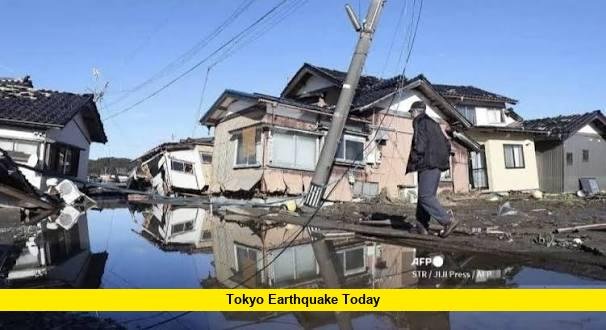

A Tokyo earthquake today jolted millions of residents awake early Sunday morning, as a magnitude 5.9 temblor struck the Kanto region and sent shockwaves through the Japanese capital. Tokyo and the eastern Kanto region were shaken at 2 a.m. Sunday by a magnitude 5.9 earthquake centered in southern Ibaraki Prefecture at a depth of 70 kilometers, with no threat of a tsunami. The quake triggered emergency alerts on millions of mobile phones and left residents across the region shaken, though early reports pointed to limited physical damage.
Japan’s Meteorological Agency confirmed the event within minutes, and officials moved quickly to assess the situation across the sprawling metropolitan area.
What Happened During the Tokyo Earthquake Today
The magnitude 5.9 earthquake struck southern Ibaraki Prefecture just past 2 a.m. local time on August 23, causing strong shaking to be felt throughout portions of the Kanto region, including Tokyo. The Japanese earthquake early warning system activated instantly, pushing alerts to residents before the shaking intensified.
The United States Geological Survey recorded a slightly lower preliminary magnitude of 5.8 for the same event. Small discrepancies like this are common between Japanese and American monitoring agencies, since each uses different seismic networks and calculation methods.
The quake occurred at an approximate depth of 70 kilometers, and earthquakes at greater depths tend to spread seismic energy across a wider geographical area rather than concentrating damage near the epicenter. This depth likely explains why so many surrounding prefectures felt noticeable shaking despite the moderate magnitude.
Shindo Intensity Levels Across the Region
Japan measures earthquake intensity using the shindo scale, a seven-point system that reflects how strongly shaking is felt at the surface rather than the raw energy released underground.
Here’s how the shaking broke down across the region:
| Prefecture/Area | Shindo Intensity |
|---|---|
| Southern Ibaraki | Lower 5 |
| Southern Saitama | Lower 5 |
| Tokyo’s Adachi Ward | Lower 5 |
| Tokyo’s 23 wards (general) | 4 |
| Chiba | Lower 5 |
| Tochigi | 4 |
| Gunma | 4 |
| Kanagawa | 4 |
Shaking at lower 5 intensity can cause objects to fall off shelves and prompt people to grab onto something stable, according to the Meteorological Agency. The shaking lasted up to a minute in some areas, arriving shortly after earthquake early warning alarms sounded on mobile phones across the region.
Damage Reports and Infrastructure Checks
Early assessments suggest the capital avoided major structural damage, though isolated incidents were reported in the hours following the quake.
An underground water pipe ruptured in Tokyo’s eastern Koto ward, with water pouring out onto the road, according to NHK footage. Roughly 460 homes across Tokyo experienced power outages, based on figures from TEPCO Power Grid.
Transportation authorities acted swiftly following the shaking. JR East began checking its rail network for damage and planned to determine by 4:30 a.m. whether the first morning trains could run on schedule. Footage from NHK showed that traffic on roads in nearby cities, including Mito and Saitama, appeared largely normal in the hours after the quake.
Nuclear safety monitors also confirmed no cause for alarm. There were no reports of anything out of the ordinary from roughly a dozen nuclear power plants and other facilities handling nuclear materials, according to Japan’s Nuclear Regulation Authority. In the village of Tokai in Ibaraki Prefecture, home to two nuclear facilities operated by Japan Atomic Power Company, shaking reached only an intensity of 3 on the shindo scale. The company reported no abnormalities at the Tokai No. 2 plant, while checks continued at the neighboring Tokai facility, which is currently being decommissioned.
No Injuries Reported So Far
Despite the widespread shaking, officials have not confirmed any casualties tied to the Tokyo earthquake today. There were no immediate reports of injuries or damage in the hours following the quake.
Emergency services remained on standby throughout the morning, monitoring for aftershocks and secondary damage reports as daylight arrived across the Kanto plain.
Government Response
Japan’s leadership responded within the hour. Prime Minister Sanae Takaichi announced on social media platform X that the government had set up a task force to assess the extent of possible damage. Takaichi also addressed residents directly within an hour of the quake, acknowledging the disruption felt across the affected areas.
Local municipalities activated standard post-earthquake protocols, dispatching inspection teams to check bridges, rail lines, and public buildings for structural stress. This rapid coordination reflects decades of disaster preparedness planning that Japan has refined since the devastating 2011 Tohoku earthquake and tsunami.
How This Compares to Recent Seismic Activity
Japan sits along the Pacific Ring of Fire, making earthquakes a routine part of life for Tokyo residents. Still, this weekend’s event stands out for its intensity and the sheer number of people who felt it.
Tokyo experiences roughly ten earthquakes of magnitude 5 or higher every year on average, based on historical data spanning more than two decades. Sunday’s quake fits squarely within that pattern, though the timing and depth combined to make it especially noticeable across the metro area.
Recent months brought other seismic reminders to the region. A magnitude 5.4 earthquake struck near Hachijō in Tokyo’s outlying islands on August 21, at a depth of 61 kilometers. That same day, a 4.7 magnitude quake hit the Ogasawara area, also part of Tokyo’s jurisdiction, at a shallower depth of 10 kilometers.
Sunday’s mainland quake carried far greater consequence simply because of its proximity to Japan’s most densely populated urban corridor.
Context: Japan’s Broader Earthquake Risk
This Tokyo earthquake arrives against a backdrop of heightened seismic activity across Japan this year. Last month, a magnitude 7.1 quake struck the Kumamoto area on Japan’s southernmost island of Kyushu, killing 38 people and injuring 364.
That earlier disaster serves as a stark reminder of how quickly a moderate quake can escalate into a major catastrophe elsewhere in the country. Sunday’s Tokyo event, by contrast, appears to have caused far less severe consequences, though officials continue monitoring the situation closely.
Seismologists have long warned that Tokyo faces significant long-term earthquake risk given its location near multiple tectonic plate boundaries. Building codes across the capital have been strengthened repeatedly since the 1923 Great Kanto earthquake, which remains the deadliest disaster in the city’s modern history.
What Residents Should Know Going Forward
Aftershocks often follow moderate earthquakes like Sunday’s event, and residents in the Kanto region should remain alert in the coming days. Japan’s Meteorological Agency typically issues follow-up guidance in the hours and days after a significant quake, updating residents on aftershock probability.
Key safety reminders following any Tokyo earthquake include:
- Checking gas lines and appliances for damage before using them
- Avoiding elevators until building inspections are complete
- Keeping emergency supplies accessible in case of aftershocks
- Monitoring official NHK and Japan Meteorological Agency updates for the latest guidance
Transportation delays remain possible in the coming hours as JR East and other rail operators complete safety inspections along affected lines. Travelers with flights or train connections through the Kanto region should check current schedules directly with their carriers.
Stay tuned as more details on the Tokyo earthquake continue to emerge throughout the day.