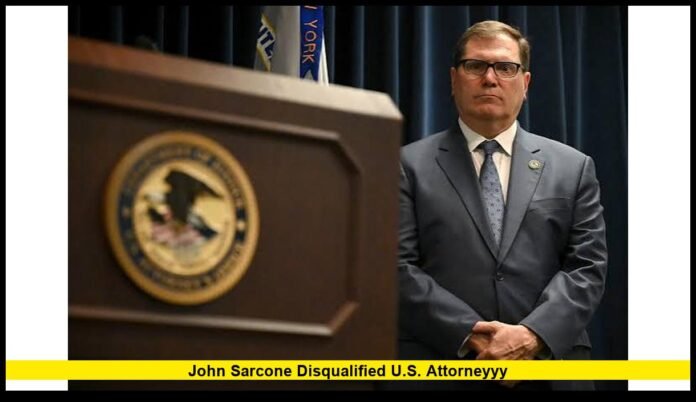

The latest john sarcone disqualified u.s. attorney development has placed the Justice Department’s handling of temporary federal prosecutor appointments under renewed scrutiny after a federal appeals court upheld a lower-court ruling that found John A. Sarcone III was not lawfully serving as acting U.S. attorney when he issued subpoenas involving New York Attorney General Letitia James’s office.
The August 21 decision by the U.S. Court of Appeals for the Second Circuit was decided 2–1 and represents another setback for the Justice Department’s effort to defend Sarcone’s authority. The ruling leaves the subpoenas at the center of the dispute blocked and prevents Sarcone from overseeing the investigations connected to them under the authority that the courts found defective.
The decision is also significant because it reaches beyond the immediate dispute involving James. At its core, the case raises questions about the limits of executive power, Senate confirmation, temporary appointments and the Federal Vacancies Reform Act.
Key Points Summary
╔════════════════════════════════════════════════════════════════════╗
║ – The Second Circuit ruled 2–1 that John A. Sarcone III was not lawfully serving as acting U.S. attorney when he issued the disputed subpoenas. ║
║ – The subpoenas sought records from New York Attorney General Letitia James’s office concerning litigation involving Donald Trump and the National Rifle Association. ║
║ – The appeals court upheld a lower-court decision blocking the subpoenas and disqualifying Sarcone from the related investigations. ║
║ – The dispute centers on how the Justice Department used changes in Sarcone’s official status after his initial temporary appointment expired. ║
║ – The Justice Department says it disagrees with the ruling and plans to ask the Supreme Court to review the case. ║
╚════════════════════════════════════════════════════════════════════╝
What Led to the Sarcone Appointment Dispute?
John Sarcone became acting U.S. attorney for the Northern District of New York during the Trump administration’s effort to establish new leadership in federal prosecutor’s offices across the country.
Sarcone was initially appointed to serve as interim U.S. attorney in March 2025. His temporary appointment was subject to a statutory time limit.
The controversy began when that initial period approached its expiration and Sarcone was not replaced through the normal process.
Rather than ending his leadership of the office, the Justice Department took a different approach. Sarcone was given another position within the department and designated as first assistant U.S. attorney.
That personnel change became the central issue in the subsequent litigation.
The government argued that Sarcone could continue serving under the Federal Vacancies Reform Act. Critics argued that the arrangement effectively allowed the administration to keep the same person in charge after the original temporary appointment had expired without going through the appointment process contemplated by federal law.
The courts ultimately sided with the latter interpretation.
Why the Federal Vacancies Reform Act Matters
The Federal Vacancies Reform Act is a federal law governing temporary service in vacant positions that normally require presidential appointment and Senate confirmation.
The statute is intended to prevent vacancies from creating administrative paralysis while also placing limits on how long an acting official can exercise the powers of a vacant office.
That balance is particularly important for U.S. attorneys.
A U.S. attorney is the chief federal prosecutor in a judicial district and exercises substantial authority over criminal investigations, prosecutions and litigation conducted on behalf of the United States.
Because of that authority, Congress established procedures governing how such offices can be filled temporarily.
The Second Circuit’s decision focused heavily on whether those procedures allowed the Justice Department to accomplish through personnel changes what could not be accomplished through the original temporary appointment.
The majority concluded that the government’s approach did not comply with the statutory framework.
The Subpoenas That Triggered the Court Fight
The legal dispute became especially consequential because Sarcone personally authorized subpoenas directed to the office of New York Attorney General Letitia James.
The subpoenas were issued in August 2025 and sought records connected to matters involving James’s office.
One investigation concerned litigation involving Donald Trump and his business interests. Another concerned litigation involving the National Rifle Association.
The federal investigations were examining whether potential civil rights violations had occurred in connection with those cases.
James’s office challenged the government’s subpoenas and questioned whether Sarcone had legal authority to issue them.
That challenge transformed what might otherwise have been an internal appointment dispute into a major federal court case involving the Justice Department’s investigative authority.
Lower Court Previously Rejected Sarcone’s Authority
The dispute first produced a major ruling in January 2026.
A federal district judge concluded that Sarcone was not lawfully serving as acting U.S. attorney when he exercised the authority underlying the subpoenas.
The judge consequently blocked the subpoenas and disqualified Sarcone from continuing to oversee the related investigations.
The ruling was not simply a disagreement over whether Sarcone’s appointment paperwork was technically correct.
The court examined the substance of the government’s actions and concluded that changing Sarcone’s title after his original temporary appointment did not cure the underlying statutory problem.
In practical terms, the decision meant that Sarcone could not continue exercising the powers of acting U.S. attorney in connection with the investigations simply because the Justice Department had reassigned him to another title.
The Justice Department appealed.
Second Circuit Delivers Another Blow to DOJ
The Second Circuit has now upheld the lower court’s core conclusion.
In its 2–1 decision on August 21, the appeals court found that Sarcone was unlawfully serving as acting U.S. attorney when he issued the subpoenas.
The majority rejected the government’s interpretation of the federal vacancies law and concluded that the sequence of personnel changes used to maintain Sarcone’s authority did not satisfy the statute.
The ruling means the lower court’s restrictions remain in place.
It also creates a significant appellate precedent concerning temporary U.S. attorney appointments.
The decision is especially notable because it is part of a broader series of legal disputes over the Trump administration’s handling of temporary federal prosecutors.
A Dissenting Judge Disagreed
The Second Circuit decision was not unanimous.
One judge dissented, taking a different view of how the Federal Vacancies Reform Act applies to Sarcone’s appointment.
The dissent provides the Justice Department with a substantial legal argument for seeking Supreme Court review.
The disagreement between the majority and dissent also illustrates why the case could have consequences beyond the Northern District of New York.
If the Supreme Court takes the case, the justices could be asked to determine how the federal government may use first-assistant positions and other personnel mechanisms when a Senate-confirmed U.S. attorney is not in place.
That question could affect future presidential administrations as well.
Sarcone’s Relationship to the Trump Administration
Sarcone’s background has also attracted attention because he was associated with Donald Trump’s political orbit before taking the federal prosecutor position.
That connection has become particularly relevant because the investigations involved the office of a prominent Trump political opponent.
However, the court’s decision was focused primarily on statutory appointment authority rather than determining whether the investigations were politically motivated.
The distinction is important.
The ruling does not establish that the underlying allegations against James were true or false. It addresses whether Sarcone had lawful authority to exercise the powers of acting U.S. attorney in the circumstances presented.
The Letitia James Investigations
James has been one of the most prominent legal adversaries of Trump.
Her office previously pursued civil litigation involving Trump and his business interests, while also bringing litigation involving the National Rifle Association.
The federal subpoenas sought records associated with those matters.
James’s side challenged the subpoenas, arguing that the federal prosecutor attempting to obtain the records did not have lawful authority.
The courts ultimately focused on Sarcone’s appointment status.
That means the appeals court ruling does not necessarily prevent the federal government from investigating the underlying issues through another prosecutor who has proper legal authority.
Instead, it prevents the government from relying on the authority that the courts determined Sarcone did not lawfully possess.
What Happens to the Subpoenas?
For now, the disputed subpoenas remain blocked.
The appellate decision leaves the lower court’s ruling intact, meaning the Justice Department cannot simply enforce the subpoenas as originally issued by Sarcone.
That does not necessarily end every possible investigation involving the underlying matters.
Federal prosecutors can potentially pursue investigative steps through officials whose authority is not subject to the same legal challenge.
The distinction is important because the courts have addressed the legality of the appointment and the authority used to issue the subpoenas, rather than issuing a blanket ruling that no federal investigation can ever occur.
The February 2026 U.S. Attorney Appointment Fight
Sarcone’s legal troubles became even more complicated earlier in 2026 when federal judges in the Northern District of New York appointed Donald T. Kinsella to serve as U.S. attorney.
The appointment was short-lived.
The Justice Department dismissed Kinsella on the same day he was appointed, creating another confrontation over who possessed the authority to lead the federal prosecutor’s office.
The episode demonstrated how unresolved the leadership question had become.
Sarcone continued to be associated with the office while his legal authority was being challenged in court.
The dispute therefore evolved from an individual appointment issue into a larger institutional conflict involving the Justice Department, federal judges and congressional appointment requirements.
Why the Ruling Is Bigger Than One Prosecutor
The significance of the Sarcone decision extends beyond New York.
U.S. attorneys occupy positions with considerable prosecutorial power. Their offices oversee investigations involving federal crimes, represent the United States in litigation and supervise large teams of federal prosecutors.
If an administration could indefinitely preserve an acting U.S. attorney’s authority simply by changing titles or assigning the individual to another position, critics argue that statutory limits on temporary appointments could become largely meaningless.
The Second Circuit majority rejected that approach.
Its ruling reinforces the principle that executive agencies must follow the appointment framework established by Congress.
For future administrations, the decision could serve as a warning that temporary personnel arrangements cannot necessarily be used to avoid statutory restrictions.
What the Justice Department Plans to Do Next
The Justice Department has said it disagrees with the Second Circuit’s decision and intends to take the case to the Supreme Court.
That makes the Supreme Court the next major focus of the dispute.
A petition for review would ask the justices to consider whether the Second Circuit correctly interpreted the Federal Vacancies Reform Act and related appointment rules.
The Supreme Court is not required to hear the case.
If the justices decline review, the Second Circuit’s ruling would remain controlling within the circuit.
If the court accepts the case, however, the resulting decision could establish a nationwide rule affecting temporary U.S. attorneys and potentially other federal officials.
Could the Underlying Investigation Continue?
Yes, the appeals court ruling does not automatically eliminate every possible federal investigation into the issues involving James.
The central problem is the authority exercised by Sarcone.
A properly authorized federal prosecutor could potentially pursue investigative measures independently, provided those actions comply with federal law and any additional court restrictions.
That means the court battle should not necessarily be interpreted as a final ruling on the merits of the underlying investigations.
Instead, it is a ruling on who had legal authority to conduct certain investigative actions and how that authority was obtained.
What the Case Means for Presidential Appointment Power
The controversy also highlights a recurring tension in American government.
Presidents have broad authority to select executive branch officials, but Congress has the constitutional power to establish appointment procedures for positions requiring Senate confirmation.
Temporary appointments create an additional challenge because agencies need to function while vacancies are being filled.
The Federal Vacancies Reform Act attempts to balance those competing interests.
The Sarcone case tests where that balance ends.
The Second Circuit’s majority essentially concluded that the executive branch cannot use administrative maneuvering to sidestep statutory limitations.
The Justice Department’s position is that the government’s interpretation of the law permits the appointment arrangement it used.
That disagreement is now positioned for a potential Supreme Court battle.
What Readers Should Watch Now
The next major development will likely be the Justice Department’s effort to seek Supreme Court review.
Several questions could shape what happens next:
- Will the Supreme Court agree to hear the case?
- Will Sarcone remain in a leadership position within the Northern District of New York?
- Will the administration nominate a permanent U.S. attorney?
- Can prosecutors pursue the underlying investigations through a different authorized official?
- Will the Supreme Court clarify the limits of temporary appointments under the Federal Vacancies Reform Act?
Each development could affect the future of the Northern District of New York and the administration’s broader approach to federal prosecutorial appointments.
What “Disqualified” Means in Sarcone’s Case
The word “disqualified” can be misleading if taken to mean that Sarcone has been permanently barred from practicing law or from working for the federal government.
The court’s ruling is narrower.
Sarcone was found not to have lawful authority to serve as acting U.S. attorney in the circumstances at issue, and he was barred from overseeing the investigations connected to the disputed subpoenas.
The ruling therefore concerns his authority in a particular federal prosecutorial role.
It does not amount to a general professional disbarment.
This distinction is essential when interpreting headlines about the case.
The Bottom Line
The john sarcone disqualified u.s. attorney controversy is now one of the most closely watched federal appointment disputes involving the Justice Department.
The Second Circuit’s 2–1 decision has upheld the conclusion that Sarcone was not lawfully serving as acting U.S. attorney when he issued subpoenas involving Letitia James’s office. The ruling keeps those subpoenas blocked and prevents Sarcone from continuing to oversee the related investigations under the disputed authority.
The Justice Department’s planned Supreme Court appeal could determine whether the case remains a regional dispute or becomes a nationwide precedent on temporary federal appointments.
For now, the ruling strengthens judicial scrutiny of executive attempts to maintain temporary federal prosecutors through changes in titles and assignments. The next stage will depend largely on whether the Supreme Court agrees to intervene and how the Justice Department proceeds while the appointment dispute remains unresolved.
What do you think the Supreme Court should do with the Sarcone appointment case? Share your view in the comments and stay with us for the latest developments.