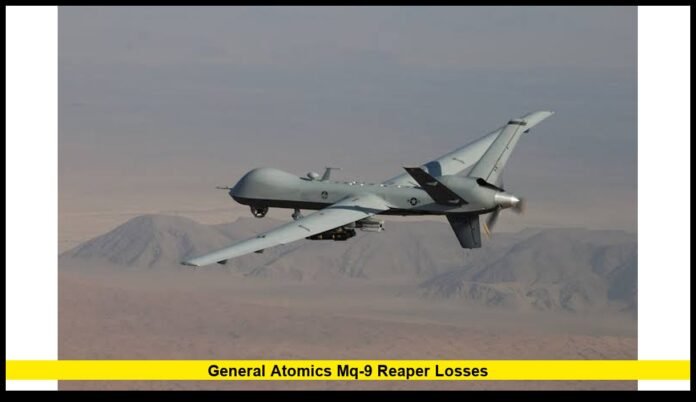

General Atomics MQ-9 Reaper losses have reached at least 45 aircraft during the U.S. military campaign against Iran, a figure that represents roughly one-quarter of the American Reaper fleet and marks a major shift in the Pentagon’s approach to large unmanned aircraft.
The latest reporting in August 2026 places the number well above the 24-aircraft figure publicly reported earlier in the year. U.S. officials have now indicated that at least 45 Reapers were lost during the conflict. The losses include aircraft destroyed in combat, aircraft lost through other operational causes, and Reapers destroyed during attacks on facilities where the drones were based or stored.
The scale of the losses has intensified questions about the size of the remaining fleet, the ability to replace the aircraft, and the future role of the MQ-9 in heavily defended airspace.
The Latest Reaper Loss Figure
The most significant development in August is the emergence of the 45-aircraft figure.
Earlier reports from the spring placed U.S. Reaper losses during the Iran operation at 24 aircraft. That number came from an earlier assessment of aircraft lost during Operation Epic Fury, which began on February 28, 2026.
The situation changed as additional losses became known.
By August, U.S. officials had placed the total at at least 45 MQ-9 Reapers lost during the Iran war. The figure represents approximately 25 percent of the American fleet.
That makes the current total substantially higher than the figures available during the early stages of the conflict.
It also explains why the Air Force has faced growing pressure to restore its inventory after the campaign.
The 45-aircraft figure should be treated as a minimum rather than a final historical total. Military losses can take time to establish because aircraft may disappear during missions, suffer damage on the ground, or become casualties of attacks on operating bases.
How the Losses Increased During 2026
The first months of the Iran conflict produced a steady rise in reported Reaper losses.
In March, U.S. officials reported that several MQ-9s had already been lost. Some aircraft were shot down while operating near Iranian territory. Others were lost through different circumstances.
By the middle of March, the reported total had reached 12 aircraft.
The number then increased rapidly.
By early April, the U.S. military had lost 24 Reapers during the conflict. That figure represented a major increase in only a matter of weeks.
The later increase to at least 45 demonstrates that the earlier total did not represent the final level of attrition.
The aircraft faced danger both in the air and on the ground. Iranian attacks against U.S. facilities also contributed to the overall number of Reapers lost.
This distinction matters because not every destroyed MQ-9 was necessarily intercepted during a surveillance or strike mission.
Why the MQ-9 Has Suffered Heavy Attrition
The MQ-9 was designed primarily around endurance, surveillance and precision-strike capabilities.
Its ability to remain airborne for long periods makes it useful for monitoring large areas. It can provide commanders with persistent intelligence and can carry weapons when assigned strike missions.
However, the aircraft was not designed to operate like a modern fighter.
The Reaper flies at much lower speeds than crewed combat aircraft. It also lacks the maneuverability and survivability features associated with high-end fighter platforms.
In an environment protected by modern air-defense systems, those characteristics create vulnerabilities.
An adversary does not necessarily need to defeat a fast-moving fighter to threaten a Reaper. A relatively slow aircraft that spends hours in an area can present a more accessible target.
The 2026 Iran campaign exposed that problem on a much larger scale than earlier conflicts.
The Difference Between Earlier and Current Numbers
The rapid change in reported totals has caused confusion among readers following the conflict.
Earlier in 2026, 24 aircraft became the commonly cited number for U.S. Reaper losses during Operation Epic Fury.
That figure remains important because it reflected the documented losses available at the time.
The newer figure of at least 45 represents a later assessment.
The difference does not necessarily mean that the earlier reporting was incorrect. It reflects the fact that military loss assessments can change as operations continue and additional information becomes available.
For readers tracking the fleet today, the latest publicly reported figure is therefore more relevant than the earlier spring estimate.
The Air Force Fleet Has Become Much Smaller
The effect of the losses can be seen in the size of the remaining MQ-9 inventory.
The Air Force entered fiscal year 2026 with a fleet that included roughly 182 MQ-9 aircraft across its active-duty and Air National Guard forces.
By May, Air Force officials said the fleet had fallen to approximately 135 aircraft.
That reduction occurred after substantial combat attrition during the Iran operation.
The numbers also show why losing dozens of Reapers has become a serious fleet-management issue.
An aircraft lost in combat cannot simply be replaced from an unlimited warehouse supply. Reaper production plans had already changed before the Iran conflict produced its unprecedented level of attrition.
The Air Force therefore entered the conflict while already reconsidering the long-term size of the fleet.
The Reaper Production Problem
One of the biggest complications is that the Air Force had previously decided to stop purchasing additional MQ-9A aircraft.
Production of the Air Force’s MQ-9A Reaper had been winding down before the 2026 conflict.
That decision made sense within an earlier modernization strategy. The Air Force wanted to move toward newer unmanned aircraft that could survive in more dangerous environments.
The Iran campaign changed the immediate calculation.
The service suddenly needed more Reapers at the same time that it was moving away from new purchases of the existing model.
This created a difficult replacement problem.
General Atomics had limited numbers of aircraft available outside the active Air Force fleet, making rapid replacement difficult.
The Air Force has explored acquiring available aircraft and finding other ways to rebuild its inventory.
Why Replacing 45 Aircraft Is Not Simple
Replacing 45 MQ-9s requires more than purchasing 45 airframes.
Each aircraft operates as part of a larger system.
The complete capability includes sensors, communications equipment, control stations, maintenance infrastructure, trained personnel and other mission-support assets.
The cost also varies depending on how the aircraft is configured.
A fully equipped MQ-9 can represent a substantial investment. Recent estimates have placed the value of an operationally configured aircraft at tens of millions of dollars.
Using a rough figure of $30 million per aircraft, 45 lost aircraft would represent approximately $1.35 billion in aircraft value alone.
That calculation is not an official Pentagon loss estimate. It does not include every support or replacement expense.
It does, however, illustrate why the fleet losses have attracted attention in Washington.
The Strategic Importance of the Remaining Fleet
Despite the losses, the Air Force has continued to describe the MQ-9 as a highly valuable operational platform.
The aircraft performed a wide range of missions during the Iran conflict.
Its long endurance allowed crews to maintain surveillance over areas for extended periods. The platform also provided targeting support and strike capabilities.
Air Force leadership highlighted the Reaper’s performance during the campaign even as the number of destroyed aircraft increased.
That apparent contradiction is central to the current debate.
The Reaper can be extremely useful and still be vulnerable.
A platform can provide valuable intelligence for hours while also becoming an expensive loss if an enemy defense system successfully targets it.
The Iran experience has therefore not simply ended the Reaper’s usefulness. Instead, it has forced military planners to reconsider how and where such aircraft should operate.
Ground Attacks Also Matter
The current loss figure should not be viewed solely as a count of drones shot down in the sky.
Iranian missile attacks against U.S. bases affected aircraft parked on the ground.
Some Reapers were destroyed before they could take off or while operating from forward locations.
That development is especially important for military planners because moving an aircraft away from an air-defense threat does not eliminate every danger.
Large concentrations of valuable aircraft can become targets when an opponent can reach the facilities supporting them.
The Iran campaign demonstrated that aircraft survivability involves both the mission environment and the security of the bases from which the aircraft operate.
The Strait of Hormuz Became an Important Operating Area
The Reaper’s endurance has made it particularly useful around strategically important areas such as the Strait of Hormuz.
The waterway is critical to global energy transportation and became a major focus of U.S. military activity during the Iran conflict.
Persistent surveillance was important for monitoring maritime movements, tracking potential threats and supporting broader military operations.
That mission placed Reapers in areas where Iranian forces had strong incentives to challenge U.S. aircraft.
The resulting attrition contributed to the fleet’s rapid decline.
The experience showed that persistent surveillance can come with substantial costs when an adversary possesses capable air defenses and is willing to use them.
Earlier Reaper Losses Also Shaped the Debate
The MQ-9 was already experiencing combat losses before the Iran war.
U.S. Reapers had suffered losses during operations against Houthi forces in Yemen. Several aircraft were lost during the 2025 campaign.
Those incidents raised concerns about the survivability of the aircraft in contested environments.
The Iran conflict amplified those concerns.
Instead of losing aircraft periodically during individual operations, the Air Force experienced sustained attrition across a major campaign.
That difference is significant.
A small number of losses can often be absorbed through existing inventory and scheduled procurement. Losing dozens of aircraft in a short period creates an immediate readiness problem.
The Air Force Is Looking Beyond the Current Reaper
The current situation has accelerated efforts to develop a new generation of unmanned aircraft.
The Pentagon is pursuing systems that can perform some missions associated with the MQ-9 while costing less and being easier to produce in large quantities.
The emerging concept emphasizes affordability, modular design and mass production.
That approach reflects a major lesson from the Iran conflict.
A drone that costs tens of millions of dollars can become difficult to sustain if an enemy can destroy it with relatively inexpensive air-defense weapons.
Future systems are therefore expected to place greater emphasis on numbers.
Instead of relying on a small fleet of highly capable but expensive aircraft, the military wants options that can deploy larger formations and accept a greater level of battlefield attrition.
The Push for a More Attritable Drone
The term “attritable” has become increasingly important in discussions about the future of unmanned aviation.
An attritable aircraft is designed with the understanding that some losses can occur during combat.
The concept does not mean the military wants drones destroyed.
Instead, it means the aircraft should be affordable enough that losing one does not create the same strategic or financial problem as losing a much more expensive platform.
The Reaper’s recent losses have strengthened the argument for this approach.
The Air Force still needs long-endurance surveillance and strike capabilities. But planners also want aircraft that can enter contested areas without placing such a large amount of value at risk each time.
Congress Is Watching the Fleet Size
The decline in the Reaper inventory has also attracted congressional attention.
Lawmakers have questioned whether the Air Force reduced its planned fleet too aggressively before the 2026 combat losses occurred.
Congressional action has pushed the service toward retaining more MQ-9 capacity and considering ways to rebuild the fleet.
That pressure reflects the continued usefulness of the platform.
Even as the Air Force develops its next-generation unmanned aircraft, those systems will take time to design, test and deploy.
The MQ-9 remains available today.
That creates a practical reason to preserve enough aircraft to cover current missions while the next generation is developed.
What the Latest Numbers Mean for the U.S. Military
The latest loss figure represents more than a simple reduction in the number of drones.
It raises questions about how the United States should conduct persistent surveillance in contested airspace.
The Reaper was highly effective in environments where enemy air defenses were limited.
Iran presented a different challenge.
The country possessed layered air-defense capabilities and could threaten U.S. aircraft from multiple directions.
That environment exposed the limitations of a platform optimized for endurance rather than high-end survivability.
The lesson is not that the Reaper has become obsolete.
Instead, its future role may become more specialized.
The aircraft can remain valuable for missions where the threat level is manageable. In heavily defended areas, newer and cheaper unmanned aircraft may increasingly take the lead.
The Current State of the Reaper Fleet
The United States now faces a difficult transition.
The Air Force has lost at least 45 MQ-9s during the Iran war, while its remaining inventory has fallen sharply from the level held before the conflict.
At the same time, the service still needs the capabilities the aircraft provides.
That creates pressure to obtain replacement aircraft while developing a new generation of unmanned systems.
The two efforts are likely to continue in parallel.
The Reaper will remain part of the U.S. military’s unmanned aviation structure, but its future role is changing.
The Iran campaign has provided a real-world test of what happens when a large, persistent drone fleet faces a determined opponent with modern air defenses.
The result has been costly.
It has also influenced how the Pentagon is thinking about the next generation of American unmanned aircraft.
The Bottom Line on Current Reaper Losses
The latest publicly reported information puts U.S. MQ-9 losses during the 2026 Iran war at at least 45 aircraft, or roughly one-quarter of the American Reaper fleet.
That figure is substantially higher than the 24-aircraft total reported earlier in the conflict.
The losses have reduced the Air Force’s available inventory and complicated a modernization plan that was already moving away from additional MQ-9A purchases.
At the same time, the Reaper’s operational performance has kept the aircraft relevant. Its endurance, surveillance capabilities and ability to conduct strikes remain valuable to U.S. commanders.
The central issue now is how the United States balances those capabilities against the cost and vulnerability of operating the aircraft in heavily defended areas.
The answer is already beginning to shape the next generation of American unmanned aviation, with greater emphasis on affordable aircraft, larger numbers and systems designed to withstand the realities of modern combat.
What do you think the latest Reaper losses mean for the future of U.S. military drones? Share your thoughts and stay informed as new verified developments emerge.