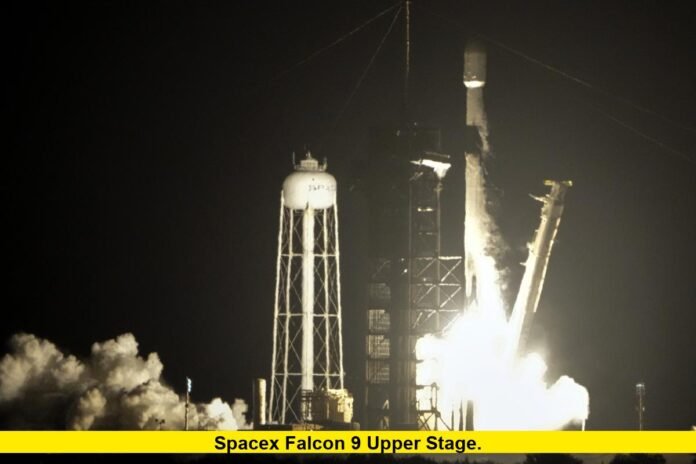

A discarded SpaceX Falcon 9 upper stage is believed to have crashed into the Moon in the early hours of August 5, 2026, marking one of the most unusual human-made impacts on the lunar surface in recent years. According to astronomers tracking the object, the rocket stage struck the Moon near Einstein Crater at approximately 2:35 a.m. ET (06:35 UTC) after spending more than a year drifting through cislunar space.
While the impact posed no threat to Earth, it has attracted significant attention from scientists because it offers a rare opportunity to study the effects of a large artificial object striking the Moon. The event also highlights the growing challenge of managing space debris beyond Earth’s orbit.
What Happened?
The object involved was the second stage of a SpaceX Falcon 9 rocket launched in January 2025. After successfully delivering Firefly Aerospace’s Blue Ghost lunar lander and ispace’s Resilience mission toward the Moon, the upper stage completed its job but lacked enough fuel to return to Earth or move into a stable disposal orbit.
Instead, it remained in a highly elliptical orbit around the Earth-Moon system. Over time, the combined effects of the Moon’s gravity, Earth’s gravity, and solar influences gradually altered its trajectory until a lunar impact became inevitable.
Where Did the Rocket Hit?
Astronomers predicted the impact would occur near Einstein Crater, located close to the Moon’s western limb near the boundary between the near side and far side.
Because of the impact location and lighting conditions, the collision was not directly visible from Earth in real time. Scientists now plan to analyze images captured by lunar orbiters and powerful Earth-based telescopes to identify the newly formed crater and study the debris left behind.
How Fast Was the Impact?
Researchers estimated the Falcon 9 upper stage struck the Moon at approximately:
- 5,400 mph (about 8,690 km/h)
- 2.43 kilometers per second
The rocket stage weighed roughly 4 metric tons and measured about 13.8 meters (45 feet) long.
Because the Moon has virtually no atmosphere, the object reached the surface intact rather than burning up, producing a high-energy collision.
Expected Lunar Crater
Scientists estimate the collision likely produced:
- A crater roughly 18 to 30 meters (60–100 feet) across
- A large plume of lunar dust and rock
- Thousands of kilograms of material ejected above the lunar surface
Several research teams had modeled the impact weeks before it occurred, predicting that the ejecta could rise tens of kilometers above the Moon before settling back onto the surface.
Why Scientists Are Interested
Unlike meteor impacts, researchers already knew many important details about this object before it struck:
- Its size
- Its mass
- Its composition
- Its impact speed
- Its predicted impact location
That makes this event an unusually valuable scientific experiment.
Scientists hope observations of the new crater will improve understanding of:
- Lunar impact physics
- Crater formation
- Dust plume behavior
- Spacecraft collision effects
- Future lunar hazard assessment
The event may also help refine techniques for detecting impacts that could support future lunar seismic experiments and Artemis missions.
Can the Impact Be Seen?
Most experts said the collision itself was unlikely to be visible with ordinary telescopes because:
- The impact occurred near the Moon’s edge.
- The surface was illuminated by sunlight.
- Any flash would have been extremely brief.
However, professional observatories and some advanced amateur astronomers attempted to observe the impact using sensitive equipment.
Scientists are now reviewing observational data to determine whether the impact flash or dust plume was captured.
Why Didn’t the Rocket Return to Earth?
Falcon 9 launches to low Earth orbit typically dispose of upper stages by allowing them to re-enter Earth’s atmosphere.
This mission was different because it traveled toward the Moon. After sending the payloads onto their lunar trajectory, the upper stage no longer had enough propellant to perform a controlled disposal maneuver.
As a result, it became an uncontrolled object in cislunar space until gravity eventually directed it toward the Moon.
Is This the First Rocket to Hit the Moon?
No.
Several human-made objects have intentionally or unintentionally struck the Moon over the decades.
Notable examples include:
- NASA intentionally crashing spacecraft for scientific experiments.
- The LCROSS mission in 2009, which intentionally impacted the Moon to search for water ice.
- A Chinese rocket body that unintentionally struck the Moon in 2022.
The SpaceX Falcon 9 impact is another example of an accidental collision involving a spent rocket stage.
What This Means for Space Debris
The incident has renewed discussion about space debris management beyond Earth orbit.
As lunar exploration accelerates—with government agencies and private companies launching more missions—experts say careful disposal planning will become increasingly important.
Future lunar traffic is expected to increase substantially through NASA’s Artemis program and commercial lunar missions, making accurate tracking and disposal of spent spacecraft more critical than ever.
Will NASA Confirm the Impact?
Although astronomers are confident the rocket reached the Moon, confirmation will likely come through:
- Lunar Reconnaissance Orbiter imagery
- Other lunar spacecraft observations
- Ground-based telescope analysis
Scientists expect images of the newly formed crater to become available after orbiting spacecraft pass over the impact site.
Final Thoughts
The accidental collision of a discarded SpaceX Falcon 9 upper stage with the Moon is an unusual event that underscores both the achievements and challenges of modern space exploration. While it poses no danger to Earth, it provides researchers with a rare opportunity to study an artificial lunar impact while also drawing attention to the importance of responsibly managing space debris as exploration beyond Earth continues.