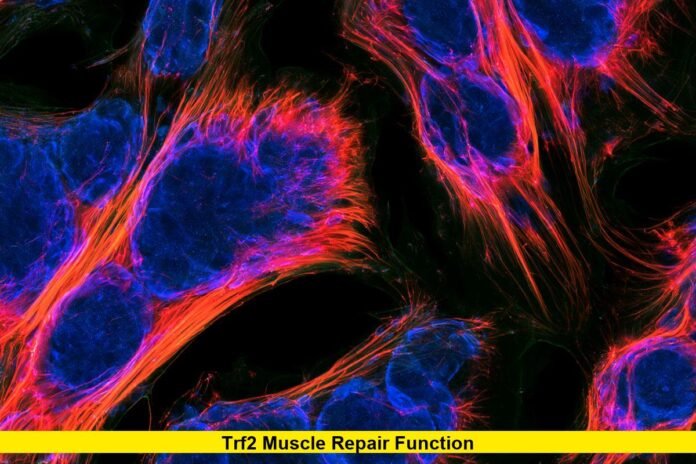

Scientists have uncovered a surprising new job for a protein long known only for guarding the ends of our chromosomes. Researchers at the University of Pennsylvania’s Perelman School of Medicine have found that TRF2, a protein traditionally associated with protecting telomeres, also plays a central role in muscle stem cell identity and tissue repair. The findings, published in the journal Science Advances in late July 2026 and widely reported starting August 1-2, 2026, may reshape how doctors and researchers think about muscle regeneration, muscular dystrophy, and even why muscle-based cancers are so rare.
What Is TRF2?
TRF2, short for Telomeric Repeat-binding Factor 2, has for decades been understood mainly as a “protector” protein. Its classic job is to sit at the tips of chromosomes, known as telomeres, and stop the cell’s repair machinery from mistaking these natural DNA ends for dangerous breaks. Without TRF2 doing this job properly, cells in most tissues would trigger alarm signals and often die.
That well-established role made TRF2 a familiar name in aging and cancer research. What nobody expected was that this same protein would turn out to be essential for something completely different: keeping muscle stem cells functional enough to repair injured muscle tissue.
The New Discovery: TRF2 and Muscle Stem Cells
The Penn Medicine team, led by senior author Foteini Mourkioti, studied muscle stem cells, also called MuSCs, which are the cells responsible for repairing skeletal muscle after injury. Normally, these cells stay dormant until muscle damage occurs. Once triggered, they wake up, multiply, rebuild the damaged tissue, and then return to a resting state so they are ready for the next injury.
The researchers found that TRF2 levels rise and fall precisely as muscle stem cells move through this cycle of rest, activation, repair, and self-renewal. This pattern suggested TRF2 was actively coordinating the regenerative process rather than simply sitting passively at chromosome tips.
To test this, the team removed TRF2 specifically from muscle stem cells in mice. What happened next surprised the researchers.
Identity Loss, Not Cell Death
Based on TRF2’s known role in other tissues, scientists expected that removing the protein would cause muscle stem cells to die, since losing telomere protection typically triggers this kind of cellular alarm response. Instead, something unexpected happened: the cells survived, but they lost their molecular identity as muscle stem cells.
Without that identity intact, injured muscle could no longer regenerate properly. Instead of rebuilding healthy muscle fibers, the damaged tissue filled in with scar tissue and fat. According to the research team, this discovery completely changes the understanding of what TRF2 does inside these cells, since the consequence was not death but a functional loss of purpose.
How TRF2 Controls Muscle Gene Expression
The researchers dug deeper to understand the mechanism behind this identity loss. They discovered that TRF2 does not only act at chromosome ends. It also binds to regulatory regions scattered across the genome, specifically areas rich in structures called G-quadruplexes, which are unusual, four-stranded secondary DNA formations.
These G-quadruplex regions sit near genes that are essential for muscle stem cell identity. By binding to them, TRF2 helps sustain the expression of the genetic program that keeps muscle stem cells “muscle” and capable of doing their regenerative job. This non-telomeric, or noncanonical, function of TRF2 had not been documented before this study.
Impact on Duchenne Muscular Dystrophy
The team also tested what happens when TRF2 is removed from muscle stem cells in a mouse model of Duchenne muscular dystrophy, a severe genetic disease that progressively weakens muscles. The results were striking: losing TRF2 dramatically accelerated disease progression in these mice. Muscle degeneration worsened, fibrosis increased, and overall survival was significantly shortened compared to standard dystrophic mice.
This suggests that TRF2 may act as a protective factor that helps slow the decline of muscle function in muscular dystrophy, and that boosting or preserving its activity in muscle stem cells could become a future avenue for therapy.
Why This Matters for Muscle Cancer Research Too
One of the more intriguing angles highlighted by the research team is the connection to cancer. Skeletal muscle is one of the most regenerative tissues in the human body, yet cancers that originate in muscle tissue are relatively rare. This new understanding of how TRF2 tightly controls muscle stem cell identity may help explain that long-standing puzzle, since a well-regulated identity program could make it harder for muscle cells to become cancerous even while they are constantly renewing themselves.
What This Means for the Future of Muscle Health
While this research was conducted in mouse models and has not yet moved into human clinical trials, the implications are significant for several areas of medicine:
Muscle injury recovery: Understanding how TRF2 supports the repair cycle could eventually inform new approaches to help muscles heal more completely after serious injury.
Muscular dystrophy treatment: Since TRF2 loss worsened disease progression in dystrophic mice, preserving or enhancing its activity may become a therapeutic target for slowing muscle degeneration in conditions like Duchenne muscular dystrophy.
Cancer biology: The G-quadruplex binding mechanism identified in this study is already of interest to cancer researchers, since these same DNA structures are studied as potential drug targets in various cancers.
Aging and regeneration: As muscle stem cell function naturally declines with age, insights into how TRF2 maintains cell identity could inform future research into preserving muscle regenerative capacity over the lifespan.
The Bottom Line
This research fundamentally shifts how scientists view TRF2, moving it from a narrow role as a chromosome-end protector to a broader regulator of stem cell identity and tissue regeneration. In muscle stem cells specifically, TRF2 appears to be a critical switch that determines whether an injured muscle heals with healthy new tissue or degrades into scar and fat. With muscular dystrophy and muscle cancer both potentially connected to this single protein’s function, researchers see this as an important step toward new therapeutic strategies, even though further studies in human tissue will be needed before any treatments can be developed.
Found this breakdown of the TRF2 muscle repair discovery helpful? Drop a comment below and stay tuned, because more research on muscle stem cells and regenerative medicine may be coming soon.