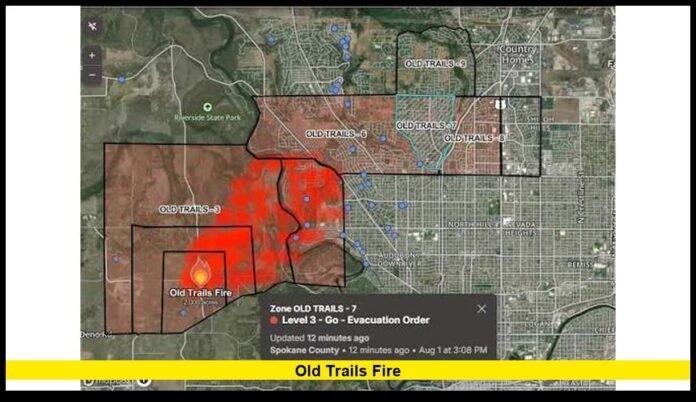

The Old Trails Fire remains one of the most significant wildfire incidents in Washington, drawing an extensive emergency response as firefighters work to contain fast-moving flames threatening homes and open land. Hot weather, dry vegetation, and strong winds have created dangerous conditions, forcing evacuations in affected communities and keeping emergency crews on high alert. As of the latest confirmed updates, firefighters continue to prioritize life safety, structure protection, and containment while residents monitor changing evacuation notices.
Old Trails Fire Continues to Challenge Firefighters
Wildfire crews remain engaged in an around-the-clock effort to slow the spread of the Old Trails Fire. Since the fire was first reported near Old Trails Road in Spokane County, it has grown rapidly because of weather conditions that favor aggressive fire behavior.
The combination of dry grasses, brush, low humidity, and wind has allowed flames to move quickly across the landscape. Firefighters have adjusted tactics throughout the incident, shifting resources whenever fire activity increases or changes direction.
Emergency officials continue to remind residents that wildfire conditions can change within minutes. Even areas that appear safe may become threatened if winds shift unexpectedly.
Where the Fire Began
The wildfire started near Old Trails Road southwest of Spokane, an area surrounded by grasslands, brush, and scattered residential properties.
Initial attack crews responded quickly after smoke was reported. Additional resources followed as the fire expanded beyond its original footprint.
Within a short period, the incident required assistance from multiple local, state, and regional agencies. Fire engines, bulldozers, water tenders, helicopters, and fixed-wing aircraft all became part of the suppression effort.
The quick response helped protect many homes, but weather conditions made the incident difficult from the beginning.
Rapid Growth Created an Emergency
One of the defining features of this wildfire has been its rapid spread.
Strong winds carried burning embers well ahead of the main fire, creating new spot fires that challenged firefighters. Instead of attacking one continuous fire edge, crews often had to respond to multiple separate ignitions.
This behavior increased the complexity of suppression operations and required additional firefighting resources.
The speed of the fire also reduced the amount of time available for residents in some areas to prepare for evacuation.
Weather Played a Critical Role
Fire weather remained one of the biggest factors influencing the incident.
Several conditions combined to create dangerous wildfire behavior:
- High temperatures
- Very low humidity
- Dry vegetation
- Gusty afternoon winds
- Continuous fine fuels such as grass
These conditions allowed flames to spread rapidly across open ground while producing heavy smoke visible across much of the Spokane region.
Even moderate changes in wind direction caused firefighters to reposition equipment and crews several times during operations.
Evacuation Orders Expanded
Public safety remained the highest priority throughout the incident.
Emergency officials expanded evacuation notifications as fire activity increased near residential neighborhoods.
Residents were instructed to monitor emergency alerts closely because evacuation levels changed throughout the incident.
Authorities encouraged people to leave immediately when mandatory evacuation orders were issued rather than waiting until conditions worsened.
Emergency managers also advised residents to prepare:
- Prescription medications
- Important documents
- Identification
- Emergency clothing
- Pet supplies
- Phone chargers
Preparing these items in advance helps families evacuate quickly when conditions change.
Read More – Wildfire Smoke Blankets Toronto as Air Quality Reaches Hazardous Levels
Structure Protection Became the Primary Mission
Although firefighters worked to slow the wildfire itself, protecting homes quickly became one of the highest operational priorities.
Fire engines positioned throughout threatened neighborhoods performed structure defense by spraying vegetation, monitoring ember activity, and extinguishing small fires before they could spread to buildings.
Crews also removed combustible vegetation around some homes whenever conditions allowed.
Aircraft supported these operations by dropping water and fire retardant ahead of advancing flames where it was safe to do so.
This coordinated strategy helped reduce damage in several threatened areas.
Multiple Agencies Responded
Large wildfires require cooperation between numerous emergency organizations.
The response to the Old Trails Fire included personnel from local fire districts, Washington state agencies, emergency management offices, law enforcement, and supporting wildfire teams.
Each agency handled specific responsibilities.
Firefighters focused on suppression.
Law enforcement managed evacuations and road closures.
Emergency managers coordinated shelters and public information.
Utility companies monitored infrastructure that could be affected by fire activity.
Working together allowed responders to manage a rapidly changing emergency more effectively.
Aircraft Supported Ground Operations
Air resources became an important part of firefighting efforts.
Helicopters delivered repeated water drops onto active fire fronts.
Air tankers placed fire retardant along portions of the wildfire where conditions allowed safe operations.
Aircraft also helped incident commanders monitor fire growth from above.
These aerial observations improved planning by identifying new spot fires and areas where suppression efforts could be strengthened.
Air operations depended heavily on visibility and weather conditions.
Heavy smoke and strong winds occasionally limited aircraft activity.
Smoke Affected Communities Across the Region
Even residents located well outside evacuation areas experienced smoke from the wildfire.
Large smoke columns reduced visibility across portions of Spokane County and neighboring communities.
Health officials generally recommend limiting outdoor activity whenever smoke levels become unhealthy.
People with asthma, heart disease, chronic lung conditions, older adults, and young children remain especially vulnerable to wildfire smoke.
Residents were encouraged to keep windows closed when possible and reduce strenuous outdoor activities during periods of poor air quality.
Road Closures Helped Emergency Operations
Several roads near the active fire area experienced temporary closures or restrictions.
These closures served several important purposes.
They provided firefighters with unobstructed access to the fire.
They reduced traffic on evacuation routes.
They kept residents away from hazardous conditions created by smoke, falling debris, and emergency equipment.
Officials reminded drivers not to bypass roadblocks because conditions can change rapidly.
Firefighters Faced Constant Challenges
Wildfire suppression involves much more than extinguishing visible flames.
Throughout the incident, crews dealt with:
- Wind-driven fire spread
- Spot fires
- Heavy smoke
- Limited visibility
- Dry fuels
- Long operational periods
- Protection of homes and infrastructure
Firefighters also worked carefully around changing terrain, where slopes and vegetation could increase fire intensity.
Every operational period required updated planning based on the latest weather forecasts and fire behavior.
Community Support Continued Throughout the Emergency
Local residents quickly came together to support those affected by the wildfire.
Neighbors helped one another move livestock, transport trailers, and secure personal belongings before evacuating.
Community organizations assisted displaced families by providing temporary shelter and other basic necessities.
Volunteers also supported emergency efforts by helping distribute information and checking on vulnerable residents.
This cooperation has become an important part of many wildfire responses across the western United States.
Why Wildfires Spread So Quickly During Summer
Summer wildfire conditions in eastern Washington often create an environment where fires can grow rapidly.
Several natural factors contribute to this risk.
Extended periods without significant rainfall leave grasses and shrubs extremely dry.
Afternoon temperatures increase fuel dryness even further.
Low humidity allows vegetation to ignite more easily.
Strong winds can carry embers long distances, starting new fires beyond established containment lines.
Together, these conditions create fast-moving wildfires capable of expanding within hours.
Emergency Officials Continue Monitoring Conditions
Incident commanders continually evaluate changing weather, fire behavior, and available resources.
As firefighters strengthen containment lines, crews also monitor hot spots that could reignite if winds increase.
Drones, aircraft, mapping technology, and field observations all contribute to updated operational plans.
Emergency officials continue issuing public updates whenever evacuation levels, road closures, or fire conditions change.
Residents living near wildfire areas are encouraged to remain prepared until the incident is fully controlled.
Wildfire Safety Remains Essential
Wildfires can develop rapidly during periods of hot and windy weather.
Emergency officials encourage every household in wildfire-prone areas to prepare before an emergency occurs.
Important preparedness measures include:
- Keeping an emergency kit ready.
- Creating an evacuation plan.
- Maintaining enough fuel in vehicles.
- Knowing multiple evacuation routes.
- Keeping mobile devices charged.
- Signing up for local emergency alerts.
Preparation allows families to respond quickly if conditions deteriorate.
Outlook for Firefighters
Fire crews will continue focusing on containment while protecting lives, homes, and important infrastructure.
Success will depend on weather conditions, available resources, and continued coordination among responding agencies.
Although firefighters have made progress in several operational areas, changing winds and dry fuels remain ongoing concerns.
Incident management teams will continue adjusting strategies as conditions evolve, ensuring resources are deployed where they are needed most.
Residents returning home after evacuation notices are lifted should remain cautious. Burned landscapes may contain hazardous trees, damaged utilities, and lingering hot spots that require additional attention.
The Old Trails Fire serves as another reminder of how quickly wildfire emergencies can develop during Washington’s summer fire season. The dedication of firefighters, emergency responders, law enforcement, and community volunteers continues to play a critical role in protecting lives and property while suppression efforts move forward.
As new confirmed updates become available on the Old Trails Fire, residents are encouraged to stay informed and share their experiences or questions in the comments below.