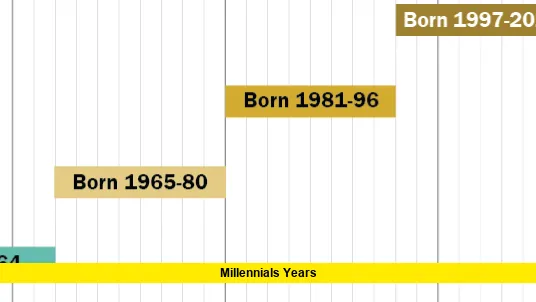

When people ask about millennials years, they are usually trying to figure out exactly who counts as a millennial and how that fits into the broader picture of generational labels used across media, marketing, and workplace research. The most widely accepted answer, based on the framework used by the Pew Research Center, is that millennials were born between 1981 and 1996. That range places millennials firmly between Generation X and Generation Z, and in the current year it means millennials are roughly 30 to 45 years old. This guide breaks down where that range comes from, why it matters, and how millennials continue to shape culture, careers, and public conversation.
How the Millennial Generation Is Defined
Generational labels are not based on strict scientific boundaries. Instead, researchers and demographers group people by shared birth years so they can study common cultural touchstones, technological shifts, and historical events that shaped a cohort during their formative years. The term “millennial” was popularized by authors William Strauss and Neil Howe, who used it to describe the generation coming of age around the turn of the millennium.
Pew Research Center, widely regarded as the leading authority on generational definitions, set 1981 as the starting birth year and 1996 as the closing birth year for millennials. That decision was not arbitrary. Researchers pointed to distinct formative experiences that separated millennials from the generation before and after them. Most millennials were old enough to understand and remember the September 11 attacks, unlike much of Generation Z, who were either very young or not yet born. Millennials also came of age during the wars in Iraq and Afghanistan, the 2008 financial crisis, and the rapid expansion of the internet and early social media platforms.
Some researchers and publications use slightly different boundaries, such as 1980 to 1994, but the 1981-to-1996 range remains the most widely cited and used across mainstream demographic reporting. It is worth noting that Pew Research itself has acknowledged that generational cutoffs are tools for analysis rather than hard scientific lines, and the organization has said it remains open to revisiting these boundaries if new data suggests a clearer break point.
How Old Are Millennials Today
Using the standard 1981-to-1996 birth range, millennials currently span an age range of about 30 to 45 years old. The oldest millennials, born in 1981, are approaching their mid-forties, while the youngest members of the generation, born in 1996, are entering their thirties. This places millennials squarely in the middle of their careers and family-building years, a stage of life that brings its own set of financial priorities, housing decisions, and workplace responsibilities.
This age range also explains why millennials are frequently discussed alongside Generation X, born roughly between 1965 and 1980, and Generation Z, born from 1997 onward. Millennials sit in the middle of the current adult population, old enough to have witnessed the pre-smartphone era but young enough to have adapted early to digital communication, streaming media, and remote work culture.
Career and Workforce Impact
Millennials have become the largest generational group in the global workforce, and their influence on how companies operate continues to grow. Because the generation now spans people in their early thirties through mid-forties, many millennials have moved beyond entry-level roles and into management, leadership, and executive positions. Industry data consistently points to millennials holding a large share of managerial promotions over the past several years, meaning this generation is no longer simply the group companies are trying to attract and retain. Increasingly, millennials are the ones setting workplace policy, shaping company culture, and making hiring decisions.
Millennials tend to be concentrated in technology, healthcare, professional services, and mission-driven or purpose-focused organizations. Several workplace trends associated with this generation include:
- A strong preference for flexible or hybrid work arrangements
- Greater emphasis on workplace mental health and wellness benefits
- Interest in employers with clear social or environmental commitments
- A tendency to change jobs more frequently than prior generations did at the same age
- Comfort with digital collaboration tools that became standard during their early careers
Millennials also carry the distinction of being the most racially and ethnically diverse adult generation in modern history, a factor that has influenced consumer trends, media representation, and political engagement over the past two decades.
Public Interest and Cultural Identity
Public curiosity about millennials years tends to spike whenever new demographic data, workplace surveys, or generational comparison articles circulate online. Much of this interest stems from ongoing debates about how millennials differ from both the generation before them and the one following them. Unlike Generation X, millennials grew up with earlier and more consistent exposure to computers and the internet. Unlike Generation Z, millennials had to actively adapt to social media and mobile technology rather than growing up with it from birth.
This “in-between” position has made millennials a frequent subject of cultural commentary, from discussions about housing affordability and student debt to conversations about parenting styles and financial habits. Millennials have also been characterized in research as holding more socially liberal views on average compared to older generations at the same life stage, a pattern that has been observed in both the United States and the United Kingdom. Analysts often attribute this to the political and economic environment millennials experienced during their early adulthood, including coming of age during a period shaped by a conservative U.S. presidential administration and the aftermath of the 2008 recession.
Education is another area where millennials stand out. Research has shown a sharp rise in educational attainment among millennials compared to earlier generations, with the increase particularly notable among millennial women, who now hold bachelor’s degrees at higher rates than their male counterparts within the same generation.
Where Millennials Fit Among Other Generations
To fully understand the millennials years range, it helps to see it alongside the surrounding generational categories, as commonly defined by Pew Research and widely used demographic frameworks:
- Silent Generation: born 1928 to 1945
- Baby Boomers: born 1946 to 1964
- Generation X: born 1965 to 1980
- Millennials (Generation Y): born 1981 to 1996
- Generation Z: born 1997 to 2012
- Generation Alpha: born 2013 onward
This layout shows why millennials are sometimes referred to as “Generation Y,” a name that reflects their position directly after Generation X. It also explains the more casual term “Echo Boomers,” which references the fact that many millennials are the children of baby boomers, creating a noticeable rise in birth rates during the millennial cohort’s early years.
Generational boundaries are not universally agreed upon, and different research organizations may shift the start or end year by a year or two. However, the general framework of millennials spanning the early 1980s through the mid-1990s remains consistent across most reputable sources, making it a reliable reference point for anyone trying to determine which generation they or someone else belongs to.
Final Thoughts
Understanding millennials years offers more than just a simple date range. It provides context for why this generation thinks, works, and communicates the way it does, shaped by formative events like the September 11 attacks, the 2008 financial crisis, and the rise of the internet age. As the oldest millennials move deeper into their forties and the youngest settle into their thirties, this generation continues to hold significant influence over workplace culture, consumer trends, and public discourse. While exact generational boundaries may be debated among researchers, the 1981-to-1996 birth range remains the most widely recognized definition, offering a useful lens for understanding one of the most talked-about generations in recent history.
Have thoughts on how millennials continue to shape today’s workplace and culture? Share your perspective in the comments and stay tuned for more generational insights.