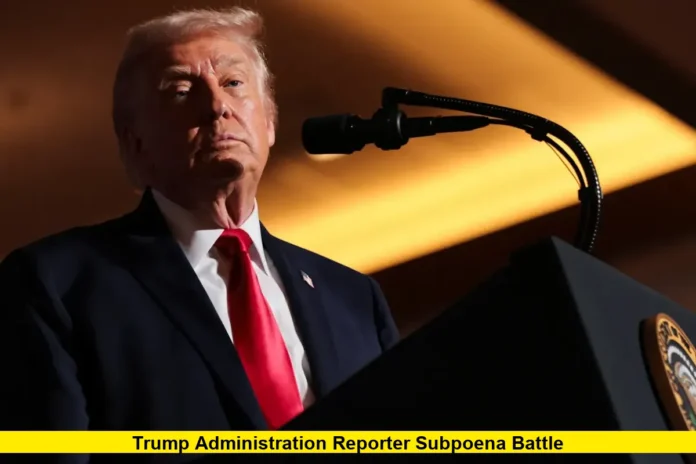

The Trump administration reporter subpoena battle has escalated into one of the most closely watched press freedom fights of 2026, pitting the Department of Justice against four New York Times journalists over their reporting on a security controversy involving President Donald Trump’s Qatari-gifted Air Force One jet. As of July 23, 2026, the case is now before a federal judge in Manhattan, with both sides asking for opposite outcomes in a dispute that could reshape how far the government can go to unmask journalists’ confidential sources.
How the Subpoena Battle Started
The controversy traces back to July 8 and July 9, 2026, when New York Times reporters Julian E. Barnes, Eric Lipton, Tyler Pager, and Eric Schmitt published stories detailing security shortcomings in the new Qatari-donated Air Force One, including reports that the aircraft lacked defensive countermeasures found on the current presidential fleet. The stories detailed how President Trump had returned from the 2026 NATO summit in Ankara, Turkiye, aboard his old Air Force One rather than the new jet, reportedly at the urging of the Secret Service over safety concerns.
On July 10, 2026, just one day after the report was published, federal agents delivered grand jury subpoenas to the reporters’ homes, compelling them to testify before a grand jury in Manhattan about the identity of their confidential sources. FBI Director Kash Patel was tapped that same day to oversee the leak investigation, in an unusual move reportedly run out of the White House rather than through standard Justice Department channels.
DOJ Expands the Probe to Phone Records and Family Members
The subpoena battle intensified when The Times revealed that the Department of Justice had also sought phone records belonging to several reporters, and, notably, to some of their spouses. According to court filings, additional subpoenas were issued on July 14 and July 16, 2026, after The Times had already moved to quash the original grand jury subpoenas. Lawyers for the paper noted that two of the subpoenas sought records dating back to January 1, 2026, well before the Air Force One stories were even published, arguing this suggested the DOJ was “foraging” for broader information about the journalists’ source relationships rather than investigating a specific leak.
The Freedom of the Press Foundation strongly condemned the move to target reporters’ relatives, with the group’s Chief of Advocacy Seth Stern stating that even organized crime networks typically consider family members off-limits.
The New York Times Fights Back in Court
David McCraw, The Times’ top newsroom lawyer, filed a motion to quash the subpoenas, calling them “abusive and improper” and arguing they were brought in bad faith to punish the paper for its coverage. The motion, initially filed under seal, was later unsealed by U.S. District Judge Arun Subramanian, who was assigned to oversee the case.
Judge Subramanian paused enforcement of all the subpoenas — both the grand jury testimony demands and the phone records requests — while he considers the newspaper’s motions. He also postponed the reporters’ scheduled grand jury appearances and ordered the Justice Department to respond by July 20, 2026, on whether it believed any of the sealed court filings should remain confidential.
Today’s Hearing: July 23, 2026
A pivotal hearing in the case is scheduled for 2 p.m. ET on Thursday, July 23, 2026, in Manhattan federal court. Prosecutors have asked Judge Subramanian to pause the subpoenas for an additional two weeks, arguing that upcoming developments in the investigation could affect his ruling. The New York Times, meanwhile, is urging the judge to throw the subpoenas out entirely. The Justice Department maintains that the subpoenas were issued in full compliance with federal law and internal department policy, and Manhattan U.S. Attorney Jay Clayton has told senators he followed all appropriate procedures.
Political Fallout and Congressional Reaction
The subpoenas quickly became a flashpoint in Washington. During Senate confirmation hearings, Todd Blanche, Trump’s pick for attorney general, defended the DOJ’s approach, comparing the subpoenaed reporters to “material witnesses, just like a reporter would be a material witness to a car crash.” Senator Ron Wyden, an Oregon Democrat, called the subpoenas a “flagrant attack” on journalists during Senate Intelligence Committee questioning, while Senator Peter Welch pressed Blanche directly on whether he supported the FBI’s role in the investigation.
Press freedom advocates and members of Congress have broadly condemned the subpoenas as an attempt to intimidate the media, while some conservative commentators have defended the DOJ’s authority to investigate leaks of what it describes as sensitive national security information.
Part of a Broader Pattern
This subpoena battle is not an isolated incident. It follows a string of confrontations between the Trump administration and major news outlets since Trump returned to office, including financial settlements with ABC News and CBS News’ “60 Minutes,” as well as civil lawsuits and federal actions involving The Wall Street Journal, The Washington Post, and the BBC. Earlier in 2026, the FBI searched the property of Washington Post reporter Hannah Natanson and seized her devices as part of a separate leak investigation tied to her reporting on federal workforce cuts.
What Happens Next
The outcome of Thursday’s hearing will determine whether the subpoenas are quashed outright, allowed to proceed, or paused further while the investigation continues. Legal experts say the case is likely to become a significant test of press freedom protections and the government’s authority to compel journalists to reveal confidential sources in matters framed as national security leak investigations.
Frequently Asked Questions
What is the Trump administration reporter subpoena battle about? It involves Justice Department subpoenas issued to four New York Times reporters, demanding they testify before a grand jury and turn over phone records related to their July 2026 reporting on security concerns with Trump’s new Air Force One jet.
Which reporters were subpoenaed? Julian E. Barnes, Eric Lipton, Tyler Pager, and Eric Schmitt of The New York Times.
Why did the DOJ issue the subpoenas? The Justice Department says it is trying to identify who leaked information about security flaws in the Qatari-donated Air Force One. Critics argue the investigation is overly broad and targets journalists’ sources rather than any specific security breach.
Did the subpoenas also target reporters’ family members? Yes. Phone records for some reporters’ spouses were also sought, a move press freedom groups have strongly criticized.
What is happening with the case now? A federal judge, Arun Subramanian, held a hearing on July 23, 2026, to decide whether to quash the subpoenas, pause them further, or allow them to proceed.
We’ll be updating this story as the case develops — bookmark this page and check back for the latest on the ruling.