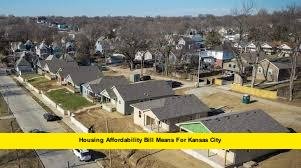

Kansas City families trying to buy or rent a home have spent years watching prices climb faster than their paychecks, and a new wave of legislation is aiming to change that trajectory. Understanding what the housing affordability bill means for Kansas City requires looking at both the sweeping federal package moving through Washington and the local efforts already underway to expand homeownership options across the metro. Together, these initiatives represent one of the most significant pushes to address housing costs the region has seen in decades, touching everything from zoning rules to manufactured housing to the availability of affordable rental units.
Background: Why Kansas City Needs Housing Relief
Home prices in the Kansas City area have outpaced local incomes for years, and the gap has only widened since the pandemic. Regional economists have pointed out that home values in the metro have risen nearly twice as fast as household incomes since 2010, while new construction has lagged well behind the pace seen before the Great Recession. That slowdown in building has left the region with tens of thousands fewer housing units than would be expected under a healthier development pattern, tightening supply and pushing up costs for buyers and renters alike.
The strain is not limited to homeownership. Thousands of low-income renters across the Kansas City region are currently paying far more than they can reasonably afford for housing, with some households spending well over half their income just to keep a roof over their heads. Local housing advocates describe this as an unsustainable burden, particularly for families who also need to cover child care, health care, transportation, and food. Executives at the KC Home Builders Association have echoed that concern, noting that so-called “starter homes” in the metro now often carry price tags in the $350,000 to $450,000 range, a figure that has stretched the definition of what counts as an entry-level purchase.
The Federal Housing Affordability Bill: What’s in It
At the national level, Congress recently passed a sweeping housing package known as the 21st Century ROAD to Housing Act, described by lawmakers as the largest piece of housing legislation to move through Congress in decades. The bill passed with strong bipartisan support, clearing the Senate and House by wide margins after months of negotiation between lawmakers from both parties. Its central goal is to tackle the housing shortage directly by making it easier and cheaper to build homes, while also protecting single-family housing stock from being absorbed by large institutional investors.
Key provisions of the federal housing affordability bill include the following:
Removing regulatory barriers to homebuilding, including streamlining environmental review requirements for infill housing projects built on vacant lots between existing structures.
Eliminating the permanent chassis requirement for factory-built and manufactured homes, a change expected to lower construction costs and allow for more flexible designs, including homes with basements or second stories.
Creating grant programs that help communities adopt pre-approved “pattern book” housing designs, which can speed up permitting and reduce the cost of new construction.
Restricting large institutional investors from purchasing additional single-family homes once they own a certain threshold of properties, a provision intended to preserve homeownership opportunities for individual buyers rather than corporate landlords.
Expanding funding tools such as Community Development Block Grants so they can be used for new affordable housing construction, and raising the cap on how much banks can invest in community development and affordable housing projects.
Creating pilot programs to convert vacant commercial and industrial buildings into housing, with priority given to economically distressed areas.
Streamlining approval processes tied to federal housing assistance programs, which supporters argue will help projects move from planning to completion more quickly.
Notably, the bill’s signing was delayed after the White House linked it to unrelated voter identification legislation, which left the housing package passed by Congress but not yet formally enacted into law at the time of that announcement. Local and national housing advocates have continued to press for the bill’s provisions to take effect, arguing that the delay does not diminish the urgency of the underlying housing shortage.
What the Bill Means for Kansas City Specifically
For Kansas City, the practical impact of the housing affordability bill centers on a few key areas. First, the push to loosen local zoning rules could open the door to more diverse housing types, including duplexes, townhouses, and accessory dwelling units, in neighborhoods that have historically been limited to single-family construction. Second, the expansion of manufactured housing options could give buyers priced out of traditional stick-built homes a more affordable path to ownership, particularly in outlying parts of the metro where land costs are lower. Third, new grant funding aimed at converting vacant buildings into housing could help address blight in older sections of Kansas City while adding to the region’s housing stock.
Local officials and housing industry leaders have been vocal about the need for these changes. Representatives from the KC Home Builders Association have noted that affordability is not simply a matter of personal budgeting, but a structural problem tied to the cost of land, labor, materials, and regulatory delays. They have also cautioned that housing should be viewed primarily as a place for families to live and build stability, rather than purely as a financial investment vehicle.
Residents who have experienced housing instability firsthand have welcomed the renewed attention on affordability. Stories from local shelters and transitional housing programs illustrate how difficult it can be for renters to meet standard requirements, such as landlords asking for income equal to three times the monthly rent, a bar that many working households simply cannot clear. For people rebuilding their lives after homelessness or domestic violence situations, stable and affordable housing options can make the difference between long-term stability and continued hardship.
Local Momentum: The Kansas City Regional Housing Fund
Beyond the federal bill, Kansas City is also seeing homegrown efforts to tackle affordability. Regional planners and housing organizations have been developing a new Kansas City Regional Housing Fund, a pool of up to $100 million designed to give developers access to low-cost, flexible capital for housing projects. The fund is being assembled through a partnership between the Mid-America Regional Council and the Greater Kansas City Local Initiatives Support Corporation, with the goal of financing a mix of market-rate and affordable units across the metro.
Under the fund’s guidelines, at least 51 percent of the units in its overall portfolio must remain affordable to households earning 80 percent of the area median income or less. For a household of four in the Kansas City region, that income threshold works out to roughly $90,700 in 2026, meaning monthly housing costs would need to stay affordable relative to that income level to avoid pushing families into a cost-burdened situation. While individual projects financed by the fund may vary in their affordability mix, the overall portfolio is designed to serve a broad range of income levels, from lower-income renters to middle-income buyers priced out of the current market.
Housing fund organizers have been careful to note that this initiative is not a complete solution on its own. Similar funds in other cities have shown promising early results but tend to work one project at a time, chipping away at a shortage measured in the tens of thousands of units. Still, supporters view it as a meaningful piece of the puzzle, particularly because Kansas City’s housing shortage is often tied less to available land or builder willingness and more to the availability of affordable financing for developers.
Public Interest and Community Reaction
Public interest in the housing affordability bill and related local efforts has grown alongside rising frustration over home prices and rents. Kansas City residents, particularly renters and first-time buyers, have expressed hope that new zoning flexibility and expanded financing options will translate into real, tangible relief rather than incremental change that takes years to materialize. Local officials, including members of Congress representing the Kansas City area, have publicly discussed the bill’s provisions and their potential effects on the region, signaling continued attention to the issue at both the local and federal level.
Housing policy researchers have generally described the federal legislation as a meaningful step forward, while also cautioning that its effects will likely unfold gradually rather than producing an immediate drop in prices. Experts have pointed out that supply-side reforms, such as streamlined permitting and reduced construction costs, tend to influence housing markets over a period of years rather than months. For Kansas City, that means the full impact of the housing affordability bill may not be felt immediately, but the combination of federal reform and local investment through initiatives like the Regional Housing Fund is expected to gradually expand housing options across the metro.
Final Thoughts
The housing affordability bill represents a significant shift in how policymakers are approaching one of the most persistent economic challenges facing Kansas City families. By pairing federal reforms aimed at boosting housing supply with local investment through the Kansas City Regional Housing Fund, the region is positioning itself to chip away at a shortage that has built up over more than a decade. While no single piece of legislation or funding pool will solve the affordability crisis overnight, the combined momentum behind these efforts suggests that Kansas City residents may see gradually expanding access to affordable homeownership and rental options in the years ahead. For now, city leaders, builders, and housing advocates continue to monitor implementation closely, recognizing that consistent follow-through will determine whether these promises translate into real relief for the families who need it most.
Stay informed on how the housing affordability bill continues to shape Kansas City’s housing market by checking back for updates, and feel free to share your thoughts or experiences in the comments below.