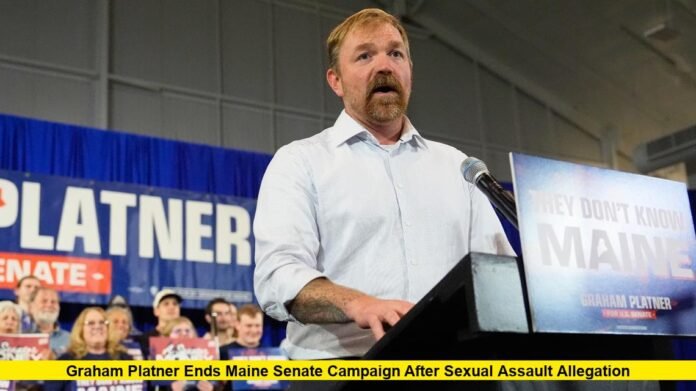

Graham Platner Ends Maine Senate Campaign After Sexual Assault Allegation, marking one of the most abrupt collapses of a U.S. Senate bid in recent memory. The Maine Democrat, who just weeks earlier had won his party’s primary by an overwhelming margin, announced on Wednesday night that he was suspending his campaign against Republican Senator Susan Collins. The decision came just two days after Politico published a report detailing an allegation from a former girlfriend, Jenny Racicot, who said Platner forced her into a sexual encounter without her consent while they were dating in 2021. What began as an insurgent, grassroots campaign that energized progressives across the country ended in a matter of days, leaving Maine Democrats scrambling to find a new nominee with less than four months until Election Day.
Background: Who Is Graham Platner
Graham Platner is a 41-year-old military veteran and oyster farmer from coastal Maine who rose from relative obscurity to become one of the most talked-about Senate candidates in the country. He built his campaign around economic populism, casting himself as an outsider willing to challenge both entrenched Republicans and the Democratic establishment. His working-class background, blunt style, and willingness to criticize wealth inequality drew comparisons to other anti-establishment figures and earned him early support from progressive stalwarts like Senator Bernie Sanders and Senator Elizabeth Warren.
Platner entered the race to challenge longtime Republican incumbent Susan Collins, who has represented Maine in the Senate since 1997. Collins has proven remarkably resilient even as Maine has trended more Democratic in statewide elections, and unseating her has been a top priority for national Democrats for well over a decade. Platner’s rapid rise gave many in the party hope that 2026 might finally be the year Collins lost her seat, especially after Maine Governor Janet Mills, who had also been considering a run, stepped back from the race in April following weak polling numbers against Platner.
Despite his momentum, Platner’s candidacy was never free of controversy. Reports surfaced about years-old Reddit posts containing offensive language, a chest tattoo that resembled a Nazi symbol (which Platner said he was unaware of and later covered up), and messages describing him sending sexually explicit texts to women while he was married. Even so, most Democratic leaders continued to back him, and he cruised to a decisive primary victory in June, taking more than 70 percent of the vote with little serious opposition.
The Allegation That Changed Everything
The turning point came when Politico published an investigation containing an on-the-record account from Jenny Racicot, a Maine woman who had previously dated Platner. Racicot alleged that in 2021, Platner forced her into a sexual encounter after she repeatedly told him to stop. In a subsequent interview, she described the incident in stark terms, saying she considered what happened to be rape “by definition.” Her account went beyond earlier reporting, including a New York Times story in which several women who had been romantically involved with Platner described his behavior as unsettling, though that report had not detailed the specific assault allegation.
Platner responded publicly within hours of the Politico story, calling the allegations “categorically false” and “not real.” In an initial video, he said he needed time to reflect on “the best path forward for the state that I love, the people that I love, the movement I belong to and the goal of defeating Susan Collins.” For two days, he resisted mounting pressure to leave the race, insisting that accusations “are supposed to be the beginning of things, not the end.”
That resistance collapsed by Wednesday. In an eleven-minute video posted to social media, Platner announced he was suspending his campaign operations. He continued to deny the sexual assault allegation but acknowledged that the political fallout had made it impossible to continue. “This is incredibly difficult, because I know that some will think it’s an admission of guilt, and it most certainly is not,” he said, adding that the decision was driven by “the structures that are being taken away from us by those in power” rather than the allegations themselves.
How Democratic Leaders Responded
The reaction from national and state Democrats was swift and largely unified. Senate Minority Leader Chuck Schumer, Senator Kirsten Gillibrand, who chairs the Democratic Senatorial Campaign Committee, and Senator Ed Markey were among the first to call on Platner to withdraw. Senator Ruben Gallego, Representative Ro Khanna, and Senator Elizabeth Warren all rescinded their previous endorsements. Notably, Bernie Sanders, one of Platner’s earliest and most prominent backers, also withdrew his support, a significant blow given how central Sanders had been to Platner’s early momentum.
The Maine Democratic Party publicly called on Platner to leave the race, and its executive director, Devon Murphy-Anderson, accused Platner’s team of attempting to influence the process for selecting a potential replacement candidate. The Democratic Senatorial Campaign Committee said it would not invest further resources in Maine as long as Platner remained on the ballot, and the Senate Majority PAC redirected funding away from the race entirely, effectively ending any realistic path forward for his candidacy even before he formally announced his withdrawal.
Republicans, for their part, wasted little time framing the episode as a broader indictment of Democratic judgment. Republican National Committee Chair Joe Gruters issued a pointed statement following Platner’s withdrawal, arguing that Democrats had damaged their own credibility by standing behind him for as long as they did.
What Comes Next for Maine Democrats
Platner’s exit throws the race into unusual territory. Because he suspended his campaign before Maine’s July 13 ballot withdrawal deadline, the Maine Democratic Party now has until July 27 to select a new nominee to face Susan Collins in November. This kind of last-minute replacement process has little modern precedent in a race of this national significance, and party officials are working under considerable time pressure to unify around a viable alternative.
Several names have already emerged as potential replacements. Troy Jackson, a former Maine Senate leader known for his own populist, working-class appeal, is seen by some strategists as a natural successor to Platner’s message, though his close ties to the outgoing candidate could complicate his path. Secretary of State Shenna Bellows has also been mentioned, though she previously challenged Collins in 2014 and lost by a wide margin, a history that gives some Democrats pause. Nirav Shah, Maine’s former COVID-19 response director, is said to be weighing a run and has indicated that any candidate should commit to public debates and town halls. Dan Kleban, co-founder of Maine Beer Company, who briefly ran for the Senate seat last year before dropping out, has also expressed interest. Governor Janet Mills, who suspended her own campaign in the spring but never formally endorsed Platner, remains a wildcard possibility, though she has not publicly addressed the latest developments.
Political analysts widely agree that whoever emerges as the new Democratic nominee will start the general election campaign with far less national baggage than Platner carried by the end. As Cook Political Report’s Jessica Taylor noted, Democrats’ hopes of retaking the Senate majority this November run largely through Maine, since the party needs to flip four seats nationwide and few paths to that majority exist without defeating Collins.
Public Reaction and Broader Implications
The speed and intensity of Platner’s downfall has left many Maine voters, particularly those who were drawn to his outsider message, stunned. His campaign had generated a level of grassroots enthusiasm that is uncommon in modern Senate races, built on promises to fight wealth inequality and take on entrenched political interests in both parties. For many supporters, the collapse represents not just the loss of a candidate but the unraveling of a broader political movement they believed he represented.
At the same time, the allegations against Platner have reignited discussions about how political parties vet and respond to serious misconduct claims against candidates, especially when those candidates have built momentum that party leaders are reluctant to interrupt. Critics have pointed out that Democrats continued to support Platner through multiple earlier controversies before the sexual assault allegation finally proved to be a breaking point.
There is no official confirmation at this time regarding any criminal investigation or legal proceedings related to the allegation, and Platner has firmly and repeatedly denied that the encounter described by Racicot occurred as she describes it. As the story continues to develop, further details about both the allegation itself and the Maine Democratic Party’s selection process for a new nominee are expected to emerge in the coming weeks.
Final Thoughts
The end of Graham Platner’s Senate campaign closes one of the more remarkable political sagas of the 2026 election cycle. A candidate who rose from near anonymity to become a symbol of anti-establishment populism within his own party saw that same momentum evaporate within days of a serious and specific allegation becoming public. With the Maine Democratic Party now racing against a late-July deadline to name a replacement, the race against Susan Collins remains one of the most closely watched contests in the country, and one that could determine whether Democrats have any realistic chance of retaking control of the Senate this fall.
Stay tuned for continuing coverage of the Maine Senate race, and share your thoughts on how this unprecedented campaign collapse could reshape the contest against Susan Collins.