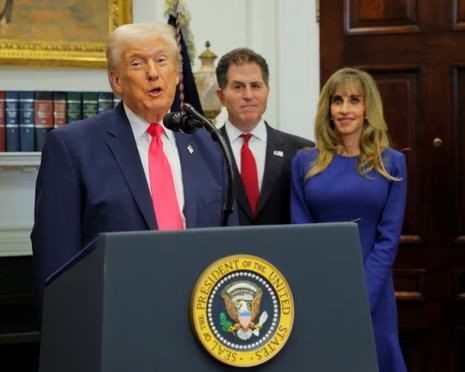

The rollout of Trump Accounts has put a spotlight on the Trump accounts $1,000 seed money program, a new federal initiative designed to give millions of American children a financial head start before they even understand what a savings account is. Launched to coincide with the 250th anniversary of the Declaration of Independence, the program has already drawn millions of applicants, sparked corporate matching pledges worth billions of dollars, and reignited a decades-old debate about how the government should help families build long-term wealth. This article breaks down what Trump Accounts are, who qualifies, how the money grows, and what families should consider before signing up.
What Are Trump Accounts
Trump Accounts, formally known as 530A accounts, are tax-advantaged investment vehicles created for children under the age of 18. They were established under the tax and spending legislation commonly referred to as the One, Big, Beautiful Bill Act, which was signed into law in 2025. Structurally, the accounts function like custodial traditional IRAs: money placed inside them is invested in low-cost funds, allowed to grow over time, and eventually converted into a standard IRA once the beneficiary turns 18.
The centerpiece of the program is the $1,000 seed deposit. Any child born in the United States between January 1, 2025, and December 31, 2028, who is a U.S. citizen with a valid Social Security number automatically qualifies for a one-time $1,000 contribution from the Treasury Department, provided a parent or legal guardian opens an account and elects the pilot program on their behalf. Older children can also have accounts opened for them, but only babies born within that specific window are eligible for the government’s seed money.
Background and Purpose Behind the Program
The idea of giving every child a financial asset at birth is not new. Similar proposals have circulated in policy circles for years, including the SEED (Saving for Education, Entrepreneurship and Downpayment) initiative from the 2000s and the “baby bonds” concept championed by several lawmakers in the 2010s and 2020s. What makes Trump Accounts different is scale: this is the first time a universal, federally seeded savings program of this kind has been implemented nationwide rather than through individual state pilots.
Supporters describe the initiative as a way to introduce more Americans to long-term investing and give children from lower-income households the same early exposure to compounding growth that wealthier families often provide through college savings plans or brokerage accounts. Treasury officials have pointed to the $1,000 seed money as a foundational building block that, left untouched and invested over 18 years at typical market returns, could grow to roughly $3,500 or more by the time a child becomes an adult.
Critics, including researchers at policy think tanks, argue that because most of the growth potential depends on additional contributions from parents and employers, the program may end up benefiting families that can already afford to save, while offering comparatively little extra advantage to lower-income households that cannot contribute beyond the initial deposit. This tension between universal access and unequal outcomes has been a consistent theme in coverage of the rollout.
How the $1,000 Seed Money Works
To receive the government’s contribution, a parent or authorized individual must submit IRS Form 4547, the Trump Account Election form, typically when filing a tax return. The form allows families to both open the account and formally elect to receive the $1,000 pilot contribution in one step. According to IRS officials, more than four million children had been signed up for Trump Accounts shortly after enrollment opened, with over a million already confirmed for the $1,000 pilot deposit. By the official July 4 launch date for contributions, Treasury officials reported that enrollment had climbed past six million children nationwide, with roughly 1.4 million confirmed eligible for the federal seed deposit.
A few key eligibility rules stand out:
- The child must be a U.S. citizen with a valid Social Security number.
- The child must have been born between January 1, 2025, and December 31, 2028.
- The person opening the account must generally be able to claim the child as a dependent for child tax credit purposes.
- Each child may have only one Trump Account.
Once an account is active, the Treasury Department deposits the $1,000 seed contribution, with officials noting the deposit process begins only after the account’s trustee confirms the account is active and properly established.
Contribution Limits and How the Money Grows
Beyond the initial $1,000 seed money, Trump Accounts allow ongoing contributions from a range of sources. Parents, grandparents, other relatives, and friends can add after-tax money, while employers can make pre-tax contributions on behalf of an employee’s child. Combined contributions from individuals and employers are capped at $5,000 per child per year, a limit that will be adjusted for inflation starting after 2027. Employer contributions specifically are capped at $2,500 per employee per year, also subject to future cost-of-living adjustments.
Funds inside Trump Accounts must be invested in low-cost, broadly diversified U.S. stock index funds or exchange-traded funds, with expense ratios capped at 0.10 percent. Leveraged products and individual stock picks are not permitted during what officials call the “growth period,” which lasts until the year the child turns 17. Bank of New York Mellon has been named as the initial account manager, and families can track their child’s account through the Trump Accounts app, developed in partnership with Robinhood.
Withdrawals are generally restricted until the beneficiary turns 18. Even then, distributions are taxed as ordinary income rather than receiving the tax-free treatment associated with Roth IRAs, though the portion attributable to after-tax contributions is not taxed again. Some financial planners have noted that certain families may later consider converting Trump Account balances into Roth IRAs as a long-term tax strategy, since the funds can bypass the earned-income requirement that normally applies to Roth contributions.
Corporate and Philanthropic Contributions
One of the more notable developments since the program’s announcement has been the wave of private-sector and philanthropic commitments layered on top of the government’s baseline contribution. Michael and Susan Dell pledged $6.25 billion to fund $250 deposits for children age 10 or under who live in ZIP codes with median household incomes of $150,000 or less and who do not otherwise qualify for the $1,000 federal seed money because they were born before 2025. That pledge alone is expected to benefit up to 25 million children nationwide.
Other high-profile commitments include a $75 million pledge from hedge fund manager Ray Dalio and his wife Barbara, aimed at children under 10 in Connecticut, and a $250 million commitment from chipmaker Micron Technology to match employee contributions and support children in counties where the company operates. Major employers, including JPMorgan Chase, Intel, Uber, IBM, Nvidia, and Steak ‘n Shake, have also announced plans to add Trump Account contributions to their employee benefits packages. Treasury Secretary Scott Bessent has framed this wave of private commitments as part of a broader “50 State Challenge” encouraging companies and philanthropists across the country to participate.
Public Interest and Ongoing Debate
Public reaction to the Trump accounts $1,000 seed money program has been substantial, reflected in the rapid enrollment numbers reported by the Treasury Department. For many families, the appeal is straightforward: free money deposited into a long-term investment account requires little more than filling out a form. For others, the program has raised questions about equity, since the ability to contribute beyond the initial deposit still depends heavily on household income.
Financial advisors have also cautioned that Trump Accounts should be viewed as a complement to, rather than a replacement for, existing savings tools such as 529 college savings plans, which offer different tax advantages and higher contribution ceilings for education-specific expenses. Because Trump Account withdrawals are taxed as ordinary income and access is restricted until adulthood, the accounts are better suited to long-term wealth building than to covering near-term costs like tuition or childcare.
Latest Updates
As of the official July 4 launch, Treasury officials confirmed that more than six million children had been enrolled in Trump Accounts, with approximately 1.4 to 1.5 million of those confirmed eligible for the $1,000 federal seed deposit. Contributions officially began flowing into accounts starting that date, following confirmation from account trustees that individual accounts were active. Enrollment and deposit figures are expected to continue rising as more families file tax returns and submit Form 4547 elections. There is no official confirmation yet of any changes to contribution limits, eligibility windows, or additional federal seed amounts beyond what has already been outlined in the legislation, and families should rely on official Treasury and IRS guidance for the most current details.
Final Thoughts
The Trump accounts $1,000 seed money initiative represents one of the largest federally backed savings programs for children introduced in recent decades. By combining a guaranteed government deposit with the potential for employer matches, philanthropic gifts, and ongoing family contributions, the program aims to give a broad swath of American children early exposure to long-term investing. Whether it ultimately narrows or widens existing wealth gaps remains a point of active debate among economists and policymakers, but for now, millions of families are moving quickly to claim the $1,000 contribution and set up accounts for the next generation.
Stay tuned for more updates on Trump Accounts, enrollment figures, and new corporate contributions — check back often and share your thoughts in the comments below.