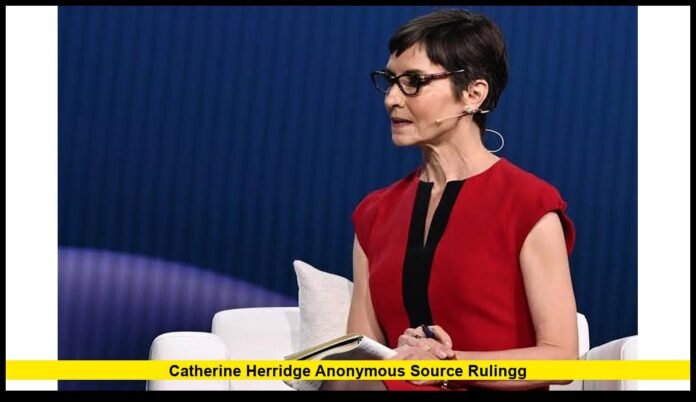

The catherine herridge anonymous source ruling has emerged as one of the most closely watched legal developments involving journalism, the First Amendment, and government transparency in the United States. As of July 2026, the case continues to generate nationwide discussion after the U.S. Supreme Court declined to halt a lower court order requiring veteran investigative journalist Catherine Herridge to face accumulating civil contempt fines for refusing to reveal a confidential source. Although the Court’s action did not decide the broader constitutional issues surrounding reporter’s privilege, it has intensified conversations about whether federal law should offer stronger protections for journalists who rely on anonymous sources while reporting on matters of public importance.
The dispute has become a defining example of the tension between protecting individual privacy rights and preserving the independence of investigative journalism. Media organizations, legal scholars, and civil liberties advocates continue to watch the case closely because its outcome could influence how future courts handle confidential sources in federal proceedings.
A Legal Battle Years in the Making
The origins of the dispute stretch back nearly a decade. In 2017, Catherine Herridge reported on an FBI counterintelligence investigation involving Yanping Chen, a Virginia-based scientist and educator. The reporting discussed concerns raised during a federal investigation examining alleged connections between Chen and the Chinese military.
Although federal authorities investigated the matter, no criminal charges were ever filed against Chen. Nevertheless, the publication of details related to the investigation led to a lengthy legal battle over how the information reached the media.
Chen later filed a lawsuit alleging that confidential government information had been improperly disclosed, arguing that the unauthorized release violated protections provided under the federal Privacy Act. To determine who leaked the information, attorneys sought testimony from Herridge regarding the identity of the confidential source who supplied information used in the reporting.
That request placed the journalist in a difficult position familiar to many investigative reporters: comply with a court order or protect a source whose identity had been promised confidentiality.
Why Catherine Herridge Refused to Identify Her Source
Throughout the litigation, Herridge has maintained that protecting confidential sources is a core principle of responsible investigative journalism. She has argued that revealing a source under court pressure could undermine the trust necessary for reporters to gather information on matters affecting the public interest.
Anonymous sources have historically played an important role in exposing government misconduct, national security failures, corporate wrongdoing, and public corruption. In many situations, individuals are willing to share sensitive information only if they believe their identities will remain protected.
Journalists and news organizations frequently contend that breaking those promises may discourage future whistleblowers from coming forward. According to supporters of Herridge’s position, the willingness of confidential sources to speak often depends on confidence that reporters will defend their anonymity, even when doing so creates personal legal risks.
For investigative reporters working in national security, intelligence, or federal law enforcement, confidential sourcing remains one of the most important tools for informing the public about issues that might otherwise remain hidden.
Court Orders and Civil Contempt
As the lawsuit progressed, federal courts determined that identifying the source was essential to resolving Chen’s claims. Judges concluded that alternative methods had not successfully revealed who disclosed the information and that compelling testimony from Herridge was necessary.
When Herridge declined to answer questions about the source, the court held her in civil contempt rather than criminal contempt. The distinction is significant.
Civil contempt is designed to encourage compliance with a court order rather than punish past conduct. Instead of imposing a criminal sentence, the court established financial sanctions intended to pressure compliance.
The order required Herridge to pay an $800 daily fine until she either identified the confidential source or another court altered the ruling. Enforcement of those sanctions was temporarily delayed while appeals moved through the judicial system.
The accumulating daily penalties have become one of the most visible aspects of the case, highlighting the financial consequences journalists may face when refusing to disclose confidential information.
Supreme Court Declines Emergency Relief
One of the most closely followed developments occurred when the U.S. Supreme Court considered an emergency application seeking to pause enforcement of the contempt order.
Initially, Chief Justice John Roberts temporarily delayed implementation while the Court reviewed the request. That temporary administrative stay gave observers hope that the justices might take a broader look at the legal questions surrounding reporter’s privilege.
Ultimately, however, the Court declined to extend that relief.
By allowing the lower court’s order to remain in effect, the Supreme Court permitted enforcement of the daily contempt fines to continue. The Court did not issue a detailed opinion explaining its decision, leaving many constitutional questions unanswered.
Importantly, the denial of emergency relief did not establish a nationwide precedent defining the scope of reporter protections under the First Amendment. Instead, it allowed the existing lower court ruling to remain in force while the broader litigation continues.
Reporter’s Privilege Remains Unsettled
Many states have enacted statutes protecting journalists from being forced to reveal confidential sources under certain circumstances. Those laws vary considerably from one jurisdiction to another, with some providing stronger protections than others.
At the federal level, however, no single statute establishes uniform rules governing reporter’s privilege.
As a result, federal judges frequently balance competing interests when deciding whether journalists must comply with subpoenas. Factors often considered include the importance of the requested evidence, whether alternative sources of information exist, and the broader public interest served by protecting confidential reporting.
This case illustrates how those competing considerations can produce difficult legal questions with no universally accepted answers.
Privacy Rights Versus Press Freedom
At the center of the dispute lies a broader constitutional debate involving two significant public interests.
On one side are advocates for press freedom, who argue that investigative journalism depends upon the ability to guarantee confidentiality when circumstances require it. They contend that compelling reporters to identify sources may discourage future disclosures concerning government activities, public safety, or official misconduct.
On the other side are privacy advocates who argue that individuals harmed by unauthorized government disclosures deserve an opportunity to identify those responsible. If confidential federal records are improperly leaked, courts may conclude that discovering the source is essential to ensuring accountability.
The challenge for judges is determining when one interest should outweigh the other.
Neither principle exists in isolation. Courts must often balance the public’s interest in a free press against the rights of individuals seeking justice through the legal system.
Reaction Across the Journalism Industry
News organizations throughout the United States have closely followed the litigation because its outcome could influence future reporting practices.
Many media companies argue that confidential sourcing has helped uncover some of the country’s most significant stories over several decades. From investigations involving government misconduct to reporting on national security issues, anonymous sources have often provided information that would otherwise never become public.
Journalism organizations have expressed concern that compelling disclosure may create uncertainty for reporters attempting to assure potential sources that their identities will remain protected.
Legal experts note that even if relatively few journalists ultimately face contempt proceedings, highly publicized cases can have a broader impact on newsroom decision-making. Editors may become more cautious about granting confidentiality, while potential whistleblowers could hesitate before contacting reporters.
The result, critics argue, could be fewer investigative stories reaching the public.
Why the Case Matters Beyond Journalism
Although much of the attention has focused on reporters’ rights, the litigation carries implications extending beyond the news industry.
Government agencies routinely handle sensitive personal information concerning employees, contractors, researchers, and private citizens. Unauthorized disclosure of that information can cause significant professional and personal consequences.
Individuals whose confidential records are leaked may reasonably seek legal remedies and attempt to identify those responsible.
Courts therefore face the difficult task of protecting legitimate privacy interests while avoiding unnecessary restrictions on investigative reporting.
The balance between those objectives continues to evolve through individual cases rather than comprehensive federal legislation.
Calls for a Federal Shield Law
The Herridge litigation has renewed discussions in Congress regarding possible federal legislation protecting journalists from compulsory disclosure of confidential sources.
Lawmakers have introduced various shield law proposals over the years, but none has become permanent federal law.
Supporters argue that a nationwide standard would create greater consistency across federal courts while offering journalists clearer legal guidance.
Proponents also believe such legislation would strengthen investigative reporting by assuring confidential sources that courts would recognize qualified protections under clearly defined circumstances.
Opponents, however, caution that absolute protections could interfere with legitimate judicial investigations where identifying a source is necessary to resolve significant legal disputes.
As Congress continues debating the issue, the absence of a uniform federal standard means courts will likely continue deciding these cases individually.
Potential Long-Term Impact
Legal scholars believe the outcome of this dispute could influence future litigation involving journalists, government agencies, and confidential information.
News organizations may devote greater attention to documenting why anonymity is granted to particular sources. Legal departments could become more involved in reviewing investigative reporting before publication, particularly when stories rely on sensitive government information.
Whistleblowers may also pay closer attention to developments in the courts before deciding whether to approach journalists with confidential information.
At the same time, attorneys representing individuals whose information has allegedly been leaked may view the case as demonstrating that courts are sometimes willing to compel testimony from reporters when alternative evidence cannot be obtained.
Regardless of how future proceedings unfold, the litigation has already become one of the most significant modern cases involving confidential sources in federal court.
What Could Happen Next
The Supreme Court’s recent action does not necessarily mark the conclusion of the legal battle.
Additional proceedings remain possible in the lower courts, and future appeals could address constitutional issues that were not resolved through the emergency application.
Congress may also revisit proposals for federal shield legislation as lawmakers respond to concerns raised by journalism organizations and civil liberties advocates.
Legal experts expect the case to remain part of ongoing national discussions regarding First Amendment protections, government transparency, privacy rights, and the responsibilities of investigative reporters.
Whether future courts strengthen, limit, or redefine reporter’s privilege, the decisions made in this litigation will likely be examined for years by journalists, attorneys, policymakers, and constitutional scholars.
Conclusion
The catherine herridge anonymous source ruling represents far more than a dispute involving a single journalist. It highlights the continuing struggle to balance the public’s interest in vigorous investigative reporting with the legal rights of individuals seeking accountability for unauthorized disclosures of sensitive government information. As federal courts continue addressing questions surrounding confidential sources and reporter’s privilege, the case stands as an important reminder that the relationship between press freedom and the judicial system remains one of the most complex areas of American constitutional law. Whatever the final outcome, the decisions reached in this litigation are expected to shape discussions about journalism, privacy, and the First Amendment well into the future.