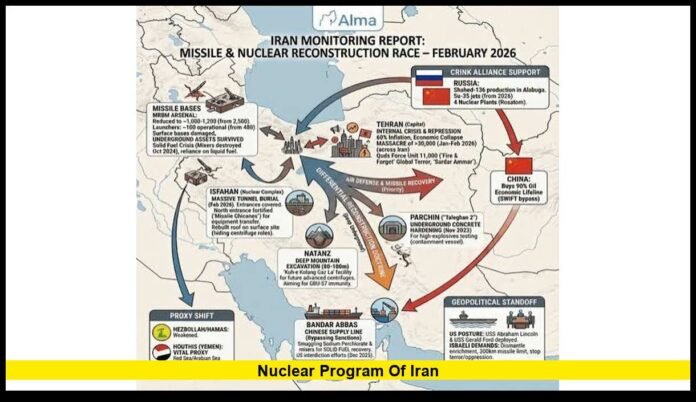

The nuclear program of Iran remains one of the most important international security issues in 2026. For decades, it has been at the center of diplomatic negotiations, economic sanctions, military tensions, and debates over nuclear non-proliferation. Recent events have once again placed Iran’s nuclear activities under intense global scrutiny, as governments and international organizations continue to assess the country’s uranium enrichment capabilities, damaged nuclear infrastructure, and future intentions.
While Iran maintains that its nuclear activities are exclusively for peaceful purposes, many Western governments and regional powers continue to monitor the program closely. As of today, there is no official confirmation that Iran possesses an operational nuclear weapon, although international inspectors continue evaluating its nuclear activities and enriched uranium inventory.
Overview of Iran’s Nuclear Program
Iran’s nuclear program began during the late 1950s under the U.S.-supported “Atoms for Peace” initiative. The country’s early nuclear activities focused on scientific research and civilian energy production.
Following the 1979 Islamic Revolution, many nuclear projects slowed before gradually restarting during the following decades. By the early 2000s, previously undisclosed nuclear facilities attracted international attention and led to extensive inspections by the International Atomic Energy Agency (IAEA).
Since then, Iran’s nuclear program has remained one of the world’s most closely monitored nuclear initiatives.
Why the Nuclear Program Matters
Iran occupies a strategically important location in the Middle East. Its nuclear capabilities influence regional security, global energy markets, international diplomacy, and military planning.
Several factors explain why the issue receives worldwide attention:
- Regional security concerns
- International nuclear non-proliferation efforts
- Global oil and energy markets
- Economic sanctions
- Diplomatic negotiations
- Military stability in the Middle East
Because of these factors, developments involving Iran’s nuclear facilities frequently become major international news.
Timeline of Major Developments
Iran’s nuclear program has evolved over several decades.
1957–1979
- Nuclear cooperation begins under the Atoms for Peace initiative.
- Iran starts civilian nuclear research.
- Construction plans for nuclear power facilities begin.
1980s–1990s
Following the Islamic Revolution and the Iran-Iraq War, nuclear development resumed with assistance from several international partners.
2002
Previously undisclosed enrichment facilities became public, leading to increased international inspections and diplomatic negotiations.
2015
Iran and six world powers reached the Joint Comprehensive Plan of Action (JCPOA), which placed restrictions on uranium enrichment in exchange for sanctions relief.
2018
The United States withdrew from the nuclear agreement and reinstated sanctions. Iran gradually reduced compliance with several commitments under the agreement.
2020–2025
Iran expanded uranium enrichment, installed advanced centrifuges, and increased its enriched uranium stockpile while diplomatic efforts struggled to restore a comprehensive agreement.
2026
Military operations targeting parts of Iran’s nuclear infrastructure, along with continued international inspections, have become the latest major developments affecting the program.
Major Nuclear Facilities
Iran operates several significant nuclear sites.
Natanz Enrichment Facility
Natanz remains Iran’s primary uranium enrichment center. Thousands of centrifuges have operated at the site over the years.
The facility has experienced multiple sabotage incidents and has undergone reconstruction and modernization efforts.
Fordow Fuel Enrichment Plant
Fordow is located deep underground inside a mountain.
Its protected location has made it one of Iran’s most strategically important nuclear facilities.
Iran has continued enrichment activities at Fordow despite international concerns.
Isfahan Nuclear Technology Center
This facility performs uranium conversion and supports multiple stages of Iran’s nuclear fuel cycle.
It also houses research laboratories and fuel-processing infrastructure.
Bushehr Nuclear Power Plant
Bushehr is Iran’s only commercial nuclear power station currently generating electricity.
Unlike enrichment facilities, Bushehr operates under internationally monitored civilian nuclear arrangements.
Arak Heavy Water Reactor
The reactor at Arak has been modified under previous international agreements to reduce concerns regarding plutonium production.
Understanding Uranium Enrichment
Uranium enrichment is the primary issue surrounding Iran’s nuclear activities.
Natural uranium contains only a small percentage of uranium-235.
Through enrichment, that percentage increases depending on the intended purpose.
Low-enriched uranium is commonly used for civilian nuclear power plants.
Higher enrichment levels support specialized research applications.
Weapons-grade uranium requires much higher enrichment combined with additional weaponization steps.
Possessing highly enriched uranium alone does not mean a country has developed a nuclear weapon.
Advanced Centrifuge Technology
Iran has significantly expanded its use of advanced centrifuges during recent years.
Compared with older machines, newer centrifuges enrich uranium faster and more efficiently.
International inspectors continue monitoring:
- Centrifuge production
- Installation of advanced models
- Operational capacity
- Enrichment output
These developments remain central to ongoing diplomatic discussions.
Read More – US Iran News: Trump Administration Pushes Forward With High-Stakes Talks as Middle East Tensions Continue
Role of the International Atomic Energy Agency
The International Atomic Energy Agency (IAEA) remains responsible for verifying Iran’s declared nuclear activities.
Inspectors examine:
- Nuclear material inventories
- Uranium enrichment levels
- Facility operations
- Monitoring equipment
- Safeguards compliance
The agency continues discussions with Iranian officials regarding access, transparency, and verification procedures.
Several unresolved issues remain under review, and inspectors continue gathering technical information.
The JCPOA and Its Legacy
The Joint Comprehensive Plan of Action represented one of the most significant diplomatic agreements concerning Iran’s nuclear activities.
The agreement introduced limits on:
- Uranium enrichment
- Enriched uranium stockpiles
- Centrifuge numbers
- Nuclear facility operations
It also established extensive inspection procedures.
Following the U.S. withdrawal in 2018, implementation gradually weakened as negotiations to restore the agreement failed to achieve a comprehensive breakthrough.
Sanctions and Their Economic Impact
Economic sanctions have affected nearly every major sector of Iran’s economy.
Areas impacted include:
- Oil exports
- Banking
- International investment
- Manufacturing
- Shipping
- Aviation
- Foreign trade
Iran has repeatedly called for sanctions relief as part of future diplomatic negotiations.
Many international governments continue linking sanctions policy to nuclear verification measures.
Latest Developments in 2026
Several important developments have shaped the current status of Iran’s nuclear program.
Damage to Nuclear Infrastructure
Earlier this year, multiple nuclear-related sites experienced significant military strikes.
Independent assessments indicate that portions of enrichment infrastructure were damaged.
However, officials have not released a complete assessment of operational capabilities at every facility.
Some infrastructure appears repairable, while additional inspections continue.
Continued Monitoring
The IAEA continues evaluating Iran’s nuclear material and facility conditions.
Monitoring efforts remain ongoing despite operational challenges at some locations.
Inspectors continue working to verify declared nuclear materials and assess the condition of affected facilities.
Diplomatic Activity
Diplomatic contacts between Iran and several international governments continue despite ongoing political disagreements.
Although no comprehensive nuclear agreement has been announced, discussions regarding inspections, sanctions, and regional security remain active.
Regional Security
Recent military tensions have increased concerns throughout the Middle East.
Neighboring countries continue monitoring developments carefully because any significant changes in Iran’s nuclear capabilities could influence regional security calculations.
Iran’s Official Position
Iran consistently states that its nuclear program serves peaceful purposes.
Government officials maintain that:
- Nuclear energy supports electricity generation.
- Nuclear research benefits medicine and science.
- Uranium enrichment is permitted under international agreements.
- Iran is not pursuing nuclear weapons.
Iran has repeatedly rejected allegations that its nuclear activities are intended for military weapon development.
International Concerns
Several governments remain concerned about:
- High levels of uranium enrichment
- Reduced monitoring access during certain periods
- Expansion of centrifuge production
- Growing enriched uranium stockpiles
- Regional missile programs
International organizations continue emphasizing transparency, verification, and diplomatic engagement.
Impact on Global Energy Markets
Iran remains one of the world’s largest holders of oil and natural gas reserves.
Because of this, developments involving its nuclear program frequently affect:
- Global oil prices
- Shipping through the Strait of Hormuz
- Energy security
- International commodity markets
Even periods of diplomatic tension can influence investor confidence and market volatility.
Current Outlook
The future of Iran’s nuclear program depends on several interconnected factors.
These include:
- Continued cooperation with international inspectors
- Future diplomatic negotiations
- Regional security developments
- Economic sanctions
- Reconstruction of damaged facilities
As of July 2026, there remains no official confirmation that Iran has built or deployed an operational nuclear weapon. International monitoring organizations continue evaluating technical evidence while encouraging further transparency.
Diplomatic efforts remain challenging but continue alongside ongoing verification activities.
Final Thoughts
Iran’s nuclear program has evolved over more than six decades from a civilian research initiative into one of the world’s most significant geopolitical issues. It continues to influence international diplomacy, regional security, global energy markets, and nuclear non-proliferation efforts.
Although military tensions and diplomatic disagreements remain, international inspections and negotiations continue to play an important role in understanding the current state of Iran’s nuclear activities. As new developments emerge, governments and international organizations will continue closely monitoring the situation.
Stay informed as new developments unfold, and share your thoughts in the comments below to join the conversation.