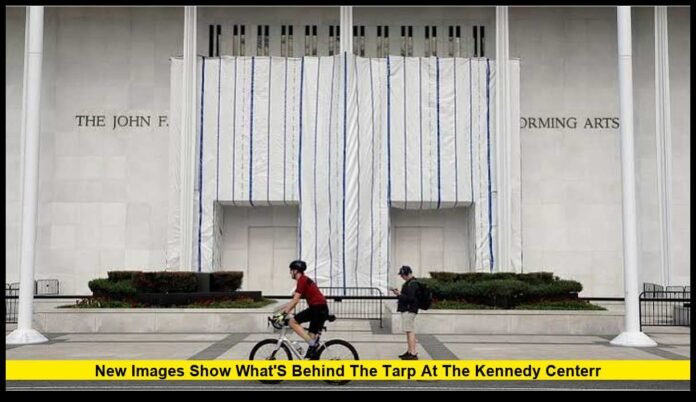

The latest developments surrounding new images show what’s behind the tarp at the kennedy center have sparked renewed public interest in one of Washington, D.C.’s most recognizable cultural landmarks. Newly released photographs have provided a clearer view of the area that had been hidden behind a large tarp for weeks, ending widespread curiosity about what was taking place on the building’s exterior. The images reveal a noticeably different appearance on a section of the facade that became the focus of legal disputes, public debate, and intense media attention throughout recent months.
The Kennedy Center has long served as a symbol of American arts and culture. However, recent events transformed the venue from a performing arts destination into the center of a national conversation involving governance, legal authority, public symbolism, and the future identity of a federally recognized institution. As construction crews continue working around portions of the exterior, the photographs have given the public its most detailed look yet at the changes that occurred behind the covering.
What started as a simple construction project quickly evolved into a story watched by people across the country. The newly visible facade now offers insight into the latest chapter of a controversy that has attracted attention from political observers, arts supporters, legal experts, and visitors alike.
A Landmark Hidden Behind Scaffolding
For weeks, visitors approaching the Kennedy Center noticed something unusual. Large sections of scaffolding and protective coverings obscured part of the building’s exterior, limiting visibility from public walkways and nearby roads.
The tarp quickly became a subject of speculation. People visiting performances, attending events, or simply touring Washington’s cultural landmarks wondered what exactly was happening behind the covering. While maintenance work was cited as one reason for the installation, the timing coincided with major developments involving the building’s exterior signage.
Because the area remained concealed, photographs taken from a distance revealed little. Curiosity continued to grow as workers spent days operating behind the barriers.
The recent release of new images finally provided a direct look at the area that had remained hidden from public view.
What the New Photos Show
Where signage previously appeared, observers can now see exposed sections of the exterior surface. The images show that the lettering that once occupied the space is no longer present. Instead, the facade displays blank panels and attachment points where components had previously been mounted.
Construction equipment and maintenance materials remain visible in some portions of the photographs, suggesting that work is still underway even after the removal process was completed.
For many observers, the photos answered a question that had persisted for weeks: what exactly remained behind the tarp after workers finished removing the signage?
The answer appears straightforward. The building now shows the original exterior surface without the lettering that had become the center of legal and political disputes.
How the Situation Developed
The controversy surrounding the Kennedy Center did not emerge overnight.
The institution became the focus of national attention following decisions involving leadership, governance, and branding. Changes implemented by the governing board led to the installation of new signage on portions of the property.
Supporters viewed the move as an expression of the board’s authority. Critics argued that changing the identity associated with a national cultural institution required additional legal approval.
As public debate intensified, legal challenges followed. The dispute eventually reached federal courts, where judges examined questions surrounding authority, governance, and the institution’s legal framework.
The resulting rulings significantly influenced the future of the signage and ultimately led to the removal process that attracted so much attention.
Why the Kennedy Center Matters
Few arts institutions carry the national significance of the Kennedy Center.
Located along the Potomac River in Washington, D.C., the venue hosts hundreds of performances, educational programs, ceremonies, and cultural events each year. Visitors from across the United States and around the world attend concerts, theatrical productions, dance performances, and special celebrations at the center.
The institution was established as a living memorial honoring President John F. Kennedy. Since opening its doors, it has become one of America’s most recognizable cultural venues.
Because of its unique status, changes involving the building often attract public interest that extends far beyond the arts community.
The recent dispute demonstrated just how closely Americans watch developments connected to the institution.
The Role of the Tarp in the Public Conversation
Construction tarps rarely become national news.
In this case, however, the covering became one of the most discussed elements of the story.
The tarp prevented passersby from witnessing the work taking place behind it. As a result, public curiosity continued to grow. Social media discussions, visitor comments, and public debates frequently centered on what exactly remained hidden behind the protective barrier.
Some viewed the covering as a standard construction measure designed to protect workers and materials. Others believed it contributed to the mystery surrounding the removal process.
Regardless of interpretation, the tarp became a visual symbol of a larger controversy.
The release of the latest photographs effectively ended much of the speculation by revealing the current condition of the facade.
Exterior Work Continues
Although the photographs show the results of the signage removal, they also indicate that work around the facade is not fully complete.
Maintenance crews continue operating in portions of the affected area. Scaffolding remains visible in several sections of the building, suggesting that restoration and exterior improvements are ongoing.
Large institutional buildings often require extensive maintenance programs involving stone surfaces, structural components, waterproofing systems, and architectural features. Projects of this scale can take weeks or even months to finish.
Visitors arriving at the Kennedy Center may therefore continue to encounter construction equipment and temporary coverings for some time.
Officials have not publicly announced a final date for the complete removal of all scaffolding and protective barriers.
Public Interest Remains High
One reason the story continues attracting attention is the broad range of issues involved.
The Kennedy Center sits at the intersection of culture, government, history, and public identity. As a result, developments involving the institution frequently resonate with multiple audiences.
Arts supporters follow changes because of the center’s cultural significance.
Legal observers monitor the story because of the court rulings connected to governance questions.
Political audiences remain interested because of the public figures involved and the national attention surrounding the dispute.
Meanwhile, ordinary visitors simply want to know why part of one of Washington’s most famous buildings has been hidden behind a tarp.
The combination of these factors transformed a construction project into a widely discussed national story.
How Visitors Have Reacted
Visitors to the Kennedy Center have expressed a variety of reactions since the photographs emerged.
Some see the images as a long-awaited answer to a mystery that dominated conversations around the venue for weeks. Others focus more on the broader issues surrounding the decisions that led to the changes.
Tourists often stop outside the building to photograph the facade and observe ongoing work. The release of the new images has encouraged additional interest among visitors hoping to compare the photographs with the current appearance of the structure.
Many visitors also view the situation as part of the Kennedy Center’s evolving history.
Over decades, the institution has experienced leadership changes, renovations, expansions, and cultural milestones. The current controversy now joins that long list of notable moments.
The Importance of Institutional Identity
The debate surrounding the facade highlights a larger question faced by many historic institutions: how should they balance tradition, governance decisions, and public expectations?
For organizations with national significance, physical changes to buildings often carry symbolic meaning. Names, monuments, signage, and architectural features can become closely tied to public perception.
That reality helps explain why modifications to a single section of the Kennedy Center generated such widespread attention.
The discussion extended beyond architecture and construction. It touched on broader questions involving heritage, governance, and the role of public institutions in American life.
The newly released photographs provide a visual record of the latest outcome in that ongoing conversation.
Why the Images Matter
Photos often shape public understanding more effectively than official statements.
For weeks, people heard descriptions of what was happening behind the tarp. Yet many remained uncertain because they had not seen the area themselves.
The new photographs changed that dynamic immediately.
Instead of relying on descriptions, viewers can now observe the facade directly. The images provide tangible evidence of the building’s current appearance and help clarify what changes occurred during the construction period.
As a result, the photos have become an important part of the broader story.
They offer a visual update at a moment when public interest remains strong and questions continue regarding the future appearance of the building.
What Comes Next for the Kennedy Center
Attention now shifts toward the next stage of developments at the institution.
Construction crews are expected to continue exterior work until maintenance projects conclude. Once scaffolding and tarps are removed, visitors will gain an unobstructed view of the facade for the first time since the controversy began.
Beyond the physical changes, broader discussions surrounding governance, programming, leadership, and the future direction of the Kennedy Center are likely to continue.
As one of the nation’s most prominent cultural institutions, the venue remains under close public scrutiny. Every major development attracts attention from audiences far beyond Washington, D.C.
For now, the latest images provide the clearest indication yet of how the building looks after the removal work that captured national headlines.
The photographs show a facade that has entered a new chapter in the Kennedy Center’s history. While construction activity continues, the mystery surrounding the covered area has largely been resolved.
For readers searching for updates on new images show what’s behind the tarp at the kennedy center, the latest photographs offer the strongest visual evidence yet of the changes that occurred behind the protective covering and why the story continues to generate interest across the country.