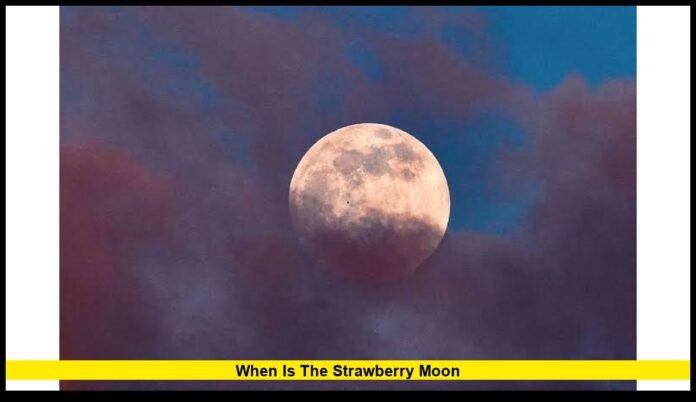

If you have been searching for when is the strawberry moon, the 2026 event is set for June 29, bringing one of the year’s most anticipated full moons to skies across the United States. Every June, millions of people look up to witness this seasonal lunar event, which has become a favorite among stargazers, photographers, and families enjoying warm summer evenings.
The Strawberry Moon marks the full moon that occurs during June. Despite the colorful name, the moon does not actually appear pink like a strawberry. Instead, the title comes from centuries-old traditions connected to the annual strawberry harvest season in North America. As summer begins, this full moon serves as a reminder of changing seasons and remains one of the most recognizable lunar events on the calendar.
Understanding the Strawberry Moon
The Strawberry Moon is the traditional name for June’s full moon. Like other full moons throughout the year, it carries a name that reflects seasonal changes observed long before modern calendars became common.
Communities across North America used lunar cycles to track important agricultural events. June was known as the time when wild strawberries became ripe for harvesting. As a result, the full moon that appeared during this period became known as the Strawberry Moon.
Today, the name continues to be widely used by astronomy organizations, observatories, educators, and skywatchers.
Unlike eclipses or rare planetary alignments, the Strawberry Moon is an annual event. Even so, it attracts significant attention because it arrives during one of the most pleasant times of year for outdoor viewing.
When Does the Strawberry Moon Happen in 2026?
The Strawberry Moon reaches its full phase on Monday, June 29, 2026.
For people across the United States, the moon will be visible throughout the night, beginning with moonrise shortly after sunset. The exact moonrise time depends on location, but observers from coast to coast will have an opportunity to see the lunar display.
2026 Strawberry Moon Overview
| Event | Information |
|---|---|
| Moon Name | Strawberry Moon |
| Date | June 29, 2026 |
| Lunar Phase | Full Moon |
| Visible In | United States and worldwide |
| Best Viewing Period | Shortly after moonrise |
| Season | Early Summer |
Because the moon rises near sunset during its full phase, viewers can enjoy hours of observation without needing special equipment.
Why Is It Called the Strawberry Moon?
Many people assume the name relates to the moon’s appearance. In reality, the title comes from seasonal harvest traditions.
Wild strawberries typically reached maturity during June in parts of North America. Indigenous communities and early settlers recognized this annual pattern and used the moon as a natural marker for the harvest season.
The naming tradition reflects the close relationship that earlier generations maintained with the natural world. Before digital calendars, people often relied on seasonal signs in the sky to help organize farming activities and community events.
The Strawberry Moon became one of several full moon names that survived into modern times.
Other Traditional Names for the June Full Moon
Different regions and cultures developed their own names for June’s full moon.
Some of the most widely recognized alternatives include:
- Rose Moon
- Honey Moon
- Mead Moon
- Blooming Moon
- Green Corn Moon
- Hot Moon
Each name reflects local climate conditions, agricultural practices, or cultural traditions.
While Strawberry Moon remains the most popular name in the United States, these alternative titles continue to appear in historical records and astronomical discussions.
Does the Strawberry Moon Turn Pink?
One of the most common questions asked every year concerns the moon’s color.
The answer is simple: no, the Strawberry Moon does not normally turn pink.
The name refers to strawberries, not the moon’s appearance.
However, people often notice rich orange, amber, or reddish colors during moonrise. This happens because the moon sits low on the horizon. Light traveling through Earth’s atmosphere scatters in a way that can produce warm tones.
Several factors may influence the moon’s color:
- Atmospheric moisture
- Dust particles
- Smoke in the air
- Haze near the horizon
- Local weather conditions
As the moon rises higher, these colors usually fade and the moon returns to its familiar bright white appearance.
Why the Moon Looks So Large During Moonrise
Many observers report that the Strawberry Moon seems unusually large when it first appears.
Scientists call this effect the Moon Illusion.
The moon is not actually growing larger. Instead, the human brain compares the moon with nearby objects such as:
- Buildings
- Trees
- Hills
- City skylines
- Mountains
These visual references make the moon appear much bigger than it truly is.
When the moon climbs higher into the sky and loses those comparison points, it appears smaller even though its actual size remains unchanged.
This optical illusion has fascinated people for centuries and remains one of the most discussed aspects of full moon viewing.
The Science Behind a Full Moon
A full moon occurs when Earth is positioned between the Sun and the Moon.
During this alignment:
- The Moon’s Earth-facing side becomes fully illuminated.
- The lunar disk appears complete.
- Moonrise occurs near sunset.
- Moonset happens near sunrise.
This arrangement creates the bright, round appearance associated with a full moon.
The cycle repeats approximately every 29.5 days, producing a new full moon each month.
While every full moon follows the same basic scientific process, each one receives a unique traditional name based on the time of year.
Why the Strawberry Moon Attracts So Much Attention
Several factors make June’s full moon especially popular.
First, it arrives near the beginning of summer in the Northern Hemisphere. Warmer temperatures encourage people to spend more time outdoors.
Second, longer daylight hours often create dramatic moonrise photography opportunities. The combination of colorful twilight skies and a bright full moon can produce stunning images.
Third, the Strawberry Moon carries a memorable name that sparks curiosity among people who may not regularly follow astronomy news.
As a result, the event consistently generates interest across social media, local communities, and astronomy groups.
Read More – Full Strawberry Moon 2026: Date, Time, Meaning, and How to Watch June’s Most Stunning Full Moon
Best Places in the United States to Watch the Strawberry Moon
The Strawberry Moon is visible throughout the country, but some locations offer particularly impressive views.
Coastal Areas
Ocean horizons provide unobstructed moonrise views.
National Parks
Parks often have darker skies and less light pollution.
Lakeshores
Water reflections create beautiful visual effects.
Rural Communities
Countryside settings improve visibility and reveal more lunar detail.
Mountain Overlooks
Higher elevations can offer panoramic views of the horizon.
People living in cities can still enjoy the moon, although bright urban lighting may reduce overall sky visibility.
Tips for Viewing the Strawberry Moon
Watching the Strawberry Moon requires very little preparation.
For the best experience:
- Find a location with a clear eastern horizon.
- Arrive before sunset.
- Check local weather conditions.
- Bring binoculars if available.
- Allow your eyes to adjust to the darkness.
Even without equipment, the moon’s brightness makes it easy to enjoy.
Many viewers simply relax outdoors and watch the moon rise above the horizon.
How to Photograph the Strawberry Moon
Photographers often plan weeks in advance for the June full moon.
Capturing high-quality images requires timing and preparation.
Choose a Good Foreground
Including landmarks, trees, bridges, or buildings can create dramatic compositions.
Use a Stable Platform
A tripod helps prevent camera shake.
Photograph Moonrise
The moon often appears most colorful and visually striking shortly after rising.
Use Manual Settings
Controlling exposure can reveal greater detail on the lunar surface.
Scout Locations Early
Finding a suitable viewing area before sunset can improve results.
Modern smartphones can also capture impressive moon images when used with night photography features.
The Strawberry Moon and Seasonal Change
For many Americans, the Strawberry Moon symbolizes the transition into summer.
By late June:
- Schools have ended for summer break.
- Vacation season is underway.
- Outdoor festivals become more common.
- Warmer weather spreads across much of the country.
The appearance of June’s full moon often coincides with these seasonal changes.
Its timing has helped maintain its cultural significance for generations.
Common Myths About the Strawberry Moon
The popularity of the Strawberry Moon has led to several misunderstandings.
Myth: The Moon Turns Bright Red
Although the moon can appear orange near the horizon, it does not become bright red because of its name.
Myth: It Is the Largest Full Moon of the Year
The Strawberry Moon is not automatically larger than other full moons.
Myth: It Is a Rare Lunar Event
The Strawberry Moon occurs every June.
Myth: Special Equipment Is Required
Anyone can view the moon without telescopes or binoculars.
Understanding these facts helps viewers appreciate the event for what it truly is: a beautiful annual full moon connected to seasonal traditions.
Full Moon Names Throughout the Year
The Strawberry Moon is one part of a year-long lunar naming tradition.
Here are the commonly recognized full moon names:
| Month | Full Moon Name |
| January | Wolf Moon |
| February | Snow Moon |
| March | Worm Moon |
| April | Pink Moon |
| May | Flower Moon |
| June | Strawberry Moon |
| July | Buck Moon |
| August | Sturgeon Moon |
| September | Harvest Moon |
| October | Hunter’s Moon |
| November | Beaver Moon |
| December | Cold Moon |
These names continue to help connect modern observers with historical traditions.
Why the 2026 Strawberry Moon Stands Out
The 2026 Strawberry Moon arrives during a period when interest in astronomy remains strong across the United States.
Public observatories, astronomy clubs, photographers, and casual skywatchers are expected to observe the event.
Its appearance near the start of summer gives people an ideal opportunity to spend time outdoors while enjoying a natural spectacle that has fascinated humanity for centuries.
The event combines science, history, culture, and seasonal tradition in a way that few astronomical occurrences can match.
Whether viewed from a city park, a beach, a mountain trail, or a backyard, the Strawberry Moon offers a reminder of the predictable rhythms of nature and the beauty of the night sky.
Looking Ahead After the Strawberry Moon
Once June’s full moon passes, skywatchers can begin anticipating the Buck Moon in July.
Each full moon carries its own history and significance, but the Strawberry Moon remains one of the most beloved annual lunar events because of its connection to summer and its rich cultural heritage.
As June comes to a close, millions of Americans will once again look skyward to watch the bright full moon rise and mark another chapter in the ongoing cycle of the seasons.
Will you be watching the Strawberry Moon this year? Share your favorite moon-viewing traditions and return for more updates on upcoming celestial events.