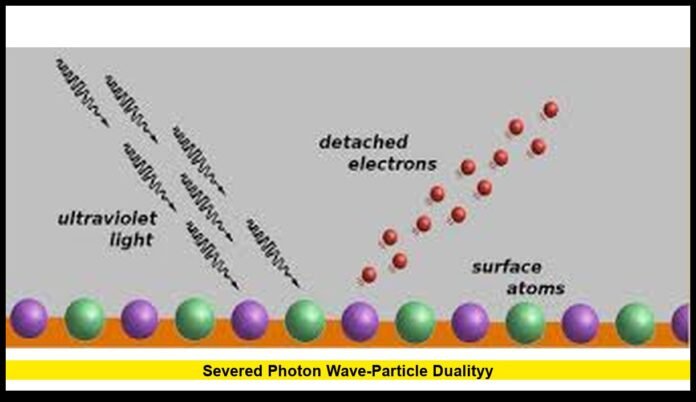

The study of severed photon wave-particle duality is attracting renewed attention across the scientific community as researchers continue to uncover new details about the fundamental behavior of light. Recent advances in quantum physics have provided deeper insight into how photons display both wave-like and particle-like characteristics, helping scientists refine some of the most important theories in modern science.
For more than a century, wave-particle duality has stood at the center of quantum mechanics. It challenges traditional ideas about how objects should behave and continues to inspire experiments that push the boundaries of human knowledge. Today, sophisticated quantum laboratories around the world are using advanced instruments to investigate the nature of photons with unprecedented precision.
As discoveries emerge from these experiments, researchers are gaining a clearer picture of the mechanisms that govern quantum systems. These findings could influence future technologies ranging from quantum computers and secure communications to advanced medical imaging and ultra-sensitive sensors.
The Long-Standing Mystery of Light
Light has fascinated scientists for centuries. Early theories described light as a wave because it exhibited behaviors such as interference and diffraction. These properties could be observed when light passed through narrow openings or interacted with other waves.
Later discoveries revealed another side of light. Experiments showed that light could also behave like a stream of particles called photons. These particles carried specific amounts of energy and interacted with matter in ways that could not be explained by wave theories alone.
The realization that light possessed both wave and particle characteristics transformed physics. It forced scientists to abandon many assumptions about the natural world and laid the foundation for quantum mechanics.
Even after decades of research, questions remain about how these two descriptions fit together and what they reveal about reality itself.
Why Wave-Particle Duality Matters Today
Lasers, semiconductors, fiber-optic communication systems, and medical imaging equipment all rely on principles derived from quantum mechanics. Understanding the behavior of photons allows engineers to design devices that are faster, more accurate, and more efficient.
As governments and technology companies invest heavily in quantum research, the importance of understanding duality continues to grow. Scientists believe that a deeper grasp of quantum behavior could unlock entirely new forms of computing and communication.
This is one reason why recent investigations into photon behavior have generated significant interest within the scientific community.
The Double-Slit Experiment Remains Essential
One of the most famous demonstrations of wave-particle duality is the double-slit experiment.
In this experiment, light is directed toward a barrier containing two narrow openings. If photons behaved strictly as particles, they would pass through one slit or the other and create two distinct bands on a detection screen.
Instead, researchers observe an interference pattern that resembles the behavior of waves.
The result becomes even more surprising when photons are sent through the apparatus one at a time. Individual photons gradually build the same interference pattern over time.
This phenomenon suggests that each photon possesses quantum properties that cannot be fully explained by classical physics.
Modern versions of the experiment use advanced detectors, lasers, and quantum measurement systems to examine the behavior of individual photons with remarkable accuracy.
These refined experiments continue to reveal new information about how quantum systems operate.
Improved Measurements Are Changing the Field
Technological advances have dramatically improved scientists’ ability to observe quantum phenomena.
Researchers can now generate single photons on demand, track their movement, and measure quantum properties with extraordinary precision.
High-performance detectors allow physicists to collect data that was impossible to obtain just a few decades ago.
These improvements have enabled researchers to test theoretical predictions more rigorously and explore questions that were previously beyond experimental reach.
As measurement techniques continue to advance, scientists are discovering subtle details about photon behavior that help refine existing quantum theories.
Quantum Coherence Takes Center Stage
One of the most important concepts emerging from recent studies is quantum coherence.
Coherence refers to the ability of quantum systems to maintain specific relationships among different quantum states. When coherence remains intact, wave-like behavior becomes more visible.
When coherence decreases, particle-like characteristics tend to dominate.
Scientists increasingly view coherence as a key factor in understanding the balance between wave and particle properties.
Rather than treating these characteristics as separate identities, many researchers now describe them as different manifestations of a single quantum system.
This perspective helps explain why observations can vary depending on how measurements are performed.
The relationship between coherence and duality is becoming a major focus of contemporary quantum research.
How Observation Influences Quantum Behavior
One of the most intriguing aspects of quantum mechanics involves the role of observation.
Experiments repeatedly demonstrate that the act of measurement can affect the outcome of a quantum system.
When researchers obtain information about which path a photon follows, interference effects often disappear. When path information is unavailable, wave-like interference can return.
This relationship between information and physical behavior has sparked decades of scientific debate.
Modern experiments continue to investigate how measurements influence quantum systems and what these effects reveal about the underlying nature of reality.
Although scientists have made substantial progress, many questions remain open.
The Growing Importance of Quantum Information Science
Quantum information science has become one of the fastest-growing areas of research worldwide.
This field combines quantum mechanics, computer science, mathematics, and engineering to develop technologies that leverage quantum properties.
Photons play a central role in many quantum information systems because they can carry information across long distances while maintaining quantum characteristics.
Researchers are exploring ways to use photons for:
- Quantum communication
- Quantum cryptography
- Quantum networking
- Advanced sensing technologies
- Distributed quantum computing
A deeper understanding of wave-particle behavior could help improve the performance and reliability of these emerging systems.
Applications in Quantum Computing
Quantum computing represents one of the most promising technological frontiers.
Unlike traditional computers that process information using binary bits, quantum computers use quantum bits capable of representing multiple possibilities simultaneously.
This capability allows quantum systems to tackle certain problems far more efficiently than conventional machines.
Photons are considered attractive candidates for quantum computing because they move quickly, interact predictably, and can be integrated into optical systems.
Research into photon behavior helps scientists identify new ways to control quantum information and reduce errors during computation.
As quantum computing progresses from laboratory demonstrations toward practical applications, understanding photon dynamics becomes increasingly important.
New Perspectives on Fundamental Physics
The concept of severed photon wave-particle duality has become associated with broader discussions about the foundations of quantum theory.
Physicists continue to investigate whether wave and particle descriptions represent separate realities or simply different aspects of a deeper quantum framework.
Several theoretical approaches attempt to unify these descriptions through advanced mathematical models.
Some researchers focus on quantum fields as the underlying reality from which particle-like and wave-like effects emerge.
Others explore geometric or informational interpretations that describe quantum behavior without relying on traditional categories.
Although no single explanation has gained universal acceptance, ongoing work continues to generate valuable insights.
These efforts are helping scientists build a more complete understanding of the quantum world.
Photon Research and Secure Communications
Quantum communication is another area benefiting from advances in photon science.
Traditional communication systems can be vulnerable to interception or unauthorized access.
Quantum communication techniques use the laws of physics to enhance security.
Because quantum states can be disturbed by observation, attempts to intercept transmitted information become detectable.
Researchers are developing quantum networks that use photons to transmit information securely over long distances.
These systems could eventually provide unprecedented levels of data protection for governments, businesses, and individuals.
Understanding photon behavior is essential to making these technologies practical and scalable.
Impact on Advanced Imaging Technologies
Photon research is also influencing imaging science.
Quantum imaging techniques use quantum properties of light to capture information that may be difficult or impossible to obtain through conventional methods.
Researchers are exploring applications in:
- Medical diagnostics
- Biological research
- Materials science
- Industrial inspection
- Environmental monitoring
Enhanced knowledge of quantum light behavior can improve image quality, increase sensitivity, and enable entirely new imaging approaches.
These developments may lead to significant advances across multiple industries.
The Role of International Collaboration
Quantum research has become a global effort involving universities, research institutions, technology companies, and government agencies.
Scientists frequently collaborate across national borders to share expertise, experimental results, and theoretical insights.
Large-scale research initiatives are accelerating progress by providing access to advanced facilities and specialized equipment.
This collaborative environment has helped drive rapid advances in understanding quantum phenomena and developing practical applications.
The pace of discovery continues to increase as more organizations invest in quantum science and technology.
Challenges That Remain
Despite impressive progress, significant challenges remain.
Quantum systems are highly sensitive to environmental disturbances. Maintaining coherence for extended periods remains difficult.
Researchers must also overcome engineering obstacles related to scaling quantum technologies for widespread use.
Many theoretical questions about wave-particle duality remain unresolved as well.
Scientists continue to debate the interpretation of quantum mechanics and the meaning of measurement within quantum systems.
Addressing these challenges will require sustained research and innovation over the coming years.
What the Future May Hold
The future of photon research appears increasingly promising.
Advances in experimental methods, computational modeling, and quantum engineering are creating opportunities that did not exist a decade ago.
Researchers are developing new tools capable of probing quantum systems at unprecedented levels of detail.
These capabilities could lead to breakthroughs in computing, communications, sensing, and fundamental physics.
As scientists continue exploring the quantum world, our understanding of light and matter is likely to evolve further.
Each discovery adds another piece to a puzzle that has captivated physicists for generations.
A New Era for Quantum Science
The study of wave-particle duality remains one of the most fascinating areas of modern physics. Recent developments are helping researchers move beyond simplified descriptions and toward a deeper understanding of how quantum systems behave.
From quantum computers and secure communication networks to advanced imaging systems and fundamental scientific discoveries, the implications of this work extend far beyond the laboratory.
As research continues, photons remain at the center of efforts to uncover the rules that govern the microscopic universe. The insights gained from these investigations could shape the next generation of scientific and technological innovation while bringing humanity closer to understanding the true nature of reality.
What are your thoughts on the latest discoveries in quantum physics? Share your perspective and stay updated on the breakthroughs shaping the future of science and technology.