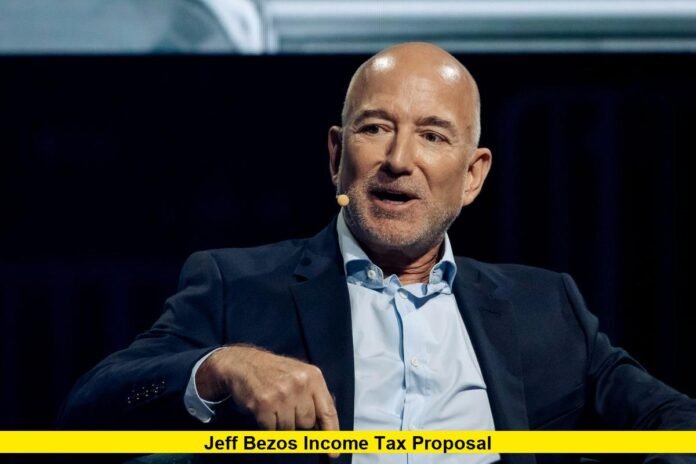

Amazon Executive Chairman Jeff Bezos has ignited a firestorm across Washington and Wall Street with a bold income tax proposal — one that could mean millions of Americans no longer owe a single dollar in federal income taxes. Speaking on CNBC’s Squawk Box on May 20, 2026, from Blue Origin’s Florida facilities, Bezos made a case that is simple, sweeping, and deeply polarizing: the bottom half of U.S. earners should pay zero federal income tax. Here is everything you need to know about the Jeff Bezos income tax proposal and what it could mean for the country.
What Exactly Did Jeff Bezos Propose?
The proposal is straightforward. Bezos argued that Americans who fall in the bottom 50% of earners — those with an adjusted gross income below roughly $53,801 — should be entirely exempt from federal income taxes. He was unambiguous in his phrasing, telling CNBC anchor Andrew Ross Sorkin: “I don’t think it should be 3%. I think it should be zero.”
Bezos was quick to point out that he does not want a reduction — he wants a full elimination. “I don’t want to reduce it, I want to eliminate it,” he said. “Zero is a much more powerful number than a small dollar amount.” He added that he plans to press the idea directly with President Donald Trump, bringing one of the most influential voices in American business into an already heated national tax debate.
The Numbers Behind the Proposal
Bezos grounded his argument in tax data. According to the Tax Foundation, citing the most recent IRS statistics, the bottom half of U.S. taxpayers accounted for just 3% of all federal income taxes paid, despite representing 12% of total adjusted gross income. The bottom half had an average adjusted gross income of nearly $54,000.
To illustrate why the change matters, Bezos used a vivid example: a nurse in New York City earning $75,000 a year. “Why is a nurse in Queens who makes $75,000 a year paying more than $1,000 a month in taxes?” he asked. “We shouldn’t be asking this nurse in Queens to send money to Washington. They should be sending her an apology. It really makes no sense.”
Approximately 76 million American households paid no federal income tax in 2025, according to the Tax Policy Center. Of those, 70% earned less than $75,000, and 45% earned less than $40,000 — many of whom already reduced their liability through the standard deduction, the earned income tax credit, and the child tax credit.
Why Bezos Says the Cost to Government Would Be Manageable
A central pillar of the Jeff Bezos income tax proposal is the claim that the revenue impact on the federal government would be relatively minor. Bezos described the income tax paid by lower earners as “a small amount of money for the government,” given the group’s 3% share of total federal income tax revenue.
He framed the current setup as economically irrational — the government collects a modest revenue slice from a group under significant financial pressure, while imposing real psychological and financial costs on working households. “When people are starting out and they’re struggling, stop taxing them,” he said. “We live in the wealthiest country in the world. We don’t need it.”
Bezos also argued the change could fuel entrepreneurship. He suggested that households no longer burdened by federal income taxes would have more capital to start small businesses, weather financial setbacks, and invest in their communities.
Reaction From Washington and Wall Street
The Jeff Bezos income tax proposal landed like a grenade in an already charged fiscal debate. Reactions spanned the political spectrum.
Financial commentator Anthony Pompliano praised the framing, pointing out the personal stakes for working households: “If you make $70,000 and you’re sending $10,000 or $12,000 to Washington, that’s an incredible amount of money that you need to live.” Pompliano also noted a broader trend of high-net-worth figures becoming more outspoken about federal fiscal policy, citing JPMorgan Chase CEO Jamie Dimon alongside Bezos as examples.
Critics, however, were quick to raise questions. With the U.S. national debt exceeding $39 trillion and the 10-year Treasury yield hovering near 4.57% as of late May 2026, some economists warned that further reducing the federal revenue base without corresponding spending cuts could worsen the country’s fiscal position. The personal savings rate had already fallen to 4.0% in the first quarter of 2026, down from 6.2% in early 2024, signaling stress across household finances.
Senator Elizabeth Warren, a Massachusetts Democrat, introduced the Ultra-Millionaire Tax Act of 2026 in March, which would impose an annual 2% tax on households worth more than $50 million, an additional 1% levy on billionaires, and a 40% exit tax on individuals worth more than $50 million who renounce U.S. citizenship. She and other progressive lawmakers have pushed back on the notion that reducing taxes at the bottom is meaningful without also raising revenue at the top.
New Jersey Senator Cory Booker offered a related but distinct proposal through the Keep Your Pay Act, which would make the first $75,000 of income tax-free for joint filers. “No income tax on the first $75,000 families earn would be a game changer for working people,” Booker said when he introduced the bill in March.
Bezos and the Billionaire Tax Debate
Bezos delivered his proposal in a climate where several Democratic-led states are actively exploring wealth taxes aimed squarely at people like him. A measure to impose a one-time 5% tax on California residents with a net worth of $1 billion or more gathered enough signatures to appear on the state ballot, according to CBS News. That proposal is just one of several efforts targeting the ultra-wealthy at the state and federal level.
Bezos, whose net worth is estimated at approximately $269 billion by Forbes, making him the world’s fourth-richest person, directly pushed back on suggestions that taxing billionaires would meaningfully help lower-income households. “You could double the taxes I pay, and it’s not gonna help that teacher in Queens, I promise you,” he said. He also called the current tax code an example of “crony capitalism,” arguing it is too heavily shaped by the influence of wealthy individuals and corporations.
Yet critics noted a striking irony. According to the Institute on Taxation and Economic Policy, Amazon received approximately $17.4 to $17.5 billion in federal corporate income tax subsidies in 2025, paying just 1.4% of its U.S. income in federal corporate income taxes rather than the standard 21% corporate rate. That figure represents about 10% of the total $180 billion in federal income tax subsidies for all publicly traded corporations in 2025. Amazon itself announced earlier this year that its annual tax bill fell from $9 billion to $1.2 billion between 2024 and 2025, largely due to provisions in the GOP-led One Big Beautiful Bill Act.
What the Current Tax Brackets Look Like
Under the 2025-2026 IRS tax brackets tied to the One Big, Beautiful Bill Act, single filers enter the 22% marginal bracket above $50,400 of income. The standard deduction for single filers stands at $16,100. The 10% bracket applies to the first $23,850 of income for married couples filing jointly, moving to 12% on income between $23,851 and $96,950. For context, U.S. per-capita disposable personal income reached $68,617 in the first quarter of 2026, placing millions of workers squarely in the income range Bezos is focused on.
Could the Proposal Actually Become Law?
As of June 2026, the Jeff Bezos income tax proposal remains a public call to action rather than legislation. No bill has been introduced in Congress that directly mirrors Bezos’ framing, though Senator Booker’s Keep Your Pay Act and several other bills touch on similar themes.
Bezos said he intends to raise the idea with President Trump, and his direct line to the White House has already been demonstrated through his business dealings and influence in political circles. Whether that translates into formal policy movement remains to be seen.
The broader backdrop is a Congress consumed by the fallout from the One Big, Beautiful Bill Act and ongoing battles over the federal budget, defense spending, and the debt ceiling. Tax reform of the scale Bezos envisions would require navigating significant legislative and fiscal headwinds — particularly in a political environment where both parties are deeply divided on how to address the growing national debt.
FAQ
What is the Jeff Bezos income tax proposal? Bezos proposed in a May 2026 CNBC interview that the bottom 50% of American earners — those making under roughly $53,801 — should pay zero federal income tax, arguing the revenue impact is minimal and the benefit to working households would be significant.
How much do the bottom 50% of earners currently pay in federal income taxes? According to IRS data cited by the Tax Foundation, the bottom half of taxpayers paid approximately 3% of all federal income taxes in the most recent available year, while accounting for about 12% of total adjusted gross income.
Did Bezos say he would push this with President Trump? Yes. During his CNBC interview, Bezos stated he planned to press the proposal directly with President Trump.
What is the Ultra-Millionaire Tax Act of 2026? Introduced by Senator Elizabeth Warren in March 2026, the bill would impose a 2% annual tax on households worth over $50 million, a 1% surcharge on billionaires, and a 40% exit tax on high-net-worth individuals who renounce U.S. citizenship.
How much did Amazon save in taxes in 2025? According to reporting by Politico, Amazon’s annual federal tax bill fell from $9 billion to $1.2 billion between 2024 and 2025, largely due to provisions in the One Big, Beautiful Bill Act.
How many American households already pay no federal income tax? Approximately 76 million American households paid no federal income tax in 2025, according to the Tax Policy Center. Many reduced their liability through the standard deduction, earned income tax credit, and child tax credit.
Is the Bezos tax proposal currently before Congress? No. As of June 2026, no bill directly reflecting Bezos’ proposal has been introduced in Congress, though related legislation such as Senator Booker’s Keep Your Pay Act touches on similar ideas.
What do you think — should the bottom 50% of Americans be completely exempt from federal income taxes, or does the math simply not add up? Drop your thoughts in the comments below and follow us for the latest updates on this developing tax debate.