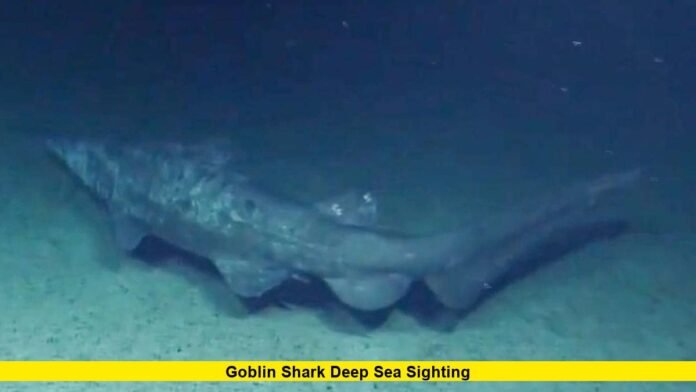

Marine researchers and ocean enthusiasts are once again fascinated by a rare goblin shark deep sea sighting, an event that highlights just how little is known about the vast ecosystems hidden beneath the ocean’s surface. Encounters with this unusual species remain uncommon, making every documented appearance an important moment for scientists studying life in the deep sea.
Unlike coastal shark species that are frequently observed near beaches and reefs, goblin sharks spend most of their lives in remote underwater environments far beyond the reach of ordinary exploration. Their elusive nature has earned them a reputation as one of the most mysterious creatures inhabiting Earth’s oceans.
A Living Relic From the Ancient Oceans
The goblin shark is often described as a prehistoric survivor. Scientists believe its evolutionary lineage extends back tens of millions of years, allowing it to retain characteristics rarely seen in modern shark species.
Its appearance immediately sets it apart. The shark’s elongated snout, soft body, and highly specialized jaws create a profile unlike almost any other marine predator. These traits have helped it adapt to life in dark, high-pressure environments where food can be scarce and visibility is virtually nonexistent.
Researchers consider the species a valuable subject for understanding how marine life has evolved over geological time.
Why Scientists Pay Close Attention to Every Encounter
Deep-sea exploration remains one of the greatest challenges in marine science. Vast areas of the ocean floor have never been directly observed, and many species are known only from occasional sightings or specimens recovered by fishing operations.
When a goblin shark is observed, scientists gain a rare opportunity to gather information about its size, behavior, habitat preferences, and physical condition. Such observations contribute to a broader understanding of biodiversity in deep-water ecosystems.
Because encounters are infrequent, even a single observation can generate significant interest within the scientific community.
Built for Life in the Darkness
The goblin shark’s body reflects millions of years of adaptation to an environment where sunlight never reaches.
One of its most remarkable features is its ability to extend its jaws forward with extraordinary speed. This feeding mechanism allows the shark to capture prey before it can react, providing a major advantage in the deep ocean where hunting opportunities may be limited.
Its long snout is also packed with sensory structures capable of detecting electrical signals produced by other animals. This adaptation helps the shark locate prey in complete darkness.
The species’ pale pink coloration, another distinctive characteristic, results from blood vessels visible beneath semi-transparent skin.
A Habitat Far Below the Surface
Goblin sharks are typically found hundreds to thousands of feet below sea level. These depths experience immense pressure and near-freezing temperatures, conditions that few marine animals can tolerate.
Reports of goblin sharks have emerged from various parts of the world, including the Pacific, Atlantic, and Indian Oceans. Many documented specimens have been discovered near continental slopes, submarine canyons, and other deep-water regions where prey species are abundant.
Their broad geographic range suggests that the species may be more widespread than once believed, although direct observations remain scarce.
The Challenges of Studying Deep-Sea Wildlife
Modern technology has dramatically improved humanity’s ability to explore the ocean’s depths. Remotely operated vehicles, advanced sonar systems, and specialized underwater cameras now allow scientists to investigate environments that were inaccessible just a few decades ago.
Even with these advances, deep-sea research remains expensive and technically demanding. Harsh conditions can limit exploration efforts, and many expeditions cover only a tiny fraction of the ocean.
As a result, researchers continue to discover species, behaviors, and ecosystems that have never been recorded before.
The latest interest surrounding a goblin shark deep sea sighting underscores the importance of these ongoing exploration programs.
What Goblin Sharks Eat
Although direct observations are limited, scientists have learned that goblin sharks primarily feed on fish, squid, and various deep-water invertebrates.
Their hunting strategy relies heavily on sensory detection rather than vision. Once prey is located, the shark’s rapid jaw extension enables a swift capture.
This unique feeding method distinguishes the species from many of its shark relatives and demonstrates the specialized adaptations required for survival in the deep sea.
No Significant Threat to Humans
Despite their intimidating appearance, goblin sharks are not considered a danger to people.
Their preferred habitat lies far beyond recreational diving depths, making interactions with humans extremely rare. Most known specimens have been encountered accidentally through commercial fishing activities or scientific research efforts.
Marine experts generally view the species as one of the least threatening sharks due to its isolated lifestyle and deep-water distribution.
Growing Curiosity About the Deep Ocean
Public interest in unusual marine animals continues to rise as new footage and discoveries emerge from deep-sea expeditions. Goblin sharks frequently capture attention because of their extraordinary appearance and the mystery surrounding their behavior.
Scientists believe that continued exploration will reveal additional insights into the species and the ecosystems it inhabits. Each expedition contributes to a larger picture of how life survives in one of the planet’s most extreme environments.
With large portions of the ocean still unexplored, researchers expect many more discoveries in the years ahead. For now, the goblin shark remains a powerful reminder that some of Earth’s most fascinating creatures live far beyond the reach of everyday observation.