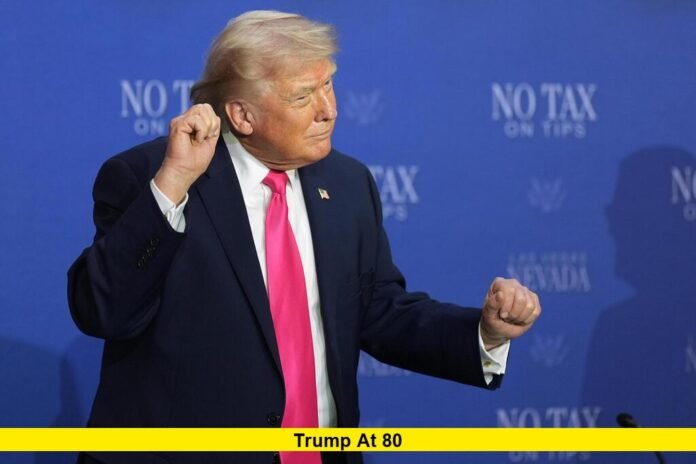

As President Donald Trump approaches a landmark birthday, the national conversation surrounding his leadership is increasingly intersecting with a topic that affects every public figure eventually: age. The debate over Trump at 80 has become more than a discussion about years lived; it is now a broader examination of political endurance, public expectations, and the realities of leading the world’s most powerful nation while entering a new stage of life.
For a politician whose image has long been associated with confidence, energy, and relentless visibility, the growing focus on age presents a challenge unlike any campaign battle or policy dispute. It is a subject that cannot be negotiated, reframed, or avoided indefinitely.
Yet Trump continues to confront the issue in a way that reflects the approach that has defined much of his public career—by emphasizing activity, influence, and continued engagement with national affairs.
A Historic Moment in American Leadership
Few presidents have served while reaching such an advanced age. The milestone places Trump in a unique category within American political history, where questions about experience and longevity are increasingly competing with concerns about physical and mental stamina.
The presidency remains one of the most demanding jobs in the world. Daily intelligence briefings, international diplomacy, domestic policy challenges, economic oversight, and emergency response responsibilities require sustained attention and resilience.
As Americans watch political leaders remain active longer than previous generations, traditional assumptions about aging are being tested. Advances in healthcare, longer life expectancy, and changing workplace norms have altered expectations regarding what older leaders can accomplish.
Trump’s presidency exists within this evolving reality.
The Politics of Perception
Modern politics is heavily influenced by image. Every public appearance, speech, interview, and unscripted moment is instantly analyzed across television networks, websites, and social media platforms.
For Trump, who has spent decades cultivating a highly recognizable public persona, perception has always been a critical component of political success. That dynamic becomes even more significant when age enters the discussion.
Supporters frequently point to his packed schedule, public appearances, and continued political influence as evidence that he remains fully capable of handling the responsibilities of office.
Critics, meanwhile, argue that advancing age naturally raises legitimate questions about endurance, decision-making, and long-term effectiveness.
The resulting debate often says as much about voter attitudes as it does about the president himself.
A Generation of Older Leaders
Trump’s situation is part of a larger trend extending beyond a single administration. Across the United States and many other democracies, political leadership has increasingly remained in the hands of older figures.
This shift has prompted broader questions about generational representation and succession. Younger voters often seek leaders who understand the economic, technological, and cultural realities shaping their future.
At the same time, many citizens continue to value experience, believing that decades spent navigating complex institutions can provide advantages during periods of uncertainty.
The conversation is no longer a simple choice between youth and experience. Instead, voters are weighing the benefits and limitations associated with both.
Why the Topic Resonates
Age has become a particularly powerful political issue because it touches on universal human experiences.
Every voter understands the passage of time. Everyone has witnessed family members, colleagues, and public figures adapt to aging in different ways. As a result, discussions about older leaders often generate strong emotional responses.
For Trump, the issue is amplified by the contrast between his public image and the natural realities that accompany advancing years. Throughout his career, he has projected certainty and control. Public discussions about aging inevitably challenge those themes.
That tension helps explain why the topic continues to attract attention from political analysts, voters, and media organizations alike.
Leadership Beyond the Numbers
Political scientists frequently caution against evaluating leaders solely by age. History provides examples of younger leaders who struggled in office and older leaders who governed effectively during challenging periods.
The more relevant questions often involve judgment, adaptability, communication skills, and the ability to respond to rapidly changing circumstances.
Supporters argue that Trump’s decades in business, entertainment, and politics have equipped him with a unique understanding of public opinion and power.
Opponents counter that experience alone does not guarantee effective leadership and that age-related concerns deserve careful consideration.
Both perspectives reflect legitimate debates taking place across the electorate.
The Weight of Constant Scrutiny
No president operates under ordinary conditions. Every decision, statement, and public appearance becomes part of an ongoing national evaluation.
For a president nearing 80, that scrutiny becomes even more intense.
Minor verbal mistakes, physical gestures, or moments of fatigue can dominate headlines and fuel speculation. Such attention creates an environment where routine human behavior is often interpreted through a political lens.
Trump’s ability to remain one of the most discussed figures in American public life ensures that these observations will continue to attract significant attention.
The challenge lies not only in governing effectively but also in managing perceptions that can shape public confidence.
Legacy Becomes Part of the Conversation
As political leaders grow older, discussions naturally begin shifting toward legacy.
Trump’s influence on American politics is already substantial. His impact on campaign strategy, voter coalitions, media engagement, and party dynamics has reshaped the political landscape in ways that will likely be studied for years.
Consequently, debates surrounding Trump at 80 are often connected to larger questions about how history will remember his presidency.
Will future generations focus primarily on policy achievements, political disruption, economic decisions, judicial appointments, or cultural influence?
The answer remains uncertain, but the discussion has already begun.
Looking Ahead
The focus on Trump’s age is unlikely to disappear as he reaches this milestone. Instead, it will remain part of a broader national conversation about leadership, capability, and the evolving expectations Americans place on elected officials.
What makes this moment noteworthy is not simply the number itself. It is the fact that a president known for commanding attention is now confronting one of the few realities that affects every public figure equally.
Age may influence perception, but voters ultimately continue to evaluate leaders based on performance, decisions, and results.
As Trump enters his 80th year, the intersection of politics, leadership, and longevity remains one of the most closely watched stories in American public life.