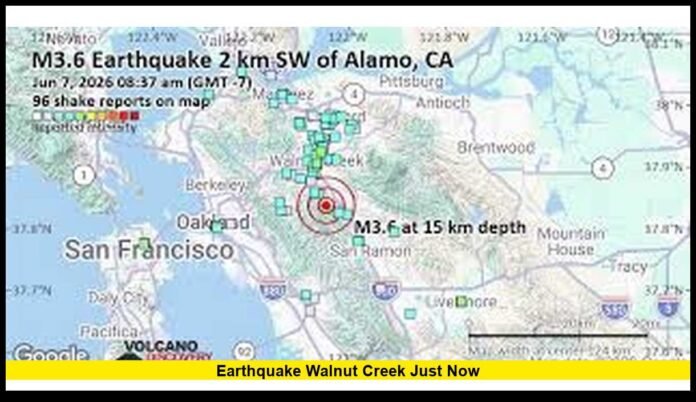

Earthquake walnut creek just now is drawing widespread attention after a magnitude 3.6 earthquake shook parts of Contra Costa County on June 7, 2026. The seismic event was centered near Alamo and was felt across Walnut Creek, Moraga, Lafayette, Danville, and portions of the Oakland Hills. While the earthquake was relatively moderate in size, its proximity to densely populated communities made the shaking noticeable for thousands of residents throughout the East Bay.
Many people reported feeling a sudden jolt followed by several seconds of movement. Social media activity surged within minutes as residents sought confirmation that an earthquake had occurred. The event quickly became one of the most discussed local news stories of the day across the Bay Area.
Morning Earthquake Rattles Communities Across the East Bay
The earthquake occurred at approximately 8:37 a.m. Pacific Time. Its epicenter was located near Alamo, just south of Walnut Creek. Because the quake struck close to heavily populated neighborhoods, residents experienced stronger shaking than would normally be expected from an earthquake of this magnitude.
People in homes, offices, schools, and retail locations reported feeling the movement. Some described a sharp impact that resembled a heavy object hitting a building. Others felt a rolling motion that lasted several seconds.
Reports came in rapidly from multiple communities throughout Contra Costa County and neighboring areas.
The earthquake was widely felt in:
- Walnut Creek
- Alamo
- Danville
- Lafayette
- Moraga
- Pleasant Hill
- Concord
- Oakland Hills
- Orinda
Residents across these communities described similar experiences, including rattling windows, shaking walls, and moving furniture.
Epicenter Located Near Alamo
The quake originated near Alamo, an unincorporated community situated between Walnut Creek and Danville. The area lies within one of Northern California’s most active seismic regions.
Earthquake monitoring stations recorded the event at a depth of approximately 9 miles below the Earth’s surface. This depth allowed seismic waves to travel efficiently through surrounding communities, making the tremor noticeable across a large portion of the East Bay.
Key Earthquake Information
| Category | Details |
|---|---|
| Date | June 7, 2026 |
| Time | Approximately 8:37 a.m. PDT |
| Magnitude | 3.6 |
| Epicenter | Near Alamo, California |
| Depth | About 9 miles |
| Region Affected | East Bay, Contra Costa County |
| Reported Injuries | None confirmed |
| Major Damage | None confirmed |
The earthquake occurred during a busy Sunday morning, increasing the number of people who were awake and able to feel the shaking.
Residents Describe Sudden Shaking
For many Walnut Creek residents, the earthquake arrived without warning.
Several people reported hearing a brief rumbling sound immediately before the shaking began. Others noticed hanging objects moving and windows vibrating.
Some homeowners said dishes rattled inside cabinets. Office workers reported desks shaking and computer monitors wobbling.
Although the event was not large enough to cause widespread destruction, it was strong enough to interrupt daily routines throughout the area.
One reason the quake felt significant is that earthquakes occurring directly beneath populated areas often produce stronger local shaking than larger events located farther away.
No Major Damage Reported
Emergency officials did not report significant structural damage in the hours following the earthquake.
Utility providers continued normal operations, and there were no widespread reports of power outages linked to the event. Transportation systems throughout the Bay Area also continued operating normally.
Minor earthquakes frequently create concern among residents, particularly in California, where memories of larger historical earthquakes remain strong. However, this event appears to have caused little disruption beyond the initial shaking.
Authorities still encourage residents to inspect their homes after any earthquake.
Areas worth checking include:
- Gas lines
- Water pipes
- Electrical systems
- Brick chimneys
- Shelving units
- Water heaters
Even minor earthquakes can occasionally loosen fixtures or create small cracks that homeowners may not notice immediately.
Why Walnut Creek Experiences Earthquakes
Walnut Creek sits within a region shaped by active geological forces.
California rests along the boundary between the Pacific Plate and the North American Plate. These massive sections of the Earth’s crust are constantly moving, although the movement occurs very slowly.
As pressure builds over time, faults release energy in the form of earthquakes.
The East Bay contains several active fault systems. This geological setting means earthquakes remain a regular part of life for residents throughout Contra Costa County.
Most seismic events in Northern California are small and pass unnoticed. A smaller number are strong enough to be felt by residents.
Events similar to the June 7 earthquake occur periodically throughout the Bay Area.
How Strong Is a Magnitude 3.6 Earthquake?
A magnitude 3.6 earthquake falls within the category of minor earthquakes.
While such events rarely produce serious damage, they can still feel surprisingly strong when they occur close to populated communities.
Typical effects of a magnitude 3.6 earthquake include:
- Noticeable shaking indoors
- Vibrating windows
- Swaying light fixtures
- Rattling dishes
- Brief feelings of movement
- Minor items falling from shelves
The intensity experienced by residents often depends on several factors beyond the earthquake’s magnitude.
These include:
- Distance from the epicenter
- Building design
- Soil composition
- Earthquake depth
- Local geological conditions
Because Walnut Creek sits near the epicenter area, many residents experienced stronger shaking than communities located farther away.
East Bay Seismic Activity Remains Closely Monitored
Northern California contains one of the world’s most sophisticated earthquake monitoring networks.
Thousands of sensors continuously track ground movement throughout the region. These instruments allow scientists to detect earthquakes within seconds and calculate their magnitude, depth, and location.
Modern monitoring systems provide valuable information to emergency managers, public safety agencies, utilities, and local governments.
Following the June 7 earthquake, seismic specialists reviewed data gathered from monitoring stations across the Bay Area.
The information helps experts understand how seismic energy moved through local fault systems and surrounding communities.
Read More – Earthquake in Las Vegas Today
Community Reaction Across Social Media
Within minutes of the quake, social media platforms filled with posts from residents asking whether others had felt the shaking.
Many users shared similar descriptions:
- A sudden jolt
- Brief shaking
- Vibrating windows
- Moving furniture
- Rattling dishes
The rapid online reaction reflected how widely the earthquake was felt.
Local community groups quickly became active as neighbors discussed their experiences and checked on friends and family members throughout the East Bay.
The shared response highlighted how even moderate earthquakes can immediately capture public attention in California.
Earthquake Preparedness Remains Essential
While the June 7 earthquake caused little disruption, emergency officials continue emphasizing preparedness.
California’s seismic history demonstrates the importance of being ready for larger events.
Experts recommend that households maintain emergency supplies that can support family members for several days.
Suggested emergency items include:
- Drinking water
- Nonperishable food
- Flashlights
- Batteries
- First-aid kits
- Portable chargers
- Prescription medications
- Emergency contact information
Families are also encouraged to discuss earthquake response plans before emergencies occur.
Preparation can reduce confusion and improve safety during future seismic events.
What To Do When an Earthquake Strikes
Safety experts continue recommending the same response strategy during earthquakes.
The steps are straightforward:
Drop
Get low to the ground immediately.
Cover
Move beneath a sturdy table or desk if available.
Hold On
Maintain your position until all shaking stops.
People outdoors should stay clear of buildings, utility poles, and trees.
Drivers should pull over safely and remain inside their vehicles until the shaking ends.
These actions significantly reduce the risk of injury during an earthquake.
Could Additional Tremors Occur?
After an earthquake, residents often wonder whether additional shaking will follow.
Smaller earthquakes can occasionally be followed by aftershocks. These secondary tremors result from adjustments within the Earth’s crust after the initial event.
Most aftershocks are weaker than the main earthquake.
Some are so small that only sensitive instruments detect them.
Residents throughout Walnut Creek and surrounding communities may remain alert for additional movement, although most aftershocks produce limited impact.
California’s Long History of Seismic Activity
Earthquakes have shaped California’s landscape for millions of years.
The state’s location along major fault systems creates ongoing seismic activity from north to south.
Northern California experiences thousands of earthquakes annually. Most are extremely small and go unnoticed by the public.
Only a small percentage become significant local news events.
When earthquakes occur near urban areas, even moderate tremors often generate substantial public attention because large numbers of people feel the shaking.
The June 7 earthquake near Alamo fits this pattern.
Although relatively modest in magnitude, its location near Walnut Creek and other populated communities ensured that many residents experienced the event firsthand.
Impact on Daily Life
For most residents, the earthquake represented a brief interruption rather than a major emergency.
Businesses remained open.
Roadways continued operating normally.
Public services experienced no major disruptions.
Nevertheless, the quake served as a reminder that seismic activity remains a constant reality across Northern California.
Many residents spent part of the day reviewing emergency kits, discussing preparedness plans, and checking their homes for any signs of damage.
Those actions reflect a long-standing culture of earthquake awareness throughout the Bay Area.
Latest Status
As of June 7, 2026, the magnitude 3.6 earthquake centered near Alamo remains the most notable seismic event affecting Walnut Creek today. Residents across Contra Costa County reported feeling the tremor, while officials reported no major injuries or significant damage.
The event generated widespread attention due to its proximity to populated neighborhoods and the noticeable shaking experienced throughout the East Bay.
Although the earthquake was relatively small by California standards, it reminded many residents that seismic activity can occur without warning and that preparedness remains an important part of life in the Bay Area.
Did you feel the earthquake in Walnut Creek today? Share your experience in the comments and check back for the latest local updates as the East Bay continues monitoring seismic activity.