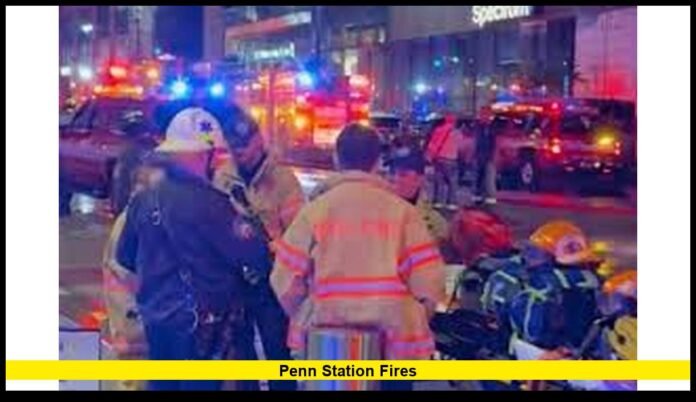

A major fire broke out in the early hours of Friday, May 29, 2026, forcing a widespread shutdown of rail service at one of the busiest transit hubs in the United States. Here is everything you need to know about the Penn Station fire, what caused it, who was injured, and how commuters are being impacted.
╔════════════════════════════════════════════════════════════════════╗ ║ – The Penn Station fire broke out at approximately 1:30 a.m. on May 29, 2026. ║ ║ – The blaze involved an Amtrak contractor maintenance work train on Track 11. ║ ║ – Five workers were injured; two were taken to Bellevue Hospital with serious injuries. ║ ║ – 46 FDNY units and 141 firefighters responded; the fire was brought under control by 4:05 a.m. ║ ║ – NJ Transit and LIRR service were suspended; Amtrak delays expected through the afternoon. ║ ╚════════════════════════════════════════════════════════════════════╝
What Happened at Penn Station Today?
In the early hours of Friday morning, a fire erupted inside the Hudson River tunnel rail yard just west of New York Penn Station. The FDNY received a 911 call at approximately 1:32 a.m. reporting a blaze on an Amtrak work train car positioned on Track 11, located just outside the entrance to the Hudson River tunnels that connect Manhattan to New Jersey.
The fire involved what Amtrak officially described as a “contractor maintenance vehicle” operating in one of the Hudson River tunnels. According to witnesses and emergency crews, the engine of the work train caught fire in the West Side Rail Yard, sending a thick cloud of black smoke billowing up through street-level vents near 10th Avenue and 31st Street. Passersby reported seeing smoke fill the street as early as 1:30 a.m., and footage from the scene showed a heavy emergency response unfolding in real time.
The incident escalated to a two-alarm fire by 2:43 a.m. but firefighters brought it under control approximately one hour and twenty minutes later, at 4:05 a.m.
How Many People Were Injured?
Five workers — all believed to be transit or railroad employees — were injured in connection with the Penn Station fire.
- Two individuals sustained serious injuries and were transported to NYC Health + Hospitals/Bellevue on Manhattan’s East Side.
- Three others were treated for smoke inhalation at the scene but refused further medical attention.
The FDNY confirmed all injured parties were transit workers, and their conditions at the time of transport were considered serious but were not immediately upgraded. The exact cause of the fire remains under active investigation.
FDNY Response: 141 Firefighters Deployed
The scale of the FDNY response underscored the severity of the Penn Station fire. A total of 46 units and 141 firefighters and emergency service personnel were dispatched to the scene. Crews worked for more than two hours to access the underground areas through a stairwell on the ground level near the rail yard entry, running hoses deep into the yard below to suppress the flames.
Emergency personnel were still visible going in and out of the site well after the fire was declared under control, as crews worked to assess damage to the track infrastructure and overhead wiring.
Train Service Disruptions: NJ Transit, Amtrak, and LIRR
The Penn Station fire caused sweeping disruptions across all three major rail networks that operate through the station. The damage to overhead wiring on Track 11 was a key factor in the extended service suspensions.
Amtrak
Amtrak suspended all rail service between New York and New Jersey starting at 1:25 a.m. on May 29. The agency said service was not expected to fully resume until the afternoon, and issued a travel advisory warning commuters to expect delays of up to approximately one hour for trains traveling through the New York area. Amtrak also confirmed it is offering rebooking opportunities and refunds to affected ticket holders. Service north and east of New York City was also running at reduced capacity.
NJ Transit
NJ Transit service between New York Penn Station and Newark Penn Station was fully suspended. The agency posted on social media that the fire caused “overhead wire damage” and that impacts were expected to last through the morning rush hour. Midtown Direct service was diverted to Hoboken Terminal. NJ Transit and private carrier buses as well as PATH trains are cross-honoring NJ Transit rail tickets and passes at Newark Penn Station, Hoboken, and 33rd Street.
Long Island Rail Road (LIRR)
LIRR service was also briefly suspended before being partially restored. The subway is currently cross-honoring LIRR tickets on several lines:
- The E line at 34 St-Penn Station, Forest Hills-71 Av, Kew Gardens-Union Tpke, and Sutphin Blvd-Archer Av-JFK Airport
- The 4, 5, 6, and 7 lines at Grand Central-42 St
- The 7 line at Woodside-61 St
A Pattern of Penn Station Disruptions
This fire is not an isolated incident. According to reports from transit journalists covering the story, the May 29, 2026 blaze came just two weeks after a separate track fire inside Penn Station that also snarled Amtrak, NJ Transit, and LIRR service into and out of the hub. That earlier incident further strained an already fragile infrastructure system that millions of commuters depend on daily.
The recurring nature of these disruptions has reignited conversations about the aging infrastructure of Penn Station and the Hudson River tunnels, which date back over a century and have been the subject of long-delayed renovation and Gateway Project tunnel discussions for years.
What Commuters Should Do Right Now
If you are planning to travel through Penn Station today, May 29, 2026, here is what you need to know:
- Avoid the area around 10th Avenue between 31st and 33rd Streets, where heavy emergency activity continues.
- Check Amtrak’s website for the latest service updates and to request a refund or rebooking if your train was cancelled.
- NJ Transit passengers should head to Hoboken Terminal or use PATH and bus alternatives. Cross-honoring is in effect at Newark Penn, Hoboken, and 33rd Street.
- LIRR passengers can use designated subway lines as listed above.
- Delays of up to one hour or more are expected across all affected services through much of Friday.
What Caused the Penn Station Fire?
As of the time of publication, the cause of the fire remains under active investigation by the FDNY. What is confirmed is that the fire originated in an Amtrak contractor maintenance work train on Track 11, located in the West Side Rail Yard just outside the Hudson River tunnels. Whether the fire was mechanical in nature, related to equipment failure, or caused by another factor has not yet been determined by investigators.
Broader Context: Penn Station’s Infrastructure Challenges
Penn Station is the busiest rail hub in the Western Hemisphere, processing hundreds of thousands of commuters daily across Amtrak, NJ Transit, LIRR, and New York City subway lines. Its underground infrastructure — including the critical Hudson River tunnels — has faced years of criticism for deferred maintenance and overcapacity.
The Gateway Program, a long-planned infrastructure project, aims to build new tunnels under the Hudson River and modernize existing facilities. However, funding and political disputes have delayed significant progress. Each major incident like today’s Penn Station fire brings renewed urgency to those conversations among transit advocates, lawmakers, and commuters alike.
If you were impacted by today’s Penn Station fire, share your experience in the comments — and bookmark this page for the latest updates as service restoration efforts continue throughout the day.