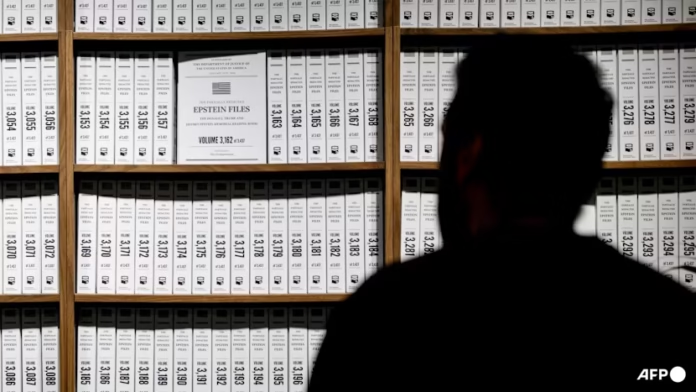

A bold and provocative pop-up installation in the heart of New York City is forcing Americans to confront the sheer scale of the Jeffrey Epstein scandal — one printed page at a time. The Donald J. Trump and Jeffrey Epstein Memorial Reading Room, organized by the nonprofit Institute for Primary Facts, has opened in Manhattan’s Tribeca neighborhood, putting 3.5 million pages of Epstein-related federal documents on physical display for the public to witness firsthand.
What Is the NYC Epstein Files Exhibit?
Located at Mriya Gallery on 101 Reade Street in Tribeca, the reading room is unlike anything the country has seen. The nonprofit Institute for Primary Facts — a federally recognized 501(c)(3) organization dedicated to civic literacy — transformed a two-story gallery space into a library of accountability. The installation opened on May 8 and runs through May 21, open to visitors aged 16 and over by appointment through the organization’s platform, fittingly named Trumpsonian.
The exhibit is the first-ever live installation by the Institute for Primary Facts, which was founded in December 2025 with a mission to advance civic literacy through immersive, traveling museum exhibits and “provide accessible, fact-based explorations of the foundational elements of American democracy.”
3.5 Million Pages, 17,000 Pounds of Documents
The scale of the installation is staggering. The documents have been organized into 3,437 bound volumes, each roughly two inches thick and weighing approximately five pounds. Combined, the entire collection weighs over 17,000 pounds — a physical representation of the magnitude of one of America’s most disturbing scandals.
It took organizers nearly a month alone to print, sort, and bind the documents, which are derived from files released by the U.S. Department of Justice in response to the Epstein Files Transparency Act. The Department of Justice released hundreds of thousands of files in December 2025, followed by over 3 million more pages in January, making the total publicly available archive one of the largest in American legal history.
The bookshelves — styled after New York City public libraries — wrap the walls of the gallery across both floors, enclosing a central draped memorial structure. The exhibit’s lead organizer, David Garrett, explained the deliberate choice to make the documents physical: “Printing out the Epstein files distinguishes them as real and tangible. What is 3.5 million documents? What does that look like? Well, now we know.”
A Memorial to Over 1,200 Victims
At the center of the main gallery floor stands one of the exhibit’s most emotionally powerful features: a memorial dedicated to Epstein’s victims. A sheer curtain is draped around a rectangular platform inside which over 1,200 estimated victims are each represented by a candle. The memorial is designed to keep the conversation grounded in human tragedy rather than political theater.
Garrett, who has two daughters, shared the personal drive behind the project: “The fact that after 10 victims it wasn’t stopped, or after 50, or after 500, or after 1,000 victims, that’s horrible.” He added that he has personally sat with Epstein survivors who visited the exhibit, helping them locate documents containing their names. “You see emails about them or pictures of their driver’s license, and it’s just horrifying and heartbreaking.”
A cork board in the basement, set up for visitors to leave messages, was completely filled after just four days — a testament to the emotional resonance of the installation.
The Trump–Epstein Timeline
One wall of the reading room features a detailed, fact-checked visual timeline of the documented relationship between Jeffrey Epstein and current U.S. President Donald Trump. The timeline stretches from their reported first meeting in Palm Beach, Florida, in 1987, through decades of documented social interactions, to Epstein’s ouster from Mar-a-Lago in 2007, reportedly for inappropriate behavior with a spa worker. Epstein later pleaded guilty in 2008 to soliciting prostitution from a minor as part of a plea deal negotiated by then-U.S. Attorney Alex Acosta, who later served as Trump’s Secretary of Labor.
The exhibit’s title — placing Trump’s name alongside Epstein’s — is intentionally provocative. Organizers say it reflects the documented public record of their social relationship and raises broader questions about power and accountability. Trump has denied any wrongdoing related to Epstein, and the White House has rejected efforts to connect him to Epstein’s crimes.
Who Can Actually Read the Files?
While all visitors can view the exhibit and the timeline, the bound volumes themselves are restricted to a specific group: accredited press, members of Congress, law enforcement officials, survivors, and their legal advocates. The reason is sobering — the Department of Justice failed to properly redact the names of all victims in the released files, and the Institute for Primary Facts determined it could not remediate the matter since not all impacted identities are publicly known.
Organizers have been vocal about their frustration with this situation, calling on the DOJ to release “the full and properly redacted files” to allow for genuine transparency. As Garrett put it: “So far, only public outrage and pressure have moved the needle.”
A Push for Transparency and Accountability
The Institute for Primary Facts describes the installation as a “physical archive of accountability.” Beyond New York, organizers are currently raising funds to bring the exhibit to other American cities, with the goal of keeping public pressure on institutions to deliver full transparency in the Epstein case.
Critics have raised questions about the exhibit’s approach, noting that presenting vast legal archives in a curated public space risks oversimplifying complex investigations. Some have also pointed out that questions remain over what has been withheld from the public, with some reports suggesting the full trove of documents could exceed six million pages.
Supporters, however, argue that the project represents a vital civic effort — one that transforms an overwhelming digital data dump into something tangible, human, and impossible to ignore.
“The truth is hard to deny when it’s printed and bound for you to see,” the project’s website reads. “The Reading Room keeps public attention fixed on the crimes of Epstein and the Epstein class, and on Trump’s desperate attempts to bury them, to support the victims and survivors as they seek justice.”
How to Visit the Exhibit
The Donald J. Trump and Jeffrey Epstein Memorial Reading Room is open by appointment only through May 21, located in Tribeca, Manhattan. Due to security concerns, the exact address is provided only upon RSVP confirmation. The exhibit is open to visitors aged 16 and over, with limited walk-in slots available.
Appointments can be scheduled through the Institute for Primary Facts’ platform at Trumpsonian. The organization is also accepting donations to fund the exhibit’s travel to further U.S. cities via ActBlue.
What do you think — does making the Epstein files physical change how you see the scandal? Drop your thoughts in the comments below and follow us for updates as this story continues to develop.