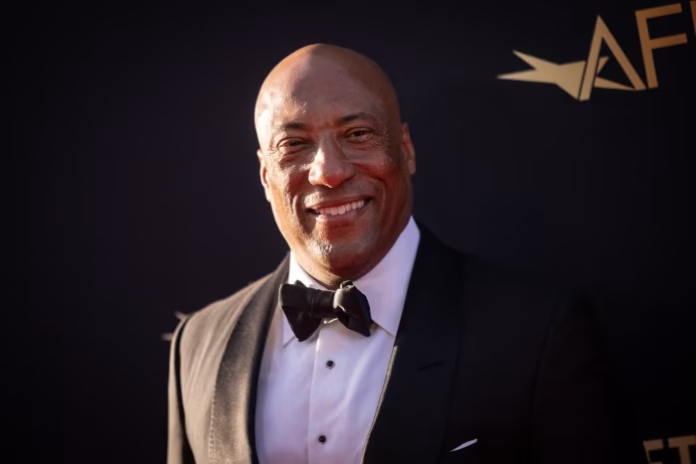

Media entrepreneur Byron Allen has made one of the boldest moves in digital media this year, striking a landmark deal to acquire a controlling stake in BuzzFeed and take over as Chairman and Chief Executive Officer. The announcement, made on May 12, sent shockwaves through the media industry and signaled a potentially transformative new chapter for one of the internet’s most iconic publishing brands.
The Deal: What We Know
Byron Allen’s family office affiliate, Allen Family Digital, LLC, has entered into a transaction agreement with BuzzFeed, Inc. (Nasdaq: BZFD) to acquire a majority stake in the company for a total of $120 million.
Under the terms of the agreement:
- Allen Family Digital will purchase 40 million shares of BuzzFeed at $3.00 per share
- Upon closing, Allen Family Digital will own approximately 52% of BuzzFeed’s outstanding Class A common stock
- The purchase price will be funded with $20 million in cash at closing and a $100 million promissory note due five years from closing, accruing interest at 5% annually
- The transaction is expected to close by the end of May, subject to customary closing conditions
This is not merely a passive investment — Byron Allen will assume the roles of Chairman and Chief Executive Officer of BuzzFeed, Inc., marking one of the most significant leadership transitions in the company’s 20-year history.
Leadership Transition: Jonah Peretti Steps Aside
BuzzFeed founder and longtime CEO Jonah Peretti, who co-founded the company in 2006 and guided it through its rise as a defining digital media brand, will step down from his executive role upon closing. Peretti will transition into a newly created position as President of BuzzFeed AI, where he will focus on applied AI research, product innovation, and developing technology-driven media tools.
In an official statement, Peretti expressed confidence in the new direction, noting that Byron Allen has spent over 30 years transforming distribution infrastructure, identifying strategic media assets, and scaling them into something far greater. Peretti added that he is personally excited to shift his attention toward AI, believing it will fundamentally reshape the media industry and empower creators in ways not previously possible.
Peretti also noted that structural changes are already being planned ahead of Allen’s formal arrival, including cost reductions and the reorganization of BuzzFeed Studios — which encompasses vertical micro-dramas, animation, digital video, and premium film production — along with Tasty, BuzzFeed’s popular food brand, being set up as a new independent entity.
Who Is Byron Allen?
Byron Allen, 65, is a Detroit-born media entrepreneur who moved to Los Angeles at a young age and built one of the country’s most expansive independent media empires from the ground up. He is the founder, chairman, and CEO of Allen Media Group, which he established in 1993 and is headquartered in Los Angeles.
Allen Media Group’s portfolio is broad and impressive, encompassing:
- The Weather Channel (and related weather media assets)
- 13 local broadcast affiliate TV stations across the United States
- A wide catalog of syndicated television programming
- Comics Unleashed, Allen’s late-night comedy program, which is reportedly on the verge of taking over the coveted CBS late-night time slot currently occupied by The Late Show With Stephen Colbert
Allen’s decades-long track record of acquiring and scaling media properties — often seen as undervalued or struggling — has made him one of the most aggressive and successful dealmakers in the industry. The BuzzFeed acquisition fits squarely within that pattern.
Allen’s Vision: Streaming, AI, and Taking on YouTube
Perhaps the most ambitious aspect of this deal is what Byron Allen plans to do with BuzzFeed and its sister brand HuffPost once he is in control.
Allen has been explicit about his goals: he intends to pivot both brands toward free-streaming video, audio, and user-generated content, positioning BuzzFeed as a direct competitor to major digital video platforms — most notably YouTube.
In his official remarks, Allen stated that BuzzFeed, powered by AI, is now “officially chasing YouTube to become another premiere free video streaming service.” This signals a dramatic strategic shift from BuzzFeed’s traditional social-media-first, text-and-quiz-driven model toward a video-first, AI-augmented content ecosystem.
Key pillars of Allen’s stated vision include:
- Free-streaming video — creating an ad-supported streaming layer built on BuzzFeed and HuffPost’s existing audience reach
- Audio content — expanding into podcasting and audio formats
- User-generated content — leveraging creator communities and participatory content models
- AI-driven publishing — using artificial intelligence to empower editorial teams, scale content production, and develop new products
This vision aligns with broader industry trends, where legacy digital publishers are increasingly pivoting to video and AI to diversify revenue streams beyond display advertising.
BuzzFeed’s Financial Context: A Struggling Publisher Gets a Lifeline
The deal arrives at a critical moment for BuzzFeed. The company has faced significant headwinds as a publicly traded entity, with revenue consistently declining. For Q1 of this year, BuzzFeed reported revenue of $31.6 million, representing a 12.4% drop year over year, alongside a slightly widened net loss.
The company’s stock has struggled on the Nasdaq since its SPAC listing, and the broader digital media sector has faced relentless pressure from social media algorithm changes, shrinking programmatic ad revenues, and the rapid rise of AI-generated content. For BuzzFeed, the Allen deal is widely seen as a much-needed financial lifeline that could stave off a more dire outcome.
The $120 million investment — even structured partly as a promissory note — injects meaningful liquidity into the business and provides what BuzzFeed’s leadership has described as renewed “operational focus.”
Industry Reaction: A Major Shake-Up for Digital Media
The announcement has prompted widespread reaction across the media landscape. Observers note that Allen’s entry into BuzzFeed represents a convergence of old-school broadcast media experience with the chaotic, fast-moving world of digital publishing — a combination that could either revitalize the brand or prove challenging to execute.
BuzzFeed and HuffPost remain two of the most recognized names in internet media, with substantial global audiences and strong cultural relevance despite their recent financial difficulties. The question now is whether Allen’s operational model — built on broadcast distribution, syndication, and lean content networks — can translate effectively to a digital-native environment.
Jonah Peretti’s continued involvement as President of BuzzFeed AI provides some continuity, ensuring that institutional knowledge of the platform, its audience, and its editorial culture remains embedded within the new leadership structure.
What Happens Next
With the deal expected to close by late May, the transition of power is imminent. Upon closing:
- Byron Allen officially becomes Chairman and CEO of BuzzFeed, Inc.
- Jonah Peretti formally steps into the President of BuzzFeed AI role
- The BuzzFeed board expands to up to nine members, with Allen’s affiliate gaining multiple board appointment rights tied to ownership thresholds
- Structural changes to BuzzFeed Studios and Tasty are set to begin
The media world will be watching closely to see how quickly Allen moves to implement his streaming and AI ambitions — and whether BuzzFeed, one of the internet’s original viral powerhouses, can find a second act under bold new leadership.
What do you think about Byron Allen’s takeover of BuzzFeed — can he turn it into the next YouTube? Drop your thoughts in the comments below and stay tuned for the latest updates as this story develops!