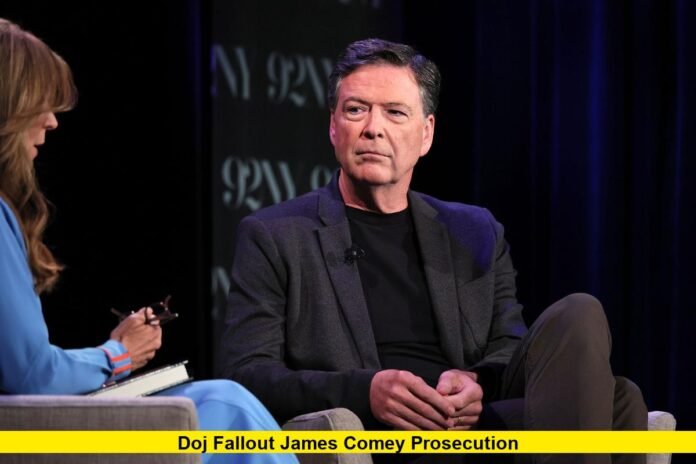

The Department of Justice is at the center of one of the most consequential — and controversial — legal sagas in recent American political history. The Trump administration’s relentless push to prosecute former FBI Director James Comey has triggered a cascade of resignations, demotions, legal dismissals, and now a fresh criminal trial set for this summer. Meanwhile, lawmakers on both sides of the aisle are responding to broader institutional dysfunction by proposing a sweeping restructuring of federal agencies — including a bipartisan bill that would remove the Secret Service from the Department of Homeland Security entirely.
Here is a deep, fully sourced breakdown of everything you need to know.
Background: Who Is James Comey and Why Is He Being Prosecuted?
James Comey served as the seventh Director of the Federal Bureau of Investigation from 2013 until President Donald Trump fired him in May 2017 — a dismissal that ignited years of fierce political conflict between the two men. According to GovFacts, the 2025 indictment of Comey follows nearly a decade of public tension between Comey and President Trump, with their conflict placing the FBI at the center of American political discourse.
Comey became a polarizing figure after his handling of the Hillary Clinton email investigation and was later dismissed during the early stages of what became the Russia investigation. Since his firing, he has remained a persistent critic of Trump, writing books, giving media interviews, and speaking out frequently about the rule of law and institutional independence — all of which made him a high-profile target when Trump returned to the White House.
The First Indictment: False Statements and Procedural Chaos
The first wave of criminal charges came in September 2025. As per Wikipedia’s documented account of the prosecution, on September 25, 2025, Comey was indicted by a federal grand jury in Virginia on two counts: one charge of making a false statement to Congress, and one charge of obstructing a congressional proceeding. The charges were related to his testimony during a September 30, 2020, Senate Judiciary Committee hearing about the FBI’s investigation of links between Russia and the 2016 Trump presidential campaign.
The circumstances surrounding the indictment were themselves deeply controversial. According to reporting by The Washington Post, the president forced out the top prosecutor in the Eastern District of Virginia, Erik S. Siebert, after Siebert determined there was insufficient evidence to pursue charges against Comey for lying to Congress. Siebert also found insufficient grounds to charge New York Attorney General Letitia James with mortgage fraud.
In Siebert’s place, Trump installed Lindsey Halligan — a close ally of the president described by The Washington Post as having no prosecutorial experience — to run the Virginia office and secure indictments against Comey and James. She personally presented the cases to grand jurors and won the indictments.
However, as per Wikipedia’s documentation, senior United States district judge Cameron McGowan Currie ruled on November 24, 2025, that Halligan had not been lawfully appointed. She dismissed without prejudice the indictments against both Comey and Letitia James. According to legal analysts cited by Wikipedia, the five-year statute of limitations on the alleged offenses had expired on September 30, 2025, raising serious questions about whether Comey could ever be prosecuted again on those charges. Comey himself called the prosecution “malevolent and incompetent.”
The DOJ Office in Freefall: Resignations, Demotions, and Leaderless Courts
Perhaps the most alarming consequence of the Comey prosecution is not the legal drama in the courtroom — it’s the institutional collapse happening inside the Department of Justice itself.
According to The Washington Post’s most recent investigation, more than a half-dozen prosecutors have been demoted or pushed out of the U.S. Attorney’s Office for the Eastern District of Virginia due to fallout from the Justice Department’s push to prosecute Comey, leaving a key prosecutorial office understaffed and weakened.
The damage does not stop there. As per The Washington Post’s reporting, other prosecutors voluntarily departed or scrambled to find new jobs, fearful they could be asked to work on cases that violated their principles — a finding corroborated by ten current and former prosecutors familiar with the office.
The ripple effects have reached far beyond the Comey case. According to the same reporting, Michael Ben’Ary — who ran the national security division in the Eastern District of Virginia — was pushed out after a right-wing influencer baselessly accused him of opposing the Comey prosecution, even though he had no involvement in it whatsoever. Ben’Ary had been leading the prosecution team in a high-profile case against an alleged planner of the 2021 suicide bombing at the Kabul airport, which killed 13 U.S. service members and approximately 170 Afghans. That terrorism case has now been severely disrupted.
Additionally, according to The Washington Post, the two career prosecutors brought in from North Carolina to assist Halligan with the Comey and James cases have both since left the department. Troy Edwards, the deputy director of the National Security Section and Comey’s son-in-law, also left when Comey was initially indicted.
As per reporting from DNYUZ citing The Washington Post, the judges of the Eastern District of Virginia unanimously selected a new U.S. attorney for the district — but Acting Attorney General Todd Blanche immediately fired him. The office remains leaderless, with the head of its criminal section also demoted. Multiple defendants indicted in the Eastern District of Virginia are now seeking to have their cases dismissed on the grounds that Halligan was unlawfully appointed.
Legal analysts and The Washington Post have noted that all the money and investigative resources spent on the two Comey indictments “have little merit and stem primarily from President Donald Trump’s animus toward the former FBI chief.”
The Second Indictment: Seashells, Social Media, and a Trial Set for July
Even as the first case collapsed in procedural failure, the Trump DOJ moved swiftly to prosecute Comey a second time on an entirely different set of charges.
According to CNN’s reporting, former FBI Director James Comey was indicted by a federal grand jury in North Carolina over a photo he posted on Instagram on May 15, 2025, of seashells arranged on a beach to read the numbers “86 47.” The number 86 in slang usage can mean to get rid of something, while 47 corresponds to Trump’s current term as the 47th president. Republicans and administration officials immediately claimed it was a veiled death threat.
As per the official Justice Department press release, FBI Director Kash Patel stated: the former Director knew “full well the attention and consequences of making such a post.” Acting Attorney General Todd Blanche announced the charges publicly, saying the case involves conduct the DOJ would “never tolerate.”
Comey, in response, posted a video to his Substack account. According to ABC News, Comey stated: “I’m still innocent. I’m still not afraid. And I still believe in the independent federal judiciary, so let’s go.” He maintained he had no idea the post could be associated with violence, and deleted it after becoming aware of the interpretation.
According to ABC News, a federal judge — U.S. District Judge Louise Flanagan in North Carolina — has set a criminal trial date of July 15. Comey is expected to be arraigned on June 30, with defense attorneys required to file any motions to dismiss and other pretrial challenges by June 5. Comey’s legal team has already previewed plans to argue the case constitutes selective and vindictive prosecution.
Legal Experts Tear Apart the Second Case
The second indictment has faced a withering reception from legal professionals across the political spectrum.
According to Newsweek’s reporting, former Assistant U.S. Attorney Elie Honig said on CNN that the case is “sorely lacking and deeply problematic,” describing Acting AG Blanche’s public insistence that the case involves more than the Instagram post as a signal of weakness, not strength. Honig argued that the prosecution appears to hinge almost entirely on the interpretation of the phrase itself, rather than any broader pattern of conduct.
As per Newsweek, Dave Aronberg, a former state prosecutor and legal analyst, warned that because prosecutors must prove intent beyond a reasonable doubt in matters involving protected speech, and because the phrase “86 47” is inherently ambiguous, that standard would be extraordinarily difficult to meet.
According to iHeart News, legal experts including John R. Vile from Middle Tennessee State University raised concerns that the case would struggle against First Amendment protections, which cover free speech unless it constitutes a “true threat.” Even Republican Senator Thom Tillis cast public doubt on the DOJ’s case, per Newsweek.
Under the charges, Comey could face up to 10 years in prison on each count if convicted.
DOJ Independence Under the Microscope
Underlying all of this is a fundamental constitutional question about the independence of the Department of Justice from presidential control.
According to GovFacts, since the Watergate scandal, a foundational norm has shaped the relationship between the White House and the Department of Justice: while the president may set broad enforcement priorities, the DOJ operates independently in specific investigations and charging decisions. This separation is intended to ensure that prosecutions are based on law and evidence, not political influence.
As per GovFacts, critics argue that the Comey prosecutions could undermine post-Watergate norms, discourage impartial decision-making across federal agencies, and set a dangerous precedent for the politicized use of prosecutorial power. When a U.S. attorney is fired for refusing to bring charges the White House demands, and replaced by a political loyalist with no prosecutorial experience, the independence of justice institutions is placed under severe strain.
Bipartisan Bill: Moving the Secret Service Out of Homeland Security
Against this backdrop of institutional disruption, Congress is actively pursuing a significant restructuring of federal agencies — and some of it is driven by bipartisan concern.
According to The Hill, a new bipartisan bill would remove the U.S. Secret Service from the Department of Homeland Security, following several threats to President Trump’s life and a record-breaking lapse in DHS funding. The legislation is being co-led by Rep. Jared Moskowitz (D-Fla.) and Rep. Russell Fry (R-S.C.), and would transfer the Secret Service to the Executive Office of the President.
As per The Hill, Rep. Fry cited the recent attack at the White House Correspondents’ Association dinner — where federal prosecutors allege that Trump and his administration were the target — as a catalyst for the proposal. One Secret Service agent was shot in the bulletproof vest during that incident, though they were uninjured. The Secret Service responded and safely escorted the president and Cabinet from the scene.
“Moving the Secret Service to the White House allows the organization to uphold its mission while simultaneously giving them more direct accountability to the President of the United States,” Fry said, as quoted by The Hill.
According to The Hill and Attack of the Fanboy, Rep. Moskowitz also introduced companion bills to restructure other DHS components, including one that would establish FEMA as an independent entity, and another that would move the Transportation Security Administration (TSA) under the Department of Transportation. “DHS has simply grown too big and too vulnerable to political dysfunction,” Moskowitz said. “Let’s be clear: when a department becomes this massive, the mission gets lost.”
As per Attack of the Fanboy, this legislative push comes after an extremely difficult security year — President Trump survived two separate assassination attempts during 2024, one in Butler, Pennsylvania in July, and another at his Palm Beach golf club in September. These events, combined with the recent dinner incident, have intensified pressure on the Secret Service and raised questions about whether the agency’s placement within DHS undermines its operational effectiveness.
Rep. Tim Burchett has co-led the TSA portion of the effort, arguing, as per The Hill, that TSA has been “used as pawns during recent government shutdowns because it is controlled by the Department of Homeland Security,” and that since the Department of Transportation already oversees air travel, it should also be responsible for the security personnel within that space.
What the Comey Saga Tells Us About America’s Institutional Moment
Taken together, the Comey prosecution story and the broader DHS restructuring debate reflect a deeper moment of reckoning for American institutions.
On one side, the Trump administration and its allies argue that powerful officials who have wronged the president — whether by damaging public statements, perceived disloyalty, or social media posts — must face legal accountability like any other citizen. On the other side, legal professionals, former prosecutors, and some members of both parties warn that using the criminal justice system as a political instrument corrupts the very institutions it claims to defend.
What is undeniable, according to the documented record, is that the pursuit of Comey has already resulted in a gutted U.S. attorney’s office, a hobbled terrorism prosecution, and two indictments — one dismissed on procedural grounds, and one that legal experts broadly describe as legally thin. A trial is now on the calendar for July 15.
Whether that trial will proceed, what it will produce, and whether the broader restructuring of DHS agencies will pass Congress — these are questions that will shape not just the careers of James Comey and his prosecutors, but the long-term integrity of American law enforcement and the rule of law itself.
What do you think — is the DOJ’s pursuit of James Comey a legitimate exercise of justice or a dangerous erosion of prosecutorial independence? Drop your thoughts in the comments and follow us for real-time updates as this story develops.