
As California barrels toward its June 2 primary, the race for governor has reached a fever pitch. A series of high-stakes televised debates have given voters their clearest look yet at the candidates competing to lead the nation’s most populous state — and the exchanges have been anything but polite.
Seven Candidates, One Stage — and No Clear Front-Runner
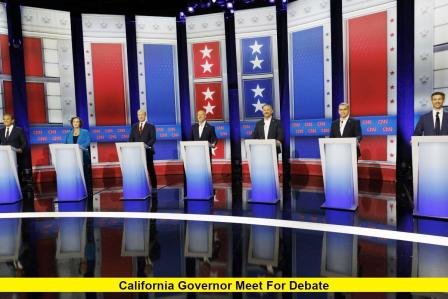
Seven candidates for California governor — five Democrats and two Republicans — squared off in the most high-profile debate of the race so far, broadcast nationally and hosted in the Los Angeles area. The debate came at a pivotal moment, with mail ballots already being delivered to voters across the state and just weeks left before Election Day.
The candidates on stage were Democrats Xavier Becerra, Katie Porter, Tom Steyer, Matt Mahan, and Antonio Villaraigosa, and Republicans Steve Hilton and Chad Bianco. All are competing to replace Democratic Governor Gavin Newsom, who is constitutionally barred from seeking a third term.
With no clear Democratic front-runner emerging and Republicans performing surprisingly well in early polls, the stakes could not be higher — for California Democrats especially.
Cost of Living Takes Center Stage
No issue dominated the debate more than affordability. California currently holds the highest average gas prices in the country, with drivers paying significantly more per gallon than the national average. The state is also tied for the highest unemployment rate in the nation, a striking reality that moderators pressed the Democratic candidates to address head-on.
Democrats struggled at times to articulate what the party has accomplished after more than 15 years controlling the governor’s office. Becerra pointed to federal tariffs and the ongoing war in Iran as key drivers of rising grocery and gas costs. Steyer vowed to take on “special interests” in healthcare, housing, and energy. Porter acknowledged that California “does need to make changes,” while Mahan said bluntly that the state deserves better.
Becerra: Front-Runner Status Comes With a Target
Xavier Becerra entered the debate with fresh momentum — a boost in polling and a wave of online supporter activity. But that visibility came with scrutiny. Candidates from both sides of the aisle went after the former Health and Human Services Secretary on multiple fronts.
Critics questioned his record as Biden’s HHS secretary, challenged him on immigration policy, and attacked him over a corruption scandal involving his former chief of staff, who pleaded guilty to a criminal case involving campaign funds. Becerra maintained he was never charged or implicated, stating clearly that if he had been involved, he would have appeared in the federal indictment — and he did not.
On healthcare, Becerra faced questions about whether he had softened his support for Medicare for All after appearing to distance himself from the policy while seeking an endorsement from the California Medical Association. On the debate stage, he pushed back: “I haven’t changed. I continue to be for Medicare for All.”
Porter vs. Steyer: A Fight for the Progressive Wing
Former Congresswoman Katie Porter and billionaire Tom Steyer spent much of the debate jabbing at each other for dominance of the progressive lane in the race.
When Steyer declared himself the only candidate willing to take on corporate interests, Porter fired back pointedly — referencing her well-known practice of grilling corporate executives in Congressional hearings using a whiteboard. “There are a lot of CEOs who have been whiteboarded,” she said.
Porter had previously targeted Steyer for his past investments in fossil fuel companies, noting that his campaign has been largely self-funded to the tune of more than $130 million. Steyer has countered that fossil fuel interests are actively working against him precisely because of his climate focus.
The Republican Wild Card: Hilton, Bianco, and Trump
Republican candidate Steve Hilton, a former Fox News host and conservative commentator, walked a careful line throughout the debate. Despite holding a Trump endorsement, Hilton avoided leaning heavily into that association — a calculated move given how unpopular the president remains in deep-blue California. His position: the governor should be focused on working productively with the federal administration, regardless of party.
When Becerra referred to Hilton as someone whose political “daddy” is Donald Trump, Hilton declined to engage, pivoting to policy instead. Riverside County Sheriff Chad Bianco took a harder conservative line, hammering Democrats on immigration and claiming that sanctuary city policies have made California less safe.
High-Speed Rail, AI, and Housing: The Policy Fights
The debate also surfaced sharp disagreements on California’s troubled high-speed rail project. The Los Angeles-to-San Francisco rail line was originally projected to be complete by 2020 but has been plagued by cost overruns and bureaucratic delays. Former LA Mayor Antonio Villaraigosa said he would not cancel the project, while Hilton tore into it as a symbol of government waste.
Matt Mahan delivered one of the night’s sharpest lines, quipping that it should not cost more to travel to Modesto than it cost to reach the moon — and called for sweeping reform of California’s environmental review laws to speed up infrastructure construction.
On artificial intelligence, Mahan highlighted his record in San Jose integrating AI into local government, and the subject of Silicon Valley’s growing involvement in state politics — particularly opposition to a proposed one-time tax on billionaires — also surfaced during the debate.
Earlier Debate at Pomona College: Round One
The CNN debate was not the first time these candidates met on stage. A 90-minute debate held at Pomona College in Claremont on April 28 was broadcast by CBS stations across the state and hosted eight candidates. In that earlier contest, the fighting was similarly chaotic, with Democrats targeting Tom Steyer and Xavier Becerra while the two Republican candidates worked to distinguish themselves from the crowded Democratic field.
A Nexstar-hosted debate on April 22 from KRON4 Studios in San Francisco added another dimension to the race, with moderators from stations across California pressing candidates on the major issues facing the state.
Los Angeles Mayoral Debate Runs in Tandem
The same week as the gubernatorial fireworks, Los Angeles voters got their own debate double-header. Incumbent Mayor Karen Bass faced challengers in a debate hosted by NBC4 and Telemundo 52 on May 6 at the Skirball Cultural Center.
The LA mayoral race has drawn national attention, particularly due to the presence of Spencer Pratt — who lost homes in the Palisades Fire and has been a vocal critic of Mayor Bass’s handling of the January 2025 wildfire crisis — and City Councilmember Nithya Raman, who has led challengers in recent fundraising reports. Mayor Bass, Pratt, and Raman have emerged as the three front-runners in a field of 14 candidates.
The mayoral and gubernatorial debates both focused on five core topics: wildfires, immigration, homelessness, public safety, and quality of life — issues that resonate deeply with Southern California voters still recovering from the devastating fires of early last year.
The Democratic Nightmare Scenario
Perhaps the most alarming prospect for California Democrats is what political observers are calling a nightmare scenario: under the state’s top-two primary system, the two candidates with the most votes advance to the November general election regardless of party. If the Democratic vote is split too many ways across five or more candidates, two Republicans could theoretically take the top two spots on June 2 — setting up a Republican-vs.-Republican general election to lead the bluest large state in the nation.
That reality is sharpening minds and accelerating the urgency behind every remaining debate appearance.
Key Dates for California Voters
- May 18 — Last day to register to vote in the primary
- June 2 — Primary Election Day; vote centers open 7 a.m. to 8 p.m. statewide
- November — General election between the top two primary finishers
Stay Informed — The Race Is Far From Over
The California governor’s race remains one of the most unpredictable in the country. With mail ballots in hand and less than four weeks until the primary closes, voters have real choices to make — and the debates this week gave them more to think about than ever. Stay tuned for continued coverage as the race enters its final stretch.