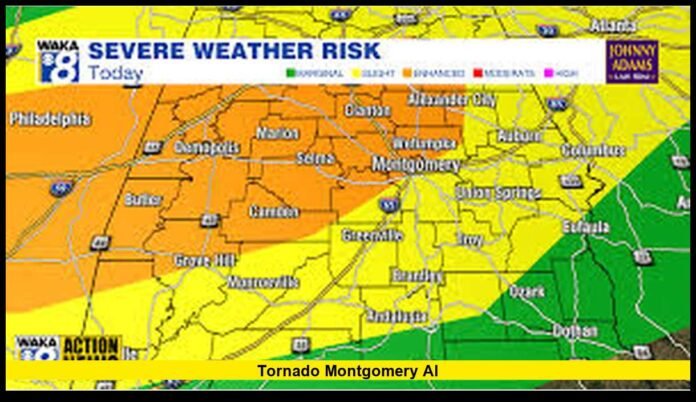

Tornado Montgomery AL warnings and severe weather concerns dominated Central Alabama this week as powerful thunderstorms moved through the region, creating dangerous conditions for residents across Montgomery County and nearby communities. Forecasters warned of damaging winds, isolated tornadoes, hail, heavy rainfall, and flash flooding as unstable weather patterns intensified throughout the state during the first week of May 2026.
Local emergency officials remained on high alert while residents monitored radar updates and weather alerts throughout the day and overnight hours. Meteorologists stressed that conditions could change rapidly as storm cells strengthened across Central Alabama, making preparedness especially important for families in the Montgomery area.
Strong Storm System Targets Central Alabama
A volatile weather setup developed across Alabama as warm Gulf moisture combined with unstable atmospheric conditions and strong upper-level winds. Meteorologists explained that this combination created a favorable environment for severe thunderstorms capable of producing tornadoes.
Montgomery sat within an active corridor where rotating storms became possible during the late afternoon and evening hours. Forecast models showed several waves of storms tracking eastward across the state, increasing concerns about severe weather impacts throughout the region.
Weather experts noted that straight-line winds remained one of the biggest threats during the outbreak. However, isolated tornadoes also remained possible as stronger storm cells developed rotation.
Residents across Montgomery County spent much of the day preparing for possible severe weather emergencies. Stores saw increased traffic as families stocked up on bottled water, batteries, flashlights, and emergency supplies ahead of the storms.
Why Tornado Threats Increase During Spring in Alabama
Spring remains one of the most active tornado seasons in Alabama. Warm temperatures and rising humidity levels often create ideal conditions for severe thunderstorms across the Southeast.
Meteorologists explained that Alabama sits in a region known for frequent severe weather outbreaks because warm air from the Gulf of Mexico regularly collides with cooler, drier air moving across the country. When strong winds higher in the atmosphere interact with unstable air near the surface, rotating thunderstorms can form quickly.
Central Alabama has experienced numerous severe weather outbreaks over the years, making storm preparedness a major priority for local officials and emergency management agencies.
Several conditions contributed to this week’s tornado concerns in Montgomery:
- High atmospheric instability
- Increased Gulf moisture
- Strong wind shear
- Rapid thunderstorm development
- Fast-moving storm systems
These ingredients often increase the likelihood of severe thunderstorms capable of producing tornadoes and damaging winds.
Montgomery Residents Monitor Watches and Warnings
As storms intensified, tornado watches covered large portions of Central Alabama, including Montgomery and surrounding counties.
Weather officials reminded residents that a tornado watch means conditions are favorable for tornado development. A tornado warning means a tornado has either been detected by radar or confirmed visually.
Understanding the difference remains critical during severe weather outbreaks because warnings require immediate action.
Throughout the evening, meteorologists tracked several rotating storm cells moving toward populated areas. Local television stations interrupted regular programming to provide continuous storm coverage while radar operators monitored potential tornado signatures.
Emergency alerts sent to smartphones warned residents to remain weather aware and prepare to seek shelter if storms strengthened further.
Storm Timing Creates Additional Safety Concerns
One major concern during the severe weather outbreak involved storm timing. Forecasters warned that some of the strongest storms could move through Montgomery after sunset.
Nighttime tornadoes are especially dangerous because visibility becomes limited. Many residents may already be asleep when warnings are issued, reducing valuable reaction time.
Emergency officials strongly encouraged families to keep phones charged and weather alerts activated overnight.
Meteorologists also reminded residents not to rely only on outdoor warning sirens. Experts recommended using multiple alert systems to stay informed during severe weather.
Recommended weather alert tools included:
| Alert Method | Purpose |
|---|---|
| NOAA Weather Radio | Emergency alerts |
| Smartphone notifications | Tornado warnings |
| Local television coverage | Live radar updates |
| Weather apps | Storm tracking |
| Battery-powered radio | Backup communication |
Officials stressed that quick action during tornado warnings can save lives.
Heavy Rain and Flooding Threats Grow
In addition to tornado concerns, heavy rainfall created flooding risks across portions of Montgomery and surrounding communities.
Repeated storms moving over the same areas increased concerns about flash flooding on roads, highways, and low-lying neighborhoods. Urban flooding also became possible where drainage systems struggled to handle intense rainfall.
Emergency management agencies warned drivers to avoid flooded roadways.
Flooded roads can appear deceptively shallow at night or during heavy rain. Even a small amount of moving water can sweep vehicles away.
Strong storms also created hazardous driving conditions because heavy rain reduced visibility across major roads in Central Alabama.
How Tornadoes Develop During Severe Thunderstorms
Meteorologists explained that tornadoes typically form inside rotating thunderstorms called supercells.
These storms develop when warm, moist air rises rapidly into colder air above. Changes in wind speed and direction with height create spinning motion inside the atmosphere. Thunderstorm updrafts can tilt that rotation vertically, eventually forming a rotating column of air.
If the circulation strengthens enough to touch the ground, a tornado forms.
Some tornadoes remain weak and short-lived. Others grow stronger and produce widespread damage.
Weather experts noted that not every severe thunderstorm produces a tornado. However, storms capable of rotation always require close monitoring because conditions can intensify rapidly.
Severe Wind Gusts Cause Additional Damage Risks
While tornadoes often receive the most attention during severe weather outbreaks, damaging straight-line winds can also create major destruction.
Forecasters warned that some storms moving through Montgomery could produce wind gusts exceeding 60 miles per hour.
These winds can:
- Knock down trees
- Damage roofs
- Break power lines
- Cause widespread outages
- Damage vehicles and buildings
Power companies prepared repair crews ahead of the storms in anticipation of possible outages across Central Alabama.
Falling trees and limbs remain one of the leading causes of storm-related property damage during severe weather events in Alabama.
Mobile Homes Face Increased Tornado Danger
Emergency officials repeatedly emphasized the dangers tornadoes pose to mobile and manufactured homes.
Even weaker tornadoes and severe winds can overturn or destroy mobile homes quickly. Residents living in these structures were urged to identify safer shelter locations before storms arrived.
Safe shelter options include:
- Community storm shelters
- Reinforced buildings
- Basements
- Interior rooms in sturdy homes
Officials stressed that waiting until a warning is issued may leave too little time to relocate safely.
This message became especially important because some storms threatened Montgomery during overnight hours.
Importance of Family Emergency Plans
Emergency preparedness experts encouraged families to review tornado safety plans before storms developed.
A strong emergency plan helps families react faster during dangerous weather situations.
Recommended preparedness steps included:
- Identifying a safe shelter location
- Keeping emergency supplies ready
- Charging phones and backup batteries
- Monitoring weather updates continuously
- Planning communication methods for family members
Experts also recommended including pets in severe weather plans whenever possible.
Families were encouraged to practice tornado drills regularly, especially during active storm seasons.
What To Do During a Tornado Warning
Meteorologists repeatedly reminded residents that tornado warnings require immediate action.
The safest place during a tornado warning is usually an interior room on the lowest floor of a sturdy building, away from windows.
Recommended shelter areas include:
Best Shelter Locations
- Basement
- Storm shelter
- Interior hallway
- Bathroom without windows
- Small interior closet
Unsafe Areas
- Vehicles
- Mobile homes
- Rooms with large windows
- Overpasses
- Open outdoor areas
Weather officials warned residents not to waste time trying to visually confirm tornadoes during nighttime storms.
Flying debris remains one of the deadliest tornado hazards.
Also Read – Tornado Watch Florida
Live Storm Coverage Becomes Essential During Outbreaks
As storms moved across Alabama, local television meteorologists provided continuous live coverage for viewers tracking severe weather conditions.
Many residents turned to live radar streams, smartphone apps, and social media weather coverage to follow storm movement in real time.
Modern radar technology allows meteorologists to detect possible tornado rotation earlier than in previous decades. Dual-polarization radar systems help weather experts identify dangerous storm signatures quickly.
Wireless Emergency Alerts sent directly to smartphones also improved warning distribution during fast-moving weather events.
Even with advanced technology, meteorologists warned that tornadoes can still develop rapidly with limited warning time.
Montgomery Schools and Community Services Adjust Schedules
The severe weather threat affected schools, businesses, and community organizations throughout Central Alabama.
Several school districts adjusted schedules because of concerns about storms arriving during dismissal times or evening activities.
Community leaders monitored forecasts closely while emergency management agencies coordinated response plans in case significant storm damage occurred.
Utility crews also prepared equipment and personnel before the storms arrived to help restore service quickly if outages developed.
Preparedness planning often begins well before severe storms enter the area.
Why Alabama Tornadoes Can Be Especially Dangerous
Meteorologists frequently describe Alabama as part of “Dixie Alley,” a region known for frequent tornado activity across the southeastern United States.
Unlike the open terrain of the Great Plains, Alabama’s landscape contains dense forests, hills, and limited visibility in many areas.
These conditions can make tornadoes harder to spot.
Several factors increase tornado dangers across Alabama:
- Nighttime tornadoes occur frequently
- Heavy rain often hides funnels
- Trees block visibility
- Fast-moving storms reduce reaction time
- Population growth increases exposure
Because of these risks, emergency officials strongly encourage residents to take every warning seriously.
Storm Recovery Efforts Often Begin Immediately
After severe weather passes, emergency crews often begin damage assessments quickly.
Local agencies monitor reports involving:
- Downed trees
- Flooded roads
- Damaged power lines
- Structural damage
- Injuries or blocked roadways
Power restoration efforts usually become a major focus after strong thunderstorms move through heavily populated areas.
Utility crews sometimes work overnight to restore electricity to affected neighborhoods.
Officials also remind residents to avoid downed power lines after storms.
How Residents Prepare for Future Severe Weather
Severe weather preparedness remains a year-round priority for many Alabama families.
Experts recommend maintaining emergency kits containing:
- Flashlights
- Batteries
- Bottled water
- Nonperishable food
- Prescription medications
- First aid supplies
- Portable phone chargers
- Important personal documents
Preparedness experts also encourage residents to monitor weather forecasts regularly during spring and early summer when severe weather activity typically increases.
Knowing where to shelter before storms arrive can make a major difference during emergencies.
Technology Improves Forecast Accuracy
Weather forecasting technology has improved significantly over the last several decades.
Meteorologists now use advanced radar systems, satellite imagery, computer forecast models, and storm spotter networks to track developing severe weather more accurately.
These tools help weather offices issue warnings faster and provide more detailed storm information to the public.
However, experts stress that forecasts still involve changing conditions. Storm intensity and exact storm tracks can shift quickly during major weather outbreaks.
Continuous monitoring remains important whenever tornado watches or severe thunderstorm warnings are issued.
Community Awareness Helps Save Lives
One of the most important lessons during severe weather events involves community awareness and preparation.
Meteorologists and emergency officials consistently emphasize that residents should stay informed and act immediately when warnings are issued.
Quick decisions often reduce injuries during tornado outbreaks.
Prepared communities usually recover faster because residents understand emergency procedures and safety recommendations before storms arrive.
Local weather awareness campaigns continue encouraging Alabama families to prepare for tornado season each year.
Tornado Montgomery AL Concerns Remain Serious During Spring Weather Season
The tornado Montgomery AL severe weather threat once again highlighted the importance of preparation, awareness, and rapid response across Central Alabama. Strong storms moving through the region brought dangerous conditions that included tornado risks, damaging winds, hail, flooding, and widespread lightning activity.
Meteorologists continue monitoring active weather patterns across Alabama as spring storm season remains underway. Residents across Montgomery and nearby communities are encouraged to stay weather aware, monitor local forecasts, and review emergency safety plans whenever severe weather threatens the region.
Severe weather can develop quickly across Alabama, so staying informed and prepared remains one of the best ways to protect your family and property during storm season.