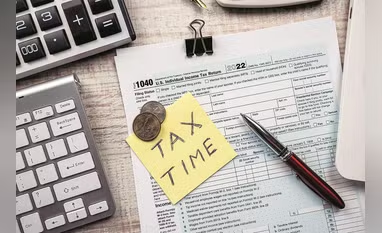

The financial services industry has a quiet secret: one of its most dependable, in-demand career paths requires no four-year degree, no Wall Street connections, and no massive financial investment to enter. For Americans looking for a career with real income potential and flexible work arrangements, learning how to become a tax preparer may be the most overlooked professional opportunity of the decade.
With tax codes growing more complex each year and millions of households and small businesses actively seeking professional help, the window of opportunity for new tax professionals has never been wider.
A Profession Built on Permanent Demand
Death and taxes, as the saying goes, are the only certainties in life. That enduring truth is what makes tax preparation one of the most recession-resistant career choices available. Regardless of economic conditions, every individual and business in the country must file tax returns. That requirement does not shrink during downturns — if anything, financial uncertainty drives more people toward professional help.
The profession sits at the intersection of finance, law, and personal service. Tax preparers work directly with clients to organize financial records, identify deductions and credits, ensure regulatory compliance, and file accurate returns on their behalf. It is detailed, meaningful work — and the market for it is enormous.
The Truth About Entry Requirements
Here is what surprises most people: the federal government sets a remarkably low barrier to entry for this profession. The Internal Revenue Service requires all paid tax preparers to hold one thing — a Preparer Tax Identification Number, universally known as a PTIN. That single credential is the legal green light to begin preparing federal tax returns for compensation.
Applying for a PTIN takes roughly fifteen minutes through the IRS online portal. As of 2025, the registration fee sits at $19.75 — a negligible cost compared to what the credential unlocks. The number must be renewed annually, but renewal is equally fast and simple.
No college degree is mandated. No prior accounting background is required. No licensing exam stands between an applicant and their first PTIN. What matters is knowledge — and knowledge can be built quickly with the right training.
Getting the Right Education Before Anything Else
While the PTIN is the legal minimum, education is what separates a competent tax preparer from a truly trusted one. Tax preparation courses are available through community colleges, online learning platforms, and specialized professional schools. Most programs can be completed in a matter of weeks.
A solid curriculum will cover federal tax law fundamentals, different types of income and deductions, filing categories, client communication skills, and hands-on work with professional tax software. The last point matters more than most beginners expect. In modern tax practice, software proficiency is not optional — it is the engine of the entire operation.
Some training programs also prepare students for nationally recognized certification exams, including those offered through bookkeeping and accounting associations. Passing such an exam, while voluntary, signals seriousness to prospective clients and employers alike.
State Rules Are Not Uniform — Know Yours
Once the federal PTIN is secured, the next critical step is understanding state-level requirements — and these vary significantly across the country.
Several states impose strict additional licensing on top of the federal credential. California stands out as the most demanding, requiring registration with a dedicated state oversight body, completion of a 60-hour qualifying course, a background screening, fingerprinting, and a surety bond to protect clients. Annual renewal requires 20 additional hours of continuing education.
Oregon, Maryland, and New York also impose registration requirements that go beyond the federal baseline. In contrast, the majority of states have no additional licensing requirements beyond the IRS PTIN.
This matters enormously. Practicing without the required state credentials can result in fines, legal liability, and loss of business. Researching local rules before taking on any paying clients is not just advisable — it is essential.
Certifications That Accelerate Everything
A PTIN opens the door. Professional certification blows it off the hinges.
Enrolled Agent (EA) is widely considered the most strategic certification for anyone serious about building a tax career. Granted directly by the IRS, the EA designation requires passing a rigorous three-part examination covering individual tax, business tax, and representation before the IRS. There are no education prerequisites — the exam alone is the gateway. Enrolled Agents hold unlimited representation rights, meaning they can defend clients in audits, appeals, and collection proceedings — services a basic PTIN holder cannot offer.
Certified Public Accountant (CPA) is the more comprehensive credential, covering accounting, auditing, and financial management far beyond taxes alone. It demands a relevant degree, state board approval, and passage of a four-part examination. The time investment is significantly greater, but so is the career ceiling. CPAs frequently move into tax management, financial advisory, and executive roles.
Annual Filing Season Program (AFSP) is a voluntary IRS initiative that recognizes non-credentialed preparers who complete a defined number of continuing education hours each year. Participants are listed in the IRS public directory of tax professionals and gain limited representation rights — a meaningful step up from PTIN-only status.
The general rule of thumb: start with a PTIN, gain real experience across at least two tax seasons, then pursue the EA credential. That sequence has launched thousands of successful tax careers at an efficient pace and cost.
Real Experience Is the Real Classroom
No course fully replicates the pressure and nuance of sitting across from an actual client with real financial questions. Practical experience is irreplaceable, and the good news is that it is accessible from day one.
The IRS Volunteer Income Tax Assistance program — commonly called VITA — places trained volunteers in communities to prepare free returns for qualifying individuals. For a new preparer, VITA offers supervised, real-world experience without the stakes of running an independent practice. It builds speed, judgment, and confidence faster than any textbook.
After a season or two of VITA experience, most preparers feel ready to take on paid clients independently or join a professional tax firm. Starting with straightforward individual returns and gradually moving into business returns, rental income, investments, and multi-state filings is the natural and sensible progression.
What the Paychecks Look Like
The income range for tax preparers is broad — intentionally so, because the profession rewards ambition and specialization.
Entry-level preparers working seasonally typically earn between $30,000 and $40,000 annually. Full-time professionals with a few years of experience and a growing client base commonly earn in the $50,000 to $65,000 range. Those who hold an EA or CPA credential, specialize in business tax or high-net-worth clients, or operate their own practice frequently surpass $80,000 to $100,000 per year.
Geography is a significant variable. Tax professionals in California, New York, and New England states consistently earn above the national average, reflecting both the cost of living and the density of complex financial situations requiring expert help. Independent preparers in mid-sized cities who build loyal client bases can reach six figures within five to seven years.
The profession also offers something increasingly rare: genuine flexibility. Many preparers work remotely, run home-based practices, or serve clients entirely online through secure platforms. The seasonal structure also makes tax preparation an ideal second income stream for those who want supplemental earnings without abandoning a primary career.
Building a Practice That Lasts
Long-term success in tax preparation is built on three pillars: expertise, reputation, and relationships.
Staying current with annual tax law changes is non-negotiable. The IRS updates rules, credits, and thresholds every year, and clients expect their preparer to know the latest developments before they walk in the door. Continuous education — whether through IRS updates, professional seminars, or formal coursework — is a permanent feature of this career, not a one-time obligation.
Professional associations such as national tax professional organizations offer members access to training resources, peer networks, practice management tools, and legislative updates. Membership signals professionalism and often leads to referral networks that feed a growing client base.
Ethical conduct underpins everything. The IRS Circular 230 document outlines the standards governing tax professional behavior, and understanding it thoroughly is one of the first things every serious preparer should do. A single ethical lapse can destroy a practice built over years. A consistent record of accuracy, honesty, and client confidentiality, on the other hand, generates the kind of trust that sustains a decades-long career.
The Takeaway for Anyone Considering This Path
The tax profession rewards people who are detail-oriented, genuinely helpful, and committed to staying sharp in a field that never stands still. It does not reward shortcuts or complacency. But for those willing to invest in solid training, pursue meaningful credentials, and serve clients with integrity, tax preparation offers one of the most stable and scalable professional paths available in today’s economy — no prestigious degree required.
The IRS keeps the front door open. What you build once you walk through it is entirely up to you.