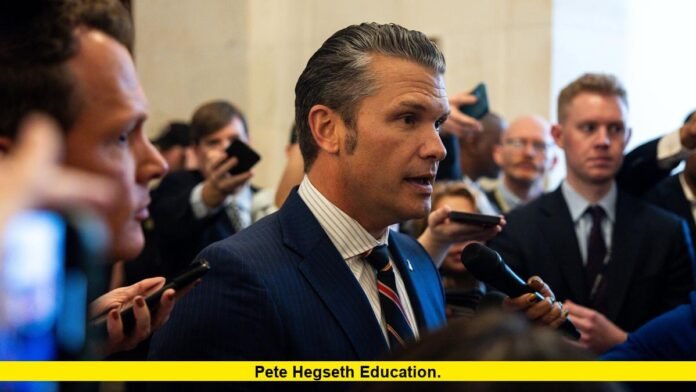

Pete Hegseth, the 29th United States Secretary of Defense, is one of the most talked-about figures in American public life today. While his military service and media career have drawn widespread attention, his academic credentials and views on education are equally compelling — and often surprising. This article takes a deep dive into Pete Hegseth’s education, tracing his journey from a small Minnesota town to the corridors of two of America’s most prestigious universities, and how his educational background shapes his current role at the helm of the U.S. Department of Defense.
Early Life and Academic Beginnings
Pete Hegseth was born on June 6, 1980, and raised in Forest Lake, Minnesota — a tight-knit community that instilled in him values of hard work, discipline, and patriotism from an early age. A standout student, he graduated as the valedictorian of his high school class, demonstrating the academic excellence that would carry him to some of the nation’s most elite institutions. This early distinction set the tone for a life characterized by ambition and a relentless drive to excel.
Pete Hegseth’s Princeton Education
After high school, Hegseth enrolled at Princeton University — one of the most prestigious universities in the world — where he majored in politics and earned his Bachelor of Arts degree in 2003. Interestingly, he chose Princeton over an offer from the United States Military Academy, reportedly to play basketball at the Ivy League school, reflecting a young man already navigating complex choices between opportunity and service.
During his time at Princeton, Hegseth was deeply active on campus beyond the classroom. He rose to become the publisher and editor of The Princeton Tory, a conservative student publication where he engaged with some of the most divisive political and cultural questions of the day. He also participated in Army ROTC, laying the groundwork for the military career that would define the next phase of his life.
His Princeton years shaped his conservative intellectual identity. Even as a young student, Hegseth was unafraid to challenge prevailing campus opinion — a trait that would become his signature in the decades ahead.
Pete Hegseth’s Harvard Education
One of the most nuanced and debated aspects of Pete Hegseth’s education is his graduate degree from Harvard University — an institution he has since become one of the most vocal critics of.
While working with Vets for Freedom, a nonprofit veterans advocacy organization he helped lead after leaving the military, Hegseth enrolled at Harvard’s John F. Kennedy School of Government in 2009. He initially studied for one semester before pausing his studies, ultimately returning to complete his degree. In 2013, he graduated with a Master of Public Policy degree, having submitted a 47-page policy brief as his capstone work.
That policy brief has since attracted considerable attention given how starkly it contrasts with his current public positions. As a Harvard graduate student, Hegseth advocated for the creation of a public STEM high school in Minnesota that would emphasize equity and prioritize a diverse student body — language and ideas that sit in direct tension with the anti-DEI policies he has championed as Secretary of Defense.
Despite holding a Harvard degree, Hegseth has publicly vowed to return his diploma, declaring that Harvard should be renamed “critical theory university.” He has called college an “educational cartel” and a “socialist camp,” and has stated that the more elite a university, the less he trusts its graduates. It is a paradox that has become one of the most-discussed aspects of his public persona: a man armed with two Ivy League credentials who campaigns vigorously against the very institutions that credentialed him.
Two Ivy League Degrees: A Defining Contradiction
Pete Hegseth holds one of the most elite educational pedigrees in American political life — a Bachelor of Arts in Politics from Princeton and a Master of Public Policy from Harvard — yet he has become one of the most prominent voices attacking elite higher education in the country.
This contradiction is not lost on observers. He has openly criticized universities for what he sees as ideological indoctrination, lamenting that institutions like Harvard are “factories” for producing leaders who view America negatively. At the same time, his own academic record demonstrates that he not only succeeded within these institutions but sought out their most advanced degrees.
Whether this makes him a hypocrite or a credible insider critic depends largely on one’s political vantage point. What is undeniable is that Pete Hegseth’s education gave him a platform, a vocabulary, and a credential set that few of his ideological peers can match.
Military Education and Training
Pete Hegseth’s formal education extends well beyond the ivy-covered walls of Princeton and Harvard. In 2003, the same year he earned his undergraduate degree, he was commissioned as an infantry officer in the Minnesota Army National Guard — beginning a military career that would take him to some of the world’s most dangerous places.
He served at Guantanamo Bay Naval Base, deployed to Iraq with the 101st Airborne Division, where he served as an Infantry Platoon Leader in Baghdad and as a Civil-Military Operations officer in Samarra, and later returned to Afghanistan as a senior counterinsurgency instructor at the Counterinsurgency Training Center in Kabul. He earned two Bronze Stars and a Combat Infantryman’s Badge for his service.
This real-world military education — gained on the ground in active conflict zones — arguably shaped Hegseth’s thinking more profoundly than any university classroom. It gave him a firsthand understanding of what combat readiness means, what military culture demands, and what he believes is at stake when political ideology infiltrates the armed forces.
Pete Hegseth’s Views on Education Policy as Secretary of Defense
Since being sworn in as Secretary of Defense on January 25, 2025, Hegseth has moved aggressively to reshape the education landscape within the Department of Defense, making his views on schooling a matter of national policy rather than media commentary.
Overhaul of DoDEA Schools
The Department of Defense Education Activity (DoDEA) operates 161 accredited schools serving more than 67,000 children of active-duty military personnel and Department of Defense civilian families. Hegseth has targeted this system for sweeping transformation. He replaced the existing DoDEA director, appointing a retired Army colonel in her place, and declared that the new leadership would “swiftly reorient the Department toward patriotic values and classical learning, consistent with the Department’s focus on merit, standards, and excellence.”
Book Removals and Curriculum Overhaul
Among his most controversial moves, Hegseth oversaw the removal of hundreds of books from DoDEA schools, targeting materials deemed related to gender ideology or discriminatory equity ideology. Democratic lawmakers sent formal letters demanding the restoration of the removed books, arguing that the removals constituted censorship in violation of the First Amendment. Hegseth and Pentagon officials have defended the changes as necessary to align military-connected schools with American values and away from what they describe as ideological programming.
Homeschooling and School Choice
In line with a broader White House executive order, Hegseth ordered a review of the Department of Defense’s support for military families who choose to homeschool their children, both in the United States and overseas. He has expressed strong support for expanding educational choice for military families, framing it as a natural extension of the Department’s commitment to the well-being of service members and their dependents.
Dismantling DEI at Military Academies
Hegseth directed the nation’s military academies — West Point, Annapolis, and the Air Force Academy — to admit students solely on merit, eliminating diversity, equity, and inclusion considerations from the admissions process. He also oversaw the removal of nearly 400 DEI-related books from Pentagon and military libraries, and changed physical fitness standards across the services to apply a single, uniform male standard to all service members regardless of gender.
He has been unambiguous about his philosophy: “Diversity is our strength” is, in his words, the “single dumbest phrase in military history.”
Authored Works Reflecting His Educational Philosophy
Hegseth’s educational views are thoroughly documented through his published books. He authored In the Arena: Good Citizens, a Great Republic, and How One Speech Can Reinvigorate America (2016), American Crusade: Our Fight to Stay Free (2020), and The War on Warriors: Behind the Betrayal of the Men Who Keep Us Free (2024). He also co-authored Battle for the American Mind: Uprooting a Century of Miseducation, which became a New York Times bestseller and lays out his comprehensive critique of the American education system.
In these works, Hegseth argues that progressive ideology has captured American schools and universities, systematically dismantling the cultural and civic foundations that once made American education a source of national strength. His books have been widely read within conservative circles and have helped cement his reputation as one of the most prominent cultural commentators of his generation.
Confirmation and the Road to the Pentagon
Hegseth’s path to the Pentagon was not smooth. His confirmation hearings were contentious, with critics questioning both his qualifications to lead the world’s largest government agency and his personal conduct. The Senate ultimately confirmed him in a 51–50 vote on January 24, 2025, with Vice President JD Vance casting the tie-breaking vote — only the second time in U.S. history that a cabinet nominee required a vice-presidential tiebreaker to be confirmed.
The narrow margin reflected deep divisions over Hegseth’s nomination, but also underscored the degree to which his appointment was seen as a deliberate signal — a choice by President Trump to install a loyalist with a clear cultural and educational agenda at the head of America’s military.
Why Pete Hegseth’s Education Matters
Understanding Pete Hegseth’s education is essential to understanding the man and his mission. He is simultaneously a product of the elite academic establishment he so forcefully critiques and a determined force working to reshape how America’s military families educate their children.
His Princeton degree gave him intellectual discipline and conservative convictions. His Harvard degree gave him policy tools — and, paradoxically, fuel for his critique of elite institutions. His military deployments gave him conviction rooted in sacrifice and lived experience. And his current role as Secretary of Defense gives him the power and the platform to act on all of it.
Whether one sees him as a contradiction, a reformer, or a provocateur, Pete Hegseth’s educational journey is undeniably one of the most fascinating in modern American public life. It is a story of ambition, transformation, and the ongoing battle over what — and how — the next generation of Americans should learn.