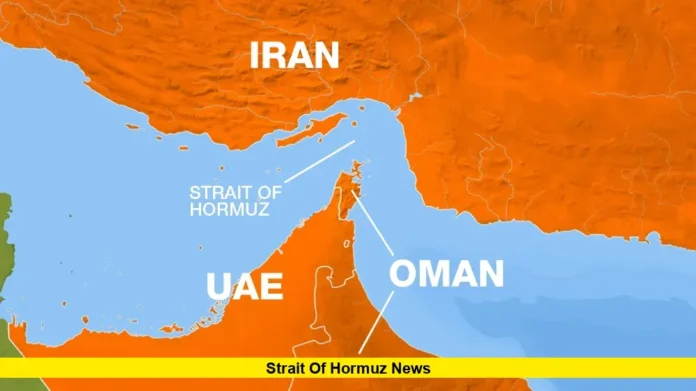

The Strait of Hormuz — a narrow passage connecting the Persian Gulf to the Gulf of Oman — has emerged as the most consequential flashpoint in global energy and geopolitics today. What was once a routinely busy waterway is now the center of an unprecedented maritime standoff, reshaping oil markets, global supply chains, and international diplomacy in real time.
What Is the Strait of Hormuz and Why Does It Matter?
The Strait of Hormuz is located between Iran and Oman, at its narrowest measuring just 34 kilometres (21 miles) wide. Despite its modest dimensions, it carries an outsized weight in the global economy. According to the U.S. Energy Information Administration (EIA), in 2024, oil flow through the strait averaged 20 million barrels per day (b/d), equivalent to roughly 20% of global petroleum liquids consumption. Flows through the strait in 2024 also represented more than one-quarter of total global seaborne oil trade.
As per the International Energy Agency (IEA), in 2025, nearly 15 million barrels per day of crude oil — nearly 34% of all global crude oil trade — passed through the Strait of Hormuz, with the majority destined for Asia. China and India combined received 44% of these exports. The IEA further notes that the strait serves as the primary export route for oil produced by Saudi Arabia, the UAE, Kuwait, Qatar, Iraq, Bahrain, and Iran.
Beyond crude oil, the strait is equally critical for liquefied natural gas (LNG). According to the IEA, nearly 20% of global LNG trade — primarily from Qatar — transited the Strait of Hormuz in 2024. Qatar alone exported over 112 billion cubic metres (bcm) of LNG in 2025, making it the world’s second-largest LNG exporter, and virtually all of it moves through this single waterway.
How the Strait of Hormuz Crisis Began
The current Strait of Hormuz crisis traces its origins to the dramatic escalation of tensions between the United States, Israel, and Iran. According to Wikipedia’s extensively sourced account of the crisis, tensions had been building through failed nuclear negotiations in Geneva and a prior 12-day air conflict. On 28 February, the United States and Israel launched an air campaign against Iran and assassinated its Supreme Leader Ali Khamenei. In retaliation, Iran launched missile and drone attacks on Israel, U.S. military bases, and U.S.-allied Gulf states.
As per NBC News, Iran launched strikes on ships transiting the strait and demanded tolls from vessels, effectively shutting down a trade route through which some 20% of the world’s oil and natural gas once passed. The Iranian Revolutionary Guard Corps (IRGC) issued formal warnings forbidding passage and subsequently began boarding and attacking merchant vessels while laying sea mines in the strait.
According to CBS News, major container shipping companies — including Maersk, CMA CGM, and Hapag-Lloyd — suspended transits through the strait and related routes such as the Red Sea almost immediately after the crisis erupted.
The “Dual Blockade”: Iran Closes the Strait, the U.S. Blockades Iran
What has made the current Strait of Hormuz crisis uniquely complex is what analysts have termed a “dual blockade.”
On one side, Iran effectively closed the strait to commercial traffic, restricting passage primarily to vessels that complied with its new requirements — including permission from Iranian authorities and, later, toll payments exceeding $1 million per ship. According to CNN, the IRGC published a map designating alternative transit routes through Iran’s territorial waters near Larak Island, effectively scrapping the International Maritime Organization’s (IMO) official shipping corridor. “The official IMO lane has been almost entirely abandoned,” CNN reported.
On the other side, from 13 April, the U.S. Navy began blockading Iranian ports. As per U.S. Central Command (CENTCOM), the blockade applies to all ships entering or leaving Iranian ports and coastal areas, but was clarified not to impede freedom of navigation for vessels transiting to and from non-Iranian ports.
According to Al Jazeera, as of late April, the U.S. had turned away 31 vessels as part of its naval blockade, most of them oil tankers. President Trump declared on Truth Social that Iran is “collapsing financially,” claiming it is “losing $500 million a day.”
However, as per Kpler, the trade intelligence firm, Iran actually exported 1.84 million barrels per day of crude oil in March and approximately 1.71 million bpd in early April — higher than its 2025 average of 1.68 million bpd — as it allowed select vessels through under its toll regime.
Ceasefire Attempts: Announced, Broken, Extended
The diplomatic situation has been as volatile as the military one.
According to NBC News, a temporary ceasefire was agreed on 8 April, but within a day, Iran’s IRGC claimed traffic had been halted again after what it called an Israeli ceasefire violation in Lebanon. As per Al Jazeera, on 17 April, following a Lebanon ceasefire agreement, Iranian Foreign Minister Abbas Araghchi announced that all commercial vessels would be allowed through the strait during the truce. However, Iran’s National Security Council subsequently stated that Iran would maintain control over the strait.
According to CBS News, on 17 April, Iran attacked and seized three commercial ships in the Strait of Hormuz just hours after President Trump announced he was extending the ceasefire indefinitely. The White House press secretary clarified that Trump did not view the seizure as a ceasefire violation because “these were not U.S. ships. These were not Israeli ships.”
As per NBC News ship-tracking data, even during the brief windows when both Iran and the United States claimed the strait was open, traffic remained a fraction of normal levels. Before the crisis, more than 3,000 vessels used the strait each month. According to the UK Parliament’s House of Commons Library, vessel numbers have now fallen to around 5% of pre-crisis levels.
The Human and Economic Toll: Ships Stranded, Oil Prices Surge
The scale of disruption is historic. According to the International Energy Agency, halting traffic in the Strait of Hormuz has caused “the largest oil supply disruption in the history” of the global oil market — larger even than the 1970s oil shocks. The head of the IEA described the situation as “the greatest global energy security challenge in history.”
As per Al Jazeera, more than 600 vessels, including 325 tankers, remain stranded in the Gulf. According to Lloyd’s List Intelligence, in the entire month of March, just 154 vessels crossed the strait — compared to a pre-war monthly average of over 3,000 ships.
The oil price impact has been severe. According to CBS News, the global benchmark Brent crude has traded as high as $126 a barrel at its peak during the crisis. According to Al Jazeera, as of late April, Brent crude stood at approximately $96 per barrel. Meanwhile, as per Wikipedia’s Iran war fuel crisis article, Brent crude initially surged 10–13% to around $80–82 per barrel within the first days of the conflict, and analysts had forecast prices could reach $100 per barrel if disruptions persisted.
The knock-on effects for consumers have been stark. As per NBC News, U.S. gas prices spiked more than 30% in March, topping an average of $4 per gallon, and prices in April continued to rise. According to Wikipedia, jet fuel in North America has spiked 95% since the war began, and companies including Amazon, FedEx, and the U.S. Postal Service implemented fuel surcharges.
Impact on Asian Economies: The Most Vulnerable
Asian nations face the greatest exposure to the Strait of Hormuz disruption. According to the EIA, approximately 84% of the crude oil and 83% of LNG that moved through the strait was destined for Asian markets in 2024. China, India, Japan, and South Korea were the top destinations, accounting for a combined 69% of all Hormuz crude flows that year.
According to Ioannis Papadimitriou, lead freight analyst at Vortexa, speaking to CNN: “Japan and South Korea were big importers of Saudi and Middle Eastern crudes. And you know, looking at the rest of Asia — taking out China — we can see the big impact and the loss in terms of imports.”
As per Wikipedia, Pakistan officially requested that Saudi Arabia reroute oil supplies through the port of Yanbu on the Red Sea, with Saudi Arabia providing assurances and arranging at least one crude shipment to bypass the closed strait.
Alternative Routes: Limited Options
As per the IEA, only Saudi Arabia and the UAE have operational crude pipelines capable of bypassing the Strait of Hormuz, with an estimated 3.5 to 5.5 million barrels per day of available capacity. The Saudi Aramco East-West pipeline runs from Abqaiq to the Yanbu port on the Red Sea, while the UAE’s Abu Dhabi Crude Oil Pipeline (ADCOP) links inland fields to the Fujairah export terminal on the Gulf of Oman.
However, the IEA also notes that “the logistics and supply chains needed to re-route and export substantial flows have not been robustly tested.” For LNG, there are no alternative routes whatsoever. As per the IEA, a full disruption of LNG through the strait would cause global LNG supply to drop by over 300 million cubic metres per day — double the average amount of gas that transited the Nord Stream pipeline in 2021.
Diplomatic Efforts to Reopen the Strait
Multiple international efforts are underway to restore navigability, though progress has been halting.
According to CBS News, the U.S. State Department launched a diplomatic initiative called the “Maritime Freedom Construct” (MFC), intended to identify safe corridors for commercial vessels. The report notes details remain scarce, but officials stressed it is meant to complement rather than replace other diplomatic efforts, including one initiated by France and the United Kingdom.
As per CBS News, President Trump has also criticised NATO countries for not helping to reopen the strait, accusing them of only offering help “now that the Hormuz Strait situation is nearly over.” NATO allies, according to Reuters, have largely rejected Trump’s requests, with European nations saying it is “not our war.”
On the question of reopening and safety, Jakob Larsen, chief safety and security officer at BIMCO (the leading international shipping organisation), told NBC News that the shipping industry is awaiting “technical details from the U.S. and from Iran on how to transit the Strait of Hormuz safely.”
Will the Strait Reopen — And What Will “Open” Really Mean?
Even when or if the strait formally reopens, experts caution that a full return to normalcy is unlikely in the near term.
According to OilPrice.com, maritime traffic through the Strait of Hormuz has at times fallen by 90% or more, with entire fleets idling outside the strait rather than risking transit. Even after announcements of partial reopenings, major operators refused to send cargo through. As the analysis notes: “The withdrawal of war-risk insurance in early March effectively shut down commercial navigation, regardless of whether the Strait was technically open.”
As per NSI’s Seikaly, quoted by Al Jazeera, insurers require more than just a ceasefire: “They need evidence that the threat environment has fundamentally stabilised. That means a durable ceasefire or political resolution, clear naval security guarantees, consistent freedom of navigation, no recent vessel seizures or attacks, credible mine clearing and surveillance, and predictable rules of engagement among the key military actors in the region.”
According to OilPrice.com, the Cape of Good Hope has already become the default alternative route for Asia–Europe shipping flows, adding 10–14 days and thousands of additional nautical miles to voyages. Shipping lines are now “recalibrating schedules, redeploying fleets, and locking in new routing strategies that assume chokepoint instability as a baseline.”
Food Security: An Overlooked Dimension
Beyond oil, the Strait of Hormuz crisis carries significant food security implications. As per Wikipedia’s Iran war fuel crisis article, the British think tank The Food Policy Institute warned of long-term increases in food prices due to disruption in fuel and fertiliser markets. Over 30% of global urea — widely used in fertiliser production and derived from natural gas — is exported from Gulf countries through the strait.
As per Wikipedia, Iraq had to start shutting down operations at the Rumaila oil field due to lack of storage space, as tankers were unable to leave the strait, further compounding the regional economic strain.
Key Facts at a Glance
- The strait carries ~20% of global oil trade and ~20% of global LNG trade
- Pre-crisis, over 3,000 vessels used the strait monthly; today that figure is roughly 5% of that level
- More than 600 vessels (including 325 tankers) remain stranded in the Persian Gulf
- Brent crude has surged to a multi-year high of $126/barrel at peak
- U.S. gas prices rose more than 30% in March; jet fuel surged 95%
- The IEA has called this the “largest oil supply disruption in market history”
- The U.S. Navy has turned away 31 vessels under its blockade of Iranian ports
- Iran’s IRGC has laid sea mines in the strait; U.S. forces have begun mine-clearing operations
- War-risk insurance premiums surged from 0.125% to over 0.4% of vessel value per transit
Conclusion
The Strait of Hormuz crisis represents an unprecedented convergence of military conflict, energy disruption, diplomatic failure, and economic shock. From skyrocketing oil prices and stranded tankers to the threat of global food insecurity and a “dual blockade” unlike anything the world has seen, every development in the strait carries immediate global consequences. As per the IEA, the world’s emergency stockpiles — roughly 1.2 billion barrels held by member nations — are being drawn upon, but they offer only a temporary buffer. Whether through a durable ceasefire, a negotiated resolution, or a structural rewiring of global trade routes, the world is watching the Strait of Hormuz more closely than at any point in history.