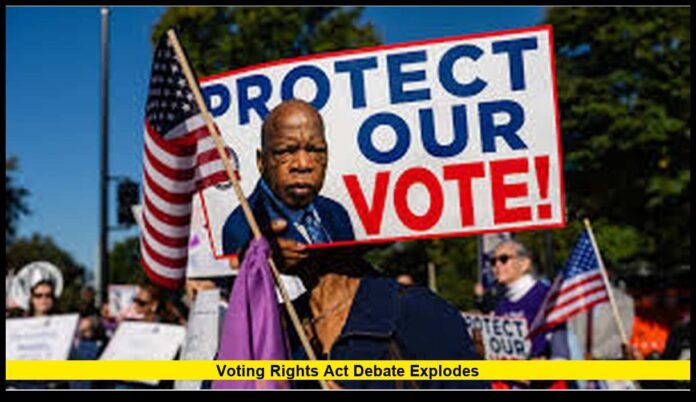

The term voting rights act reddit is rapidly gaining traction as Americans react to a major shift in U.S. election law following a new ruling by the Supreme Court of the United States. The decision is already fueling intense debate online and raising urgent questions about representation, redistricting, and the future of voting protections across the country.
A Landmark Ruling Changes the Legal Landscape
In a closely watched decision, the Supreme Court ruled 6–3 on a case involving congressional maps in Louisiana, reshaping how courts interpret protections under the Voting Rights Act of 1965. At the center of the case was whether lawmakers could draw districts with race as a key factor to ensure fair representation for minority voters.
The Court concluded that the map in question placed too much emphasis on race, crossing constitutional limits. While the ruling did not eliminate Section 2 of the law, it significantly narrowed how it can be applied—especially in cases involving redistricting.
This distinction is crucial. For decades, Section 2 has allowed courts to evaluate whether minority voters have an equal opportunity to elect representatives. Now, the legal standard appears more restrictive, potentially making it harder to challenge district maps in court.
Why the Louisiana Case Became So Important
The case drew national attention because Louisiana’s population is approximately one-third Black, yet previous congressional maps included only one majority-Black district out of six.
After legal challenges, a revised map introduced a second majority-Black district. Supporters argued that this adjustment better reflected the state’s demographics and complied with federal protections.
Opponents disagreed, claiming that race had been used too heavily in drawing the district boundaries. The Supreme Court sided with that argument, determining that the approach violated constitutional principles.
This ruling effectively blocks the revised map and sets a new precedent for how states must balance race and representation when drawing districts.
What This Means for Section 2 Enforcement
Section 2 of the Voting Rights Act has long been a cornerstone of civil rights enforcement. It focuses on outcomes—specifically, whether voting systems disadvantage minority groups.
Under the updated interpretation, courts may now require stronger evidence that mapmakers intentionally discriminated, rather than simply producing unequal results.
This shift changes the burden of proof in future cases. Legal experts say it could discourage some lawsuits or make them significantly more difficult to win.
The broader implication is that fewer districts may be drawn specifically to ensure minority representation, depending on how states interpret the ruling.
Ripple Effects Across the United States
The impact of the decision extends far beyond Louisiana. States across the South and other regions have faced similar legal challenges over redistricting.
Now, lawmakers may revisit how they approach map drawing. Some could adopt more race-neutral strategies to avoid legal challenges, even if that results in fewer majority-minority districts.
This could influence the political balance in the U.S. House of Representatives over time, particularly in closely contested regions.
At the same time, ongoing and future lawsuits will test how lower courts apply the Supreme Court’s updated standard.
Online Reaction: A Surge in Debate
As news of the ruling spread, online platforms lit up with reactions. Discussions quickly intensified, especially in political forums where users analyze breaking developments in real time.
The keyword voting rights act reddit reflects this surge in engagement. Thousands of users are debating what the ruling means for democracy, fairness, and constitutional law.
Some argue that the decision weakens protections that have been in place for decades. Others believe it reinforces the principle that government actions should not prioritize race.
These debates mirror broader national divisions and highlight how legal decisions now unfold in public view almost instantly.
The Constitutional Argument at the Core
The ruling centers on a fundamental question: To what extent can race be considered in government decision-making?
The majority opinion emphasized that while addressing discrimination is important, race cannot dominate the process of drawing electoral districts.
This perspective aligns with a long-standing constitutional principle that laws and policies should treat individuals equally, regardless of race.
However, critics argue that ignoring race entirely can overlook historical inequalities that still affect voting access and representation today.
This tension—between equality under the law and the need to address systemic disparities—remains at the heart of the debate.
Civil Rights Groups Raise Concerns
Advocacy organizations have expressed concern about how the decision could affect minority voters.
For decades, the Voting Rights Act has been viewed as a powerful safeguard against discrimination. Changes in how it is enforced are therefore closely scrutinized.
Some groups worry that the ruling may lead to fewer opportunities for minority communities to elect candidates who represent their interests.
They also caution that the decision could embolden states to adopt maps that are less reflective of demographic realities.
Supporters Say the Ruling Clarifies the Law
Supporters of the decision argue that it provides clearer guidance for states and courts.
They contend that the ruling prevents the overuse of race in government decisions, reinforcing constitutional limits.
From this perspective, the decision ensures that redistricting focuses on neutral principles such as geography and population balance rather than racial considerations.
Proponents believe this approach strengthens the integrity of the electoral system.
What Happens Next in Redistricting Battles
The immediate impact of the ruling is already unfolding. States involved in ongoing redistricting disputes may need to revise their strategies.
Courts will play a critical role in interpreting how the new standard applies to future cases. Legal challenges are expected to continue, as both sides test the boundaries of the decision.
Election officials and lawmakers will also need to consider how to implement maps that comply with the updated legal framework.
This process could take years, meaning the full effects of the ruling may not be immediately visible.
Implications for Upcoming Elections
While the ruling may not drastically alter the next election cycle, its long-term impact could be significant.
Changes in district boundaries can influence which candidates run, how campaigns are conducted, and ultimately, who wins office.
Even small shifts in representation can have major consequences in closely divided legislative bodies.
Voters may also become more engaged as awareness of redistricting issues grows, particularly through online discussions.
The Role of Digital Platforms in Political Awareness
The rapid rise of discussions tied to voting rights highlights the evolving role of digital platforms in shaping public opinion.
Communities that once had limited reach can now influence national conversations within hours.
This has created a new dynamic where legal decisions are not only interpreted by experts but also debated by millions of everyday users.
The result is a more participatory, but also more polarized, public discourse.
A Defining Moment for U.S. Election Law
This ruling marks another significant chapter in the ongoing evolution of voting rights in the United States.
From the passage of the Voting Rights Act in 1965 to recent court decisions, the legal framework governing elections continues to change.
Each shift reflects broader societal debates about fairness, representation, and the role of government.
As the country moves forward, these issues are likely to remain central to political and legal discussions.
Why This Story Matters Now
The growing attention around this issue shows that Americans are deeply invested in how elections are conducted.
Search trends, online debates, and public reactions all point to a heightened awareness of voting rights.
This moment represents more than a legal decision—it is part of a larger conversation about democracy itself.
How the nation responds will shape not only future elections but also public trust in the system.
Stay informed, share your perspective, and join the conversation as this pivotal moment in voting rights continues to unfold.