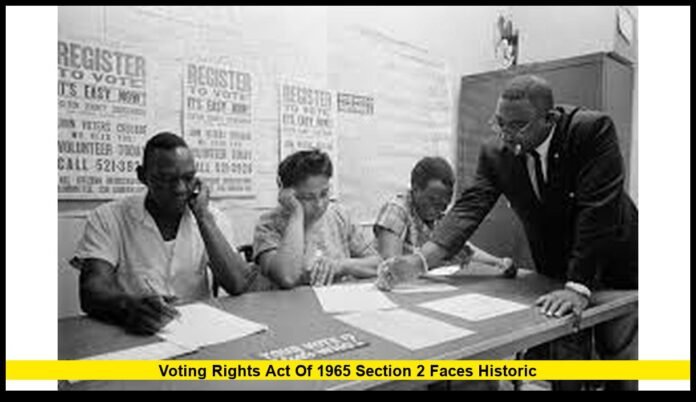

The voting rights act of 1965 section 2 has entered a new era following a landmark Supreme Court ruling that is already transforming how election laws are interpreted across the United States. The decision, issued amid ongoing disputes over congressional maps, has narrowed how courts evaluate claims of racial discrimination in voting—raising urgent questions about representation, fairness, and the future of federal protections.
The ruling arrives at a time when redistricting battles are shaping political power nationwide, making the impact of this legal shift both immediate and far-reaching.
A Turning Point in Voting Rights Law
Section 2 has long been one of the most powerful tools used to challenge discriminatory voting practices. It prohibits election laws or district maps that result in minority voters having fewer opportunities than others to participate in the political process and elect candidates of their choice.
For decades, courts relied on this provision to strike down voting systems that diluted minority influence, even when there was no clear proof of intentional discrimination. This approach allowed advocates to focus on real-world outcomes rather than trying to prove intent—a standard that is often difficult to meet.
The Supreme Court’s latest ruling changes that landscape significantly.
Understanding the Case Behind the Decision
The case that led to this ruling centered on a southern state’s congressional map drawn after the most recent census. Lawmakers initially adopted a map with a single majority-Black district despite a large Black population in the state.
A lower federal court found that this map likely violated Section 2 by diluting minority voting strength. The court ordered the state to redraw its map to include an additional majority-Black district, which it did.
However, that revised map was challenged again—this time on the grounds that it relied too heavily on race when drawing district boundaries. The argument focused on whether complying with Section 2 could itself violate constitutional limits on race-based decision-making.
The Supreme Court ultimately sided with the challengers, concluding that race cannot be the dominant factor in redistricting unless strict legal criteria are met.
What the Court’s Decision Actually Changes
The ruling does not eliminate Section 2, but it redefines how it can be used.
Courts are now expected to apply a stricter standard when evaluating whether district maps violate federal law. Plaintiffs must do more than show that minority voters have less influence; they must also demonstrate that race played a decisive role in how districts were drawn.
This creates a more complex legal test. In many cases, states may argue that political considerations—not race—drove their decisions. Because political affiliation often overlaps with race, distinguishing between the two can be challenging.
As a result, fewer cases may succeed under Section 2, and those that do will likely require stronger and more detailed evidence.
Why This Matters for Representation
The implications of this shift go beyond legal theory. Congressional and legislative maps directly shape who gets elected and whose voices are heard in government.
Majority-minority districts have historically provided a pathway for minority communities to elect representatives who reflect their interests. These districts emerged as a remedy for decades of exclusion and unequal representation.
With the new ruling, states may have greater flexibility to draw maps that do not prioritize the creation of such districts. While this does not automatically eliminate them, it raises the likelihood that fewer will be required under federal law.
That change could influence the composition of legislative bodies at both the state and national levels.
A Broader Trend in Voting Rights Decisions
This decision fits into a larger pattern of Supreme Court rulings over the past decade that have reshaped voting rights protections.
Earlier decisions reduced federal oversight of state election laws and placed greater emphasis on state authority. As those protections narrowed, Section 2 became the primary tool for challenging discriminatory practices.
Now, with Section 2 itself facing new limits, the balance between federal enforcement and state control continues to evolve.
Legal scholars note that this trend reflects a shift in how the Court views the relationship between race and public policy. The emphasis has increasingly moved toward restricting the use of race in government decision-making, even in cases where it is used to address inequality.
Political and Public Reactions
The reaction to the ruling has been swift and deeply divided.
Supporters argue that the decision reinforces constitutional principles by preventing excessive reliance on race in government actions. They say it ensures that redistricting remains grounded in neutral criteria such as geography and population.
Critics contend that the ruling weakens one of the last remaining safeguards against voting discrimination. They warn that it could make it harder to challenge maps that disadvantage minority voters, even when the effects are clear.
Public debate has intensified as both sides consider what the ruling means for future elections.
Impact on Redistricting Nationwide
Redistricting occurs every ten years following the census, but legal challenges can continue for years afterward. This ruling is expected to influence ongoing and future cases across multiple states.
States currently facing lawsuits over their maps may seek to revisit their legal strategies in light of the new standard. Some may defend existing maps more aggressively, while others may adjust boundaries to reduce the risk of litigation.
The decision could also affect how lawmakers approach redistricting in the next cycle. With a clearer understanding of the legal limits, states may design maps differently from the outset.
In competitive regions, even small changes in district boundaries can have significant political consequences.
Challenges in Proving Discrimination Going Forward
One of the most important aspects of the ruling is how it changes the burden of proof.
Under the updated framework, it is no longer enough to show that a map has a discriminatory effect. Plaintiffs must connect those effects to specific decisions about race in the map-drawing process.
This creates several challenges:
- Evidence may be harder to obtain, especially when lawmakers cite political motivations
- Courts must distinguish between race and politics, which often overlap
- Legal cases may become longer and more complex
These factors could discourage some challenges altogether, while others may take years to resolve.
The Role of Congress and Future Legislation
The ruling also raises questions about whether Congress will take action.
Lawmakers have the authority to amend voting rights laws, including Section 2, to clarify how it should be applied. In the past, Congress has responded to court decisions by updating the law to restore or strengthen protections.
Whether that happens again remains uncertain. Any legislative effort would likely face intense political debate.
In the meantime, the courts will continue to interpret the new standard, shaping how it is applied in practice.
Why the Voting Rights Act of 1965 Section 2 Still Matters
Despite the changes, the voting rights act of 1965 section 2 remains a central part of U.S. election law.
It continues to prohibit practices that deny equal access to voting and provides a mechanism for challenging unfair systems. The difference now lies in how those challenges are evaluated.
Courts will play a critical role in defining the boundaries of the law in the years ahead. Each new case will help determine how much protection Section 2 can still provide.
For voters, advocacy groups, and policymakers, understanding these developments is essential.
Looking Ahead: What Comes Next
The full impact of the ruling will unfold over time.
Lower courts will begin applying the new standard to ongoing cases, creating a body of decisions that clarify its meaning. States will adjust their approaches to redistricting, and political strategies may shift in response.
At the same time, public attention on voting rights remains high. Issues of representation, fairness, and access continue to be central to national conversations about democracy.
The debate over how to balance these principles is far from settled.
A Defining Moment for U.S. Democracy
This decision represents more than a legal adjustment—it marks a pivotal moment in the ongoing evolution of voting rights in America.
It highlights the tension between competing values: ensuring equal representation while limiting the use of race in public policy. How those values are balanced will shape the country’s political landscape for years to come.
As new cases emerge and policies adapt, the legacy of this ruling will become clearer. What is certain is that the conversation around voting rights is entering a new and complex chapter.
Have a perspective on how this shift could affect elections in your state? Share your thoughts and keep following for deeper updates as the story continues.