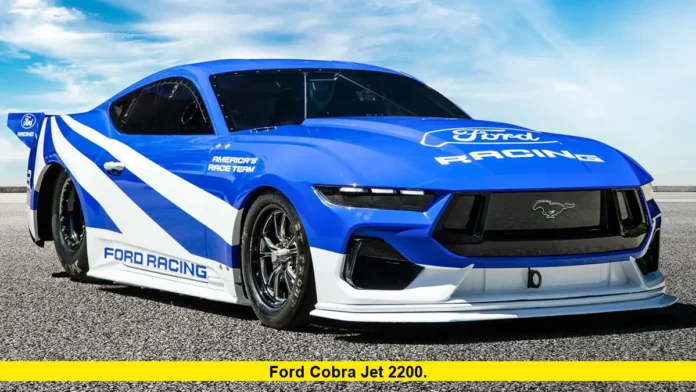

Ford has done it again. The Ford Racing Mustang Cobra Jet 2200 made its thunderous — and near-silent — debut at the 2026 NHRA 4-Wide Nationals at zMAX Dragway in Charlotte, North Carolina, and it didn’t just turn heads. It shattered records, rewrote expectations, and cemented itself as the quickest electric drag car ever built.
With 2,200 horsepower on tap, a ground-up redesign, and a quarter-mile best of 6.87 seconds at 221 mph, the Cobra Jet 2200 represents a seismic leap forward for electric performance — and for Ford Racing’s ongoing mission to push the outer limits of drag racing.
What Is the Ford Mustang Cobra Jet 2200?
The Cobra Jet 2200 is not a modified version of anything that came before it. Ford engineers started with a blank sheet of paper and built a purpose-made electric drag racing machine from the ground up, borrowing chassis architecture from Pro Mod construction and powertrain philosophy from its predecessors — the Cobra Jet 1400 (2021) and the Cobra Jet 1800 (2023) — while dramatically exceeding both in every measurable way.
At the heart of the car are two custom-built electric motors paired with inverters that exceed 98% efficiency. Each motor/inverter pair delivers roughly 1,200 horsepower, totaling 2,200 hp combined. Remarkably, these new motors weigh approximately half as much as those used in the previous Cobra Jet 1800, while producing 600 more horsepower — a stunning achievement in power density.
The Numbers That Matter
| Spec | Detail |
|---|---|
| Power Output | 2,200 horsepower |
| Drivetrain | Rear-wheel drive |
| Motors | 2 custom-built electric motors |
| Inverter Efficiency | 98%+ |
| Battery Architecture | 900-volt system |
| Battery Capacity | 32 kWh (4 modular packs) |
| Transmission | 5-speed clutchless |
| Clutch System | Patented Reverse-Acting Centrifugal Clutch (RACC) |
| Quarter-Mile Best | 6.869 seconds @ 222.36 mph |
| Chassis Certification | SFI 25.3D |
| Charge Time (targeted) | ~20 minutes |
Breaking the 7-Second Barrier: The Record Run
Ford’s electric drag racing program has been on an extraordinary trajectory. The original Cobra Jet 1400 ran an 8.128-second quarter mile back in 2021. The Cobra Jet 1800 brought that down to 7.759 seconds in March 2024, then 7.623 seconds in September 2024.
Now, the Cobra Jet 2200 has blown through the 7-second barrier entirely. During its debut weekend at zMAX Dragway, the car laid down early test runs of 7.19 seconds at 211 mph before quickly stepping up to consistent 6.87–6.86-second passes at over 221–222 mph, with its personal best clocking in at 6.869 seconds at 222.36 mph.
That’s a 0.75-second improvement over the previous record in a sport measured in thousandths of a second. Ford officially confirmed the achievement on April 25, 2026, declaring the Cobra Jet 2200 the quickest electric car on the planet.
The Secret Weapon: A Patented Centrifugal Clutch
One of the most fascinating — and counterintuitive — technical breakthroughs of the Cobra Jet 2200 is its patented Reverse-Acting Centrifugal Clutch (RACC). In a world where electric vehicles are typically associated with simple direct-drive setups, Ford has gone old-school in the best possible way.
This system allows the car to launch from zero RPM in gear, then manage torque application through clutch slip during gear changes — critical for maintaining traction and preventing tire spin at extreme power levels. The clutch slips only momentarily before locking up and allowing the car to operate in direct drive, where efficiency is highest.
Paired with a five-speed clutchless transmission, the system keeps the electric motors operating within their optimal power band throughout the run. Ford estimates that the multi-speed transmission alone adds over a second of performance potential compared to a single-speed setup.
Smart Battery Architecture
The Cobra Jet 2200 runs a 900-volt electrical architecture — considerably higher than most production EVs — with 32 kWh of capacity distributed across four strategically placed battery packs throughout the chassis. The layout includes a large underfloor pack, dual rear-mounted packs, and an adjustable front battery position for weight transfer tuning. This flexibility allows teams to dial in weight distribution depending on track conditions and tire choice, which is critical in a sport where traction is everything.
With a targeted 20-minute charge time, the car fits comfortably within NHRA’s standard 45-minute turnaround window, meaning teams can charge, make suspension adjustments, and be ready for the next pass without compromise.
Built for Safety, Too
Ford didn’t just focus on speed. The Cobra Jet 2200 introduces a new pyrotechnic fuse system that can instantly sever the high-voltage connection in an emergency via a small explosive charge. This system offers faster response times than conventional circuit breakers and can be triggered externally by track safety crews — a meaningful advancement for both the team and NHRA safety protocols.
The chassis itself is certified to SFI 25.3D specifications, meeting the rigorous standards required for high-powered drag racing machinery.
The Evolution of Ford’s Electric Drag Racing Program
| Model | Year | HP | Quarter-Mile Best |
|---|---|---|---|
| Cobra Jet 1400 | 2021 | 1,400 hp | 8.128 sec @ 171.97 mph |
| Cobra Jet 1800 | 2023 | 1,800 hp | 7.623 sec @ 182.16 mph |
| Cobra Jet 2200 | 2026 | 2,200 hp | 6.869 sec @ 222.36 mph |
The progression is staggering: a 1.26-second improvement in under five years, with each generation representing a fundamentally new engineering approach rather than an incremental update.
Who Built the Cobra Jet 2200?
The Cobra Jet 2200 was engineered by Ford Racing and built in partnership with MLe Racecars, with testing conducted at Las Vegas Motor Speedway and zMAX Dragway in Charlotte. Ford’s extensive simulation work is credited with enabling the car to achieve remarkable consistency with minimal real-world test runs — a hallmark of modern engineering discipline.
At its NHRA debut, the car was supported by a full contingent of Ford engineering staff on-site throughout the event, alongside Ford’s Switchgear off-road electric truck and a Ford F-100 with an electric powertrain — a showcase of Ford’s broader electric performance ambitions.
What Does This Mean for the Future of Drag Racing?
The Cobra Jet 1400 proved electric cars could be fast. The Cobra Jet 1800 proved they could compete with internal-combustion benchmarks. The Cobra Jet 2200 asks a bigger question: how far can this technology go when treated as a purpose-built race platform, not a conversion or adaptation?
The answer, so far, is very far indeed. At 6.87 seconds and 221 mph, no electric car has ever gone faster down a quarter mile. The 900-volt architecture and high-efficiency inverters pioneered in this program represent the kind of technology that could eventually benefit Ford’s consumer EV lineup as well — though that bridge is still being built.
For now, what’s clear is this: electric drag racing is no longer a novelty. It’s the frontier.
Final Thoughts
The Ford Racing Mustang Cobra Jet 2200 is a landmark achievement — in engineering, in motorsport, and in the ongoing story of the Mustang nameplate. Whether you’re a lifelong drag racing fan, an EV enthusiast, or someone who simply appreciates extraordinary machines doing extraordinary things, the Cobra Jet 2200 demands attention.
Ford arrived at zMAX Dragway with a statement. They left with a world record.