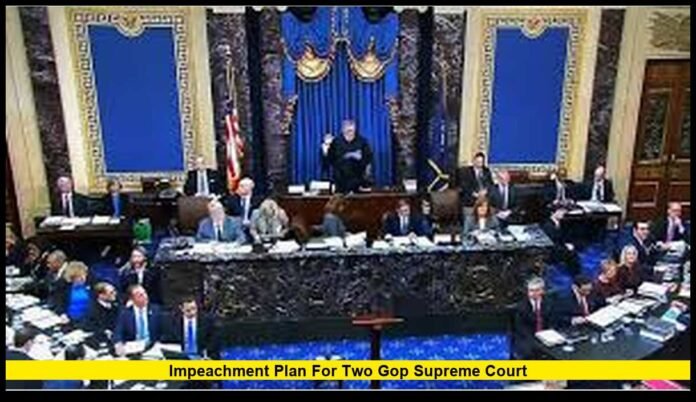

The topic of an Impeachment plan for two GOP Supreme Court judges has surged into the national conversation, reflecting deep political divisions and renewed scrutiny of the U.S. Supreme Court’s role in American governance. As election season intensifies and trust in institutions remains a major concern for voters, discussions about holding justices accountable have taken on new urgency across Washington and beyond.
Follow along as we unpack what’s driving this debate, what’s actually possible under the Constitution, and why Americans are paying close attention right now.
How the Debate Reached a Boiling Point
The latest wave of attention began after a prominent Democratic Senate candidate publicly raised the possibility of impeaching members of the Supreme Court. While the comments did not result in any formal congressional action, they quickly gained traction in political circles and on social platforms.
The remarks came amid broader frustrations with recent Supreme Court decisions and ongoing concerns about judicial conduct. Over the past few years, several justices—particularly those aligned with conservative legal philosophies—have faced heightened scrutiny related to ethics, transparency, and outside relationships.
This moment reflects more than a single statement. It represents a convergence of political pressure, legal controversy, and a shifting public perception of the Court’s authority.
A Closer Look at the Constitutional Process
Impeachment of a Supreme Court justice is legally possible but extremely difficult to achieve. The Constitution outlines a two-step process that sets a very high bar:
- The House of Representatives must pass articles of impeachment by a simple majority vote
- The Senate must then hold a trial and secure a two-thirds majority to convict and remove the justice
This process mirrors the one used for presidents and other federal officials, but its application to Supreme Court justices is exceedingly rare.
In fact, only one justice has ever been impeached in U.S. history—Samuel Chase in the early 19th century. He was ultimately acquitted, reinforcing a long-standing norm that justices are not removed for controversial rulings alone.
Why This Issue Is Resurfacing Now
Several key developments have pushed the impeachment discussion back into the spotlight in 2026.
Rising Focus on Judicial Ethics
Public concern about judicial ethics has grown significantly in recent years. Questions about financial disclosures, travel, and relationships with donors or political figures have fueled calls for stronger oversight.
Although the Supreme Court introduced a formal code of conduct in 2023, critics argue that enforcement mechanisms remain unclear. Unlike lower federal courts, there is no external body that can directly discipline Supreme Court justices.
This gap has led some lawmakers and candidates to suggest that impeachment could serve as a last-resort accountability tool.
Impact of Major Court Decisions
The Supreme Court continues to shape policies that directly affect millions of Americans. Recent rulings involving federal regulatory authority, administrative law, and executive power have sparked intense political reactions.
Some elected officials have openly criticized certain justices, arguing that their decisions have shifted the balance of power in ways that favor specific ideological outcomes.
These rulings have amplified the perception that the Court plays an increasingly political role, even as justices maintain that their decisions are grounded in constitutional interpretation.
Election-Year Strategy and Messaging
With the 2026 midterm elections approaching, political messaging has intensified on both sides. The Supreme Court has become a central issue in campaign rhetoric, with candidates using it to energize their base.
For some, raising the possibility of impeachment signals a commitment to accountability. For others, it represents a dangerous escalation that could threaten judicial independence.
The debate has quickly evolved into a broader conversation about the future of American democracy and the separation of powers.
What Lawmakers and Leaders Are Saying
Political reactions have been swift and deeply divided.
Supporters of stronger action argue that no public official should be beyond scrutiny. They emphasize that impeachment is part of the constitutional system of checks and balances, designed to address serious misconduct if it occurs.
Opponents counter that using impeachment as a political tool could undermine the credibility of the judiciary. They warn that targeting justices over ideological disagreements could set a precedent that destabilizes the Court.
This clash highlights a fundamental tension between accountability and independence—two principles that are both essential to the functioning of the judicial system.
Is There a Real Path Forward for Impeachment?
Despite the heated rhetoric, there is currently no active legislation or formal effort in Congress aimed at impeaching Supreme Court justices.
Several practical obstacles stand in the way:
- The House of Representatives would need a majority willing to approve impeachment articles
- The Senate would require a two-thirds majority to convict, which is difficult to achieve in a closely divided chamber
- Bipartisan agreement would likely be necessary, given the seriousness of removing a justice
These hurdles make it unlikely that impeachment will move beyond discussion in the near term.
The Broader Movement for Supreme Court Reform
While impeachment remains a distant possibility, it is part of a larger conversation about reforming the Supreme Court.
Proposals gaining attention include:
- Establishing enforceable ethics rules
- Increasing transparency around financial disclosures
- Implementing term limits for justices
- Expanding or restructuring the Court
Each of these ideas carries its own legal and political challenges, but together they reflect growing public interest in how the Court operates.
Public Opinion and Institutional Trust
Polls and public discourse indicate that Americans hold mixed views about the Supreme Court. While many still respect its role as the final arbiter of constitutional questions, confidence has declined in recent years.
This shift is partly driven by perceptions that the Court is influenced by political considerations. High-profile cases and closely divided decisions have reinforced this view for some observers.
The renewed focus on an Impeachment plan for two GOP Supreme Court judges taps into these concerns, even as the actual likelihood of such a plan being implemented remains low.
Historical Lessons and Legal Precedents
The history of judicial impeachment provides important context for today’s debate.
The failed impeachment of Samuel Chase established a critical precedent: justices should not be removed simply for their legal opinions or political leanings. Instead, impeachment is intended for serious misconduct, such as corruption or abuse of power.
This principle has guided Congress for more than two centuries and continues to shape how lawmakers approach calls for accountability.
Why This Debate Matters Right Now
The current discussion goes beyond individual justices. It raises fundamental questions about how power is distributed in the United States.
At its core, the issue touches on:
- The independence of the judiciary
- The authority of elected officials
- The role of public opinion in shaping institutions
As these questions become more prominent, they are likely to influence not only the 2026 elections but also the long-term direction of the country’s legal and political systems.
What to Watch in the Coming Months
Several developments could shape how this story evolves:
- Continued scrutiny of Supreme Court ethics practices
- New legislative proposals aimed at judicial reform
- Intensified campaign messaging tied to the Court
- Public responses to future Supreme Court decisions
Each of these factors will play a role in determining whether the conversation around impeachment gains traction or fades from the spotlight.
Conclusion
The debate surrounding the Supreme Court reflects a nation grappling with questions about fairness, accountability, and institutional trust. While talk of impeachment may dominate headlines, the underlying issues are far more complex and deeply rooted in the structure of American government.
As political leaders, legal experts, and voters continue to engage with these questions, the future of the Supreme Court—and its place in the broader system—will remain a defining issue of the current era.
What do you think about the growing debate over the Supreme Court? Share your perspective and stay connected for ongoing updates.