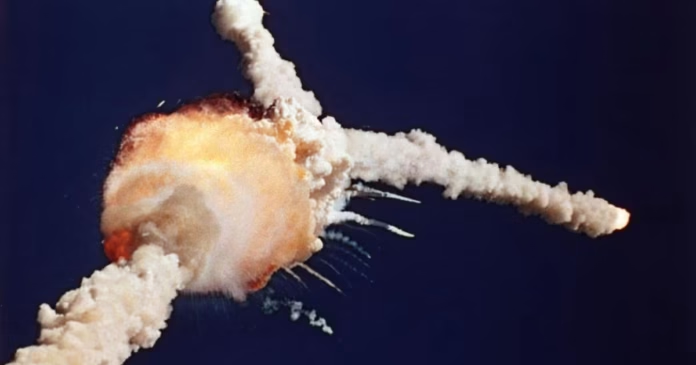

The search term space shuttle explosion 1982 continues to gain attention across the internet, but it reflects a widespread misunderstanding of U.S. space history. No space shuttle exploded in 1982. Instead, that year marked a period of progress and technical achievement for NASA’s shuttle program, which was still in its early operational phase.
Understanding what actually happened—and what didn’t—offers a clearer view of how the United States built one of the most ambitious spaceflight programs in history and how later events reshaped it forever.
A Year of Momentum, Not Disaster
In 1982, NASA was focused on proving that the space shuttle could operate as a reusable spacecraft capable of frequent missions. The program had successfully transitioned from experimental test flights to more routine operations.
Missions carried out that year demonstrated the shuttle’s growing reliability. Astronaut crews conducted scientific experiments, tested onboard systems, and deployed satellites into orbit. These flights were critical in showing that reusable spacecraft could support long-term space goals.
Rather than tragedy, 1982 represented confidence. Engineers refined systems, mission planners expanded objectives, and NASA began to envision a future where space travel would become more frequent and accessible.
How the Confusion Took Hold
The phrase “space shuttle explosion 1982” has circulated widely due to a mix of digital misinformation and misremembered history. As online searches increase, incorrect timelines often spread quickly.
Several factors contribute to the confusion:
- The shuttle program began in the early 1980s, leading some to associate early years with major incidents
- The memory of later disasters is so strong that dates are sometimes misattributed
- Online platforms amplify repeated inaccuracies, making them appear credible
Despite the persistence of this claim, official mission records from 1982 show no fatal accidents or shuttle losses.
The Tragedy That Defined a Generation
The event most people are actually thinking of occurred on January 28, 1986. On that day, the Space Shuttle Challenger launched with seven crew members aboard.
Shortly after liftoff, the vehicle broke apart in a catastrophic failure witnessed live by millions. The loss of the crew deeply affected the nation and marked one of the most significant moments in American space history.
Among those onboard was a civilian teacher, whose participation had brought unprecedented public attention to the mission. Classrooms across the country had tuned in, making the tragedy even more personal for many Americans.
What Went Wrong
Investigators later determined that the disaster stemmed from a failure in a key component of the solid rocket boosters. Cold weather conditions on launch morning affected the performance of rubber seals designed to contain high-pressure gases.
When these seals did not function as intended, hot gases escaped, leading to structural damage and ultimately the breakup of the shuttle.
The event is often described as an explosion, but it was actually a rapid structural failure followed by a massive fireball as fuel components ignited.
A Deep Impact on NASA and the Nation
The aftermath of the Challenger disaster brought intense scrutiny to NASA’s processes and culture. The agency halted shuttle flights and conducted a comprehensive review of its systems and decision-making practices.
The findings revealed not only technical flaws but also communication breakdowns within the organization. Concerns raised by engineers before launch had not been fully addressed.
This moment forced a shift in how NASA approached safety, risk assessment, and internal accountability.
Rebuilding Trust and Redesigning Systems
In the years following the tragedy, NASA implemented sweeping changes to improve mission safety.
These included:
- Redesigning critical booster components
- Introducing stricter launch criteria
- Enhancing oversight of engineering decisions
- Improving astronaut safety equipment
The shuttle program eventually resumed flights, but under a renewed emphasis on caution and precision.
Why Historical Accuracy Still Matters
The continued spread of the space shuttle explosion 1982 claim highlights the importance of accurate information in the digital age. As interest in space exploration grows, so does the need for clear and reliable historical context.
Misunderstandings can obscure the real lessons learned from past events—lessons that continue to influence current missions.
Today’s engineers, scientists, and mission planners rely on decades of experience, including hard-earned knowledge from past failures.
The Shuttle Program’s Lasting Legacy
NASA’s space shuttle program officially ended in 2011, but its impact continues to shape modern spaceflight.
The program helped build the International Space Station, launched critical scientific instruments, and advanced reusable spacecraft technology. It also demonstrated both the potential and the risks of human space exploration.
The lessons learned from tragedies like Challenger have become foundational to modern aerospace safety standards.
A New Era of Space Exploration
Today, the United States is once again expanding its ambitions in space. Missions aimed at returning humans to the Moon and eventually traveling to Mars are underway.
Unlike the early shuttle era, current programs emphasize redundancy, rigorous testing, and improved safety systems. Both government agencies and private companies are applying decades of knowledge to reduce risk while pushing technological boundaries.
The past continues to inform the future.
Separating Fact From Fiction
There is no record of a space shuttle explosion in 1982. That year stands as a milestone of progress, not tragedy.
The real turning point came later, in 1986, when a devastating failure reshaped NASA’s approach and left a lasting mark on the nation.
By understanding the difference, readers can better appreciate both the achievements and the challenges of human spaceflight.
Conclusion
The story behind the confusion surrounding 1982 reveals how easily history can be distorted—and how important it is to revisit the facts. The shuttle program remains one of the most ambitious engineering efforts ever undertaken, marked by both success and sacrifice.
As the United States moves forward into a new era of exploration, the lessons from the past remain as relevant as ever.