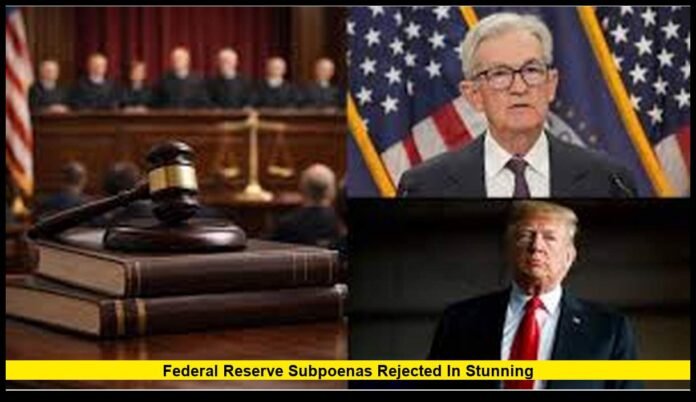

The legal battle surrounding the nation’s central bank took a dramatic turn this week as federal reserve subpoenas rejected became the defining headline in Washington, following a federal judge’s decision to block a renewed attempt by prosecutors to compel evidence from Federal Reserve Chair Jerome Powell.
The ruling, issued in early April 2026, denies federal prosecutors the ability to revive subpoenas tied to an ongoing investigation into the Federal Reserve’s headquarters renovation project. The decision reinforces earlier findings that questioned the legal basis behind the subpoenas and raises new questions about the limits of prosecutorial authority when it comes to independent financial institutions.
The outcome marks a significant development in a case that has drawn attention from lawmakers, economists, and market participants alike, with implications that extend far beyond the courtroom.
Follow this developing story as it continues to shape the future of U.S. financial leadership and accountability.
Court Reaffirms Decision to Block Subpoenas
In a detailed opinion, the federal judge declined to reverse a prior ruling that had already invalidated the subpoenas. Prosecutors had sought reconsideration, arguing that additional context justified reviving their request for documents and testimony.
However, the court found that those arguments did not meet the legal threshold required to overturn the earlier decision. Judges rarely grant reconsideration unless new evidence or a clear legal error is presented. In this case, the court determined neither condition had been satisfied.
As a result, the subpoenas remain unenforceable, preventing investigators from accessing internal communications, planning documents, and other materials related to the Federal Reserve’s renovation efforts.
The decision sends a clear message about the judiciary’s willingness to scrutinize the use of subpoena power, particularly in cases involving high-ranking officials and sensitive institutions.
Background of the Investigation
The controversy stems from a multibillion-dollar renovation of the Federal Reserve’s historic headquarters in Washington, D.C. The project, which has been underway for several years, has drawn scrutiny due to rising costs and questions about how those costs were communicated to Congress.
Lawmakers raised concerns after testimony suggested that certain elements of the project may have been described differently in official statements compared to internal planning documents. These concerns prompted a closer look by federal prosecutors.
Investigators sought to determine whether any statements made to Congress could constitute misleading or false representations. As part of that effort, subpoenas were issued to gather evidence directly from the Federal Reserve and its leadership.
Jerome Powell has consistently maintained that all communications were accurate and that no laws were violated. The central bank has also emphasized that the renovation project followed established procedures and oversight protocols.
Judicial Concerns Over Prosecutorial Intent
A key factor in the court’s decision was its assessment of how and why the subpoenas were issued.
The judge concluded that prosecutors did not provide sufficient evidence to justify the scope and intent of their requests. In particular, the court expressed concern that the subpoenas may have been used as a tool to apply pressure rather than to pursue a clearly defined legal violation.
This distinction proved critical. Courts are generally deferential to investigative authority, but they also impose limits to prevent misuse. In this instance, the judge found that those limits had been exceeded.
By rejecting the attempt to revive the subpoenas, the court reinforced the principle that legal processes must be grounded in demonstrable evidence, not speculation or strategic leverage.
Implications for the Justice Department
The ruling represents a notable setback for federal prosecutors, who now face a more complicated path forward.
Without access to the materials sought through the subpoenas, investigators may find it more difficult to build a case or pursue additional lines of inquiry. The decision also places greater scrutiny on how the investigation has been conducted so far.
Officials within the Justice Department are expected to weigh their options carefully. An appeal appears likely, but appellate courts typically focus on whether the lower court applied the law correctly, rather than reexamining the underlying facts.
This means the next phase of the legal battle could hinge on technical legal arguments rather than new evidence.
Political Reactions Intensify
The case has sparked strong reactions across the political spectrum.
Some lawmakers have criticized the investigation as an overreach that risks undermining the Federal Reserve’s independence. They argue that central banks must operate free from political pressure in order to effectively manage inflation, employment, and economic growth.
Others have defended the investigation as a legitimate effort to ensure accountability and transparency, particularly when public funds and major infrastructure projects are involved.
The court’s decision has added momentum to both sides of the debate, with each interpreting the outcome in a way that supports their broader position.
Federal Reserve Independence Under the Spotlight
At the heart of the controversy is a longstanding principle: the independence of the Federal Reserve.
Since its creation, the central bank has been designed to operate separately from direct political control. This independence is intended to allow policymakers to make decisions based on economic data rather than short-term political considerations.
The investigation into Jerome Powell—and the legal fight over subpoenas—has brought renewed attention to this principle.
Supporters of the Federal Reserve argue that allowing aggressive legal actions against its leadership could set a precedent that weakens institutional autonomy. Critics counter that independence should not shield any organization from scrutiny when legitimate questions arise.
The balance between these perspectives remains a central issue as the case unfolds.
Leadership Uncertainty and Its Consequences
The timing of the legal dispute adds another layer of complexity.
Jerome Powell’s term as chair is approaching its conclusion, and discussions about future leadership are already underway. The ongoing investigation has introduced uncertainty into that process, complicating decisions about nominations and confirmations.
Some lawmakers have indicated that they may delay or oppose leadership appointments until the situation is resolved. This could create a leadership gap or prolong Powell’s tenure in a caretaker capacity.
Such uncertainty can have broader implications, particularly in periods of economic volatility when clear and consistent leadership is essential.
Market Sensitivity to Institutional Stability
Financial markets are closely monitoring developments in the case.
The Federal Reserve plays a central role in setting interest rates and guiding monetary policy. Any disruption to its leadership or perceived independence can influence investor confidence.
While the court’s decision may provide short-term clarity by limiting the scope of the investigation, the possibility of an appeal ensures that uncertainty will persist.
Market participants are likely to remain cautious, watching for signals that could indicate changes in policy direction or institutional stability.
Legal Precedents and Broader Impact
Beyond its immediate effects, the case could establish important legal precedents.
The court’s emphasis on evidentiary standards and proper use of subpoenas may influence how future investigations are conducted, particularly those involving senior officials or independent agencies.
Legal experts note that decisions like this help define the boundaries of prosecutorial authority, ensuring that investigative tools are used appropriately.
These precedents can shape not only similar cases but also the broader relationship between government institutions and the legal system.
The Road Ahead for the Case
As the situation continues to evolve, several key developments are expected in the coming weeks:
- A potential appeal by federal prosecutors
- Responses from appellate courts
- Ongoing political discussions about Federal Reserve leadership
- Market reactions to shifting expectations
Each of these factors will contribute to the next phase of the case and determine how its impact unfolds over time.
Why This Moment Matters
The renewed focus on federal reserve subpoenas rejected highlights the intersection of law, politics, and economics in a way that few cases do.
It underscores the importance of judicial oversight, the challenges of maintaining institutional independence, and the complexities of accountability at the highest levels of government.
For the public, the case serves as a reminder that decisions made in courtrooms can have far-reaching consequences—affecting everything from financial markets to leadership stability.
As new developments emerge, the story will continue to command attention across the country.
How do you see this legal battle shaping the future of the Federal Reserve and its leadership? Share your perspective and stay informed as events continue to unfold.