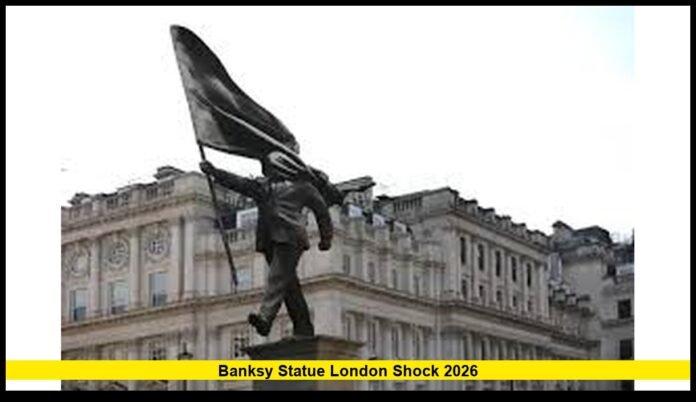

The sudden appearance of a new artwork tied to the keyword banksy statue london has captured global attention, as a striking sculpture surfaced overnight in one of the city’s most recognizable historic areas. The installation, later acknowledged by the anonymous street artist Banksy, has drawn large crowds, triggered intense debate, and added a new layer to ongoing conversations about public monuments, identity, and modern political expression.
A Dramatic Reveal in a Historic Setting
In the early hours of a spring morning, passersby in central London noticed something unusual in Waterloo Place. Known for its formal statues and traditional monuments, the area had quietly gained a new addition. Unlike the surrounding tributes to historic leaders and figures, this sculpture immediately stood apart.
The piece depicts a life-sized man dressed in a formal suit, frozen mid-step. His posture suggests movement—almost urgency—but his face is completely hidden behind a large flag draped across his head. The flag’s fabric appears to billow, covering his vision entirely. One foot extends forward, dangerously close to the edge of the pedestal, creating a sense of imbalance.
The visual tension of the moment—movement without sight—quickly became the center of attention.
Confirmation from the Elusive Artist
As images of the sculpture spread rapidly across social platforms, speculation grew about its origin. It did not take long for Banksy to confirm authorship through a video shared online. The footage showed the installation process unfolding under cover of darkness, consistent with the artist’s long-standing approach of anonymity and surprise.
The sculpture also bears a signature marking, reinforcing its authenticity.
Banksy’s decision to step into large-scale sculpture marks another evolution in his work. While he is globally recognized for stencil-based street art, he has occasionally experimented with three-dimensional forms. This latest piece, however, stands out due to its prominent placement and immediate global impact.
A Powerful Visual Message
At its core, the sculpture presents a simple but striking image: a man guided by a flag, yet unable to see beyond it. That contradiction has sparked countless interpretations.
Some viewers see it as a commentary on blind allegiance—whether to national identity, political ideology, or leadership figures. Others interpret it as a warning about the dangers of moving forward without awareness or critical thinking.
The decision to obscure the face entirely removes individuality, transforming the figure into a symbol rather than a person. This universality allows people from different backgrounds to project their own interpretations onto the artwork.
Unlike traditional monuments that celebrate specific achievements or individuals, this piece raises questions instead of offering answers.
Why Waterloo Place Matters
The location of the sculpture is no accident. Waterloo Place is lined with statues commemorating military leaders, monarchs, and historical figures tied to Britain’s past. These monuments are formal, permanent, and rooted in tradition.
By placing a contemporary, thought-provoking sculpture among them, Banksy creates a striking contrast. The clean lines and modern materials of the new piece stand in opposition to the classical bronze and stone statues nearby.
This juxtaposition forces viewers to reconsider what monuments represent—and who decides which stories are told in public spaces.
Crowds Gather as Interest Grows
Within hours of its discovery, the site became a gathering point for curious onlookers. Tourists, locals, and art enthusiasts lined up to see the sculpture firsthand. Many paused to take photos, while others stood quietly, studying its details.
The reactions have been diverse.
Some praise the artwork as a bold and necessary statement in a time of global uncertainty. Others express confusion or discomfort, unsure of how to interpret the imagery. This range of responses reflects the artist’s ability to provoke thought without dictating meaning.
For many visitors, the experience goes beyond viewing art—it becomes a moment of reflection.
If you’re following major cultural developments and want deeper insights into stories like this, staying engaged with evolving discussions can offer a richer perspective.
Banksy’s Evolving Artistic Approach
Banksy has built a reputation on creating art that challenges authority and invites dialogue. His works often appear unexpectedly, turning ordinary locations into powerful stages for commentary.
This sculpture represents a continuation of that approach, but with a new dimension.
Unlike murals, which can be painted over or removed relatively easily, a statue occupies physical space in a more permanent way. It demands attention and interacts directly with its surroundings.
This shift suggests a broader exploration of how public art can influence perception—not just through imagery, but through presence.
Authorities Take a Measured Response
Despite being installed without official approval, the sculpture has not been removed. Instead, authorities have taken steps to manage public access and ensure safety around the site.
Barriers have been placed to protect the artwork, and it remains accessible for viewing.
This response highlights a significant change in how Banksy’s work is treated. What was once dismissed as vandalism is now often recognized as culturally valuable. Cities increasingly see the benefit of preserving such works, both for their artistic impact and their ability to attract visitors.
The Symbolism Behind the Flag
The flag itself is one of the most discussed elements of the sculpture. It serves as both a visual focal point and a symbolic layer.
By covering the figure’s face, the flag transforms from a symbol of identity into one of obstruction. It raises questions about how symbols can both unite and limit perspective.
The act of moving forward while blinded adds urgency to the message. It suggests not just a lack of awareness, but a willingness to proceed despite it.
This layered symbolism has contributed to the artwork’s widespread resonance.
Global Conversation and Cultural Impact
As images of the sculpture spread online, discussions quickly moved beyond London. People around the world began sharing interpretations, debating its meaning, and connecting it to broader social and political themes.
The artwork has become a focal point for conversations about nationalism, leadership, and the role of public art in shaping discourse.
Its ability to spark dialogue across different cultures and perspectives underscores the power of visual storytelling.
The Role of Public Art in Modern Cities
The appearance of this sculpture highlights an ongoing shift in how cities approach public art. Traditional monuments often reflect a fixed narrative, celebrating specific figures or events.
Contemporary works like this one challenge that model.
They introduce ambiguity, encourage questioning, and reflect the complexities of modern society. By existing in shared spaces, they invite everyone—not just art experts—to participate in the conversation.
This democratization of art changes how people engage with their environment.
Uncertain Future, Lasting Impression
The long-term future of the sculpture remains unclear. Banksy’s works are known for their unpredictability. Some are removed, others are preserved, and a few become permanent fixtures.
For now, the sculpture continues to draw attention and spark discussion.
Regardless of how long it remains in place, its impact is already evident. It has transformed a familiar location into a site of reflection and debate, proving that a single piece of art can reshape how people see a space.
A Defining Moment in Contemporary Art
The emergence of the banksy statue london story represents more than just a new artwork—it marks a moment in the ongoing evolution of public expression.
By blending surprise, symbolism, and strategic placement, Banksy has once again captured the world’s attention. The sculpture stands as both a visual statement and an open question, inviting viewers to think more deeply about the forces that shape their perspectives.
As crowds continue to gather and conversations unfold, the artwork’s meaning will likely evolve, shaped by the very people who encounter it.
If you’re interested in stories that challenge the way we see the world, keeping up with developments like this can offer fresh insight into the power of art and ideas.
What’s your interpretation of this powerful new sculpture? Share your thoughts and keep the conversation going.