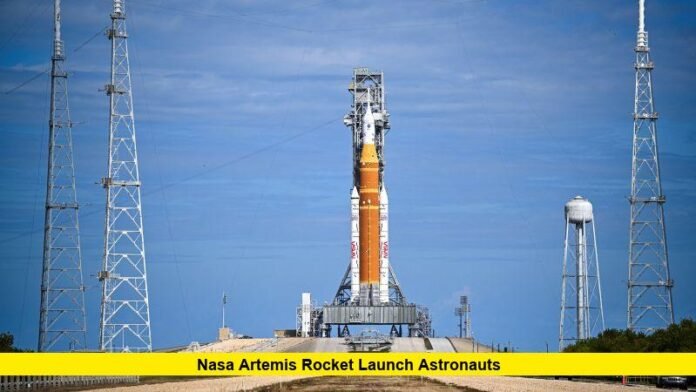

The nasa artemis rocket launch astronauts mission has officially ushered in a historic chapter for the United States, as NASA successfully sent a crew of four toward the Moon for the first time in more than half a century. The April 1, 2026 liftoff from Florida marked a defining moment not only for the agency, but for the future of human spaceflight.
This mission, known as Artemis II, represents far more than a symbolic return. It is a critical step in NASA’s long-term strategy to establish a sustained human presence beyond Earth orbit and prepare for missions to Mars.
A Launch That Redefined America’s Space Ambitions
The powerful Space Launch System rocket roared to life at Kennedy Space Center, lifting the Orion spacecraft and its crew into orbit before sending them on a trajectory toward the Moon. The scale of the launch underscored the ambition behind the Artemis program.
This was not simply a repeat of past achievements. It was a demonstration that the United States is ready to move beyond low Earth orbit once again. The mission represents years of engineering, testing, and coordination, all culminating in a single moment that reignited global attention on space exploration.
Crowds gathered in person while millions watched live broadcasts, turning the event into a national spectacle.
The Crew at the Center of History
Artemis II carries four astronauts, each bringing experience and representing a milestone in the evolution of spaceflight.
- Reid Wiseman, serving as commander, leads the mission with prior spaceflight experience.
- Victor Glover, the pilot, becomes the first Black astronaut to travel toward lunar space.
- Christina Koch, mission specialist, becomes the first woman assigned to a lunar mission.
- Jeremy Hansen, also a mission specialist, represents Canada as the first Canadian astronaut to participate in a mission of this kind.
Together, the crew reflects a broader and more inclusive vision of exploration—one that extends beyond national boundaries.
Mission Profile: A High-Stakes Test Flight
Artemis II is designed as a full-scale test with astronauts onboard. While it will not land on the Moon, every phase of the mission is essential.
Launch and Orbit
After liftoff, the Orion spacecraft enters Earth orbit, where systems are checked before the journey continues.
Journey to Lunar Space
A precisely timed engine burn propels the spacecraft toward the Moon, pushing it far beyond Earth’s gravitational influence.
Lunar Flyby
The crew travels around the Moon in a wide arc, observing the far side and collecting vital performance data.
Return to Earth
The mission concludes with a high-speed reentry and splashdown in the Pacific Ocean.
Each stage is carefully monitored, as the data collected will shape future missions.
Why Artemis II Is a Turning Point
The importance of this mission goes beyond distance or duration. Artemis II is about proving that modern systems can safely support humans in deep space.
NASA is evaluating:
- Life-support capabilities for extended missions
- Deep-space navigation systems
- Communication reliability over vast distances
- Spacecraft durability under extreme conditions
These elements must function flawlessly before astronauts can land on the Moon again.
Engineering Behind the Mission
At the heart of Artemis II are two major technological achievements.
Space Launch System (SLS)
This rocket provides the thrust required to send humans beyond Earth orbit. It is the most powerful rocket NASA has ever developed.
Orion Spacecraft
Built for deep space, Orion includes advanced avionics, improved safety systems, and the ability to support astronauts during long-duration missions.
Together, these systems form the backbone of NASA’s exploration plans.
Overcoming Challenges on the Path to Launch
The road to April 2026 included multiple delays and technical hurdles. Engineers addressed issues related to rocket components and completed extensive testing to ensure readiness.
Every adjustment reflected the complexity of sending humans into deep space. Even small concerns required detailed analysis and resolution before launch approval.
The result was a mission that met strict safety and performance standards.
A Broader Vision Beyond the Moon
While Artemis II focuses on a lunar flyby, its true purpose lies in what comes next.
NASA plans to follow with Artemis III, a mission intended to land astronauts on the Moon’s surface. That mission aims to include the first woman and the first person of color to walk on the Moon.
Future missions will expand on this effort, building infrastructure that supports long-term exploration.
The Moon is not the final destination—it is a stepping stone toward Mars.
The Global Context of the Mission
Artemis II takes place during a period of renewed international interest in the Moon. Several countries are developing their own lunar programs, increasing competition and collaboration in space exploration.
NASA’s approach includes partnerships with other nations, highlighting a shift toward shared goals in space.
This mission demonstrates leadership while also opening the door to broader cooperation.
What This Means for the Future of Spaceflight
The success of Artemis II could reshape how humanity approaches space exploration.
Instead of short missions, the focus is shifting toward sustainability. NASA is working toward systems that allow repeated travel, longer stays, and deeper exploration.
This includes:
- Developing lunar habitats
- Testing new propulsion technologies
- Preparing astronauts for extended missions
The knowledge gained from Artemis II will influence every step of that process.
Public Engagement and Cultural Impact
The launch has sparked renewed excitement across the United States. Schools, universities, and research institutions are closely following the mission, using it as an opportunity to inspire the next generation.
For many Americans, the mission represents a return to ambition and innovation. It serves as a reminder of what can be achieved through scientific advancement and national commitment.
Key Milestones to Watch
As the mission progresses, several moments will determine its success:
- Stability of onboard systems during deep space travel
- Performance of communication networks
- Accuracy of navigation during lunar flyby
- Safety of reentry and landing
Each milestone provides critical insights for future missions.
A Defining Step Into Deep Space
The nasa artemis rocket launch astronauts mission is not simply a return to the Moon. It is a transition into a new phase of exploration—one focused on long-term presence and deeper journeys.
By combining advanced technology, international collaboration, and a clear strategic vision, NASA is laying the groundwork for the next era of human spaceflight.
This mission proves that humanity is ready to move beyond past achievements and take on new challenges in space.
Looking Ahead
As Artemis II continues its journey, its impact is already being felt. The mission represents progress, possibility, and the beginning of something much larger than a single flight.
With future missions on the horizon, the path toward sustained exploration is becoming clearer.
The Moon is once again within reach—but this time, the goal is to stay.