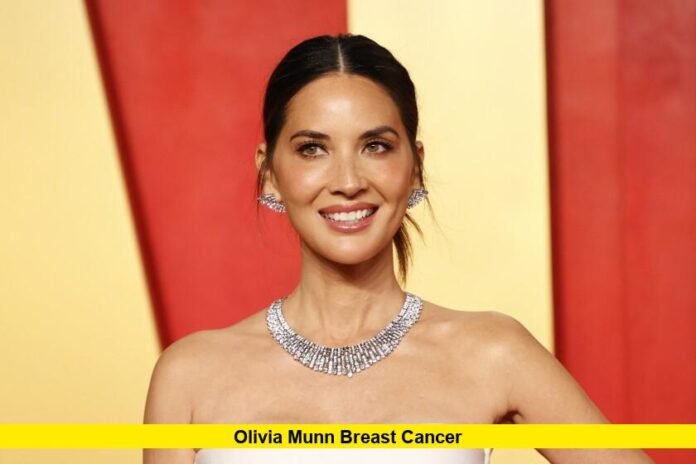

Olivia Munn Breast Cancer Journey: How One Simple Test With Zero Symptoms Led to a Diagnosis — and a National Movement
Olivia Munn’s breast cancer story is one of the most powerful health narratives in recent American pop culture — not because it followed a familiar script, but because it broke every rule about what a cancer diagnosis is supposed to look like. No family history. No warning signs. No symptoms at all. And yet, in April 2023, one free online risk assessment questionnaire revealed that the actress and mother of two was living with Stage 1 bilateral breast cancer. Nearly three years later, Munn is back on screen, still navigating treatment, and more determined than ever to make sure other women don’t miss what she almost did.
In the last few days, Munn has made a wave of high-profile media appearances — including a deeply personal interview that aired on March 29, 2026 — to share where she stands today and what she wants every American woman to know about early detection, risk assessment, and the quiet ways cancer can grow without announcing itself.
If you’ve been putting off a conversation with your doctor about your personal risk, Munn’s story is exactly the kind of wake-up call worth reading to the end.
A Diagnosis That Defied Every Expectation
In February 2023, Munn took a genetic test to assess her risk for 90 different types of cancer. The results came back negative across the board. She also had a routine mammogram that came back clear. By every standard measure, she was healthy.
Then her OB-GYN recommended she take a Breast Cancer Risk Assessment — a free online questionnaire that factors in age, reproductive history, family history, and other variables to generate a lifetime risk percentage. Anything above 20% is considered high risk. Munn’s score came back at 37.3%.
That number sent her doctors looking deeper. Additional imaging and a biopsy followed. What they found was Stage 1 bilateral breast cancer — cancer growing in both breasts simultaneously — with no symptoms, no genetic red flags, and no warning from a mammogram or ultrasound that anything was wrong.
“No symptoms,” Munn has said. “And I had a clear mammogram and a clear ultrasound.”
For millions of American women who rely on annual mammograms as their primary line of defense, Munn’s experience revealed a significant and sobering gap. A clear mammogram does not always mean cancer-free. The risk assessment tool she took — widely available online and completely free — is the step that made all the difference.
The Treatment: Swift, Aggressive, and Comprehensive
Once the diagnosis was in, Munn moved fast. Within 30 days of her biopsy, she underwent a double mastectomy — the surgical removal of both breasts. That was only the beginning of what would become a five-surgery process.
She also underwent an ovariectomy and a partial hysterectomy. After completing all of her procedures, her lifetime risk score dropped to zero.
The specific subtype she was living with — Luminal B hormone receptor-positive breast cancer — is known for being particularly aggressive and fast-growing, often developing without clear early symptoms. The presence of tumors in both breasts simultaneously added urgency to an already serious medical reality.
In the time since her surgeries, Munn began a five-year hormone treatment designed to prevent recurrence. She has been open about the fact that her journey is ongoing — that treatment does not end with surgery, and that living as a survivor still means showing up for doctors, medications, and monitoring year after year.
Despite all of it, she says she feels genuinely lucky to be here.
The Ripple Effect: A 4,000 Percent Surge in Women Getting Tested
Perhaps the most extraordinary chapter in Olivia Munn’s breast cancer story is not what happened to her personally — it is what happened because of her willingness to go public with the experience.
According to data from the National Cancer Institute, the rate of women taking the Breast Cancer Risk Assessment tool increased by 4,000 percent after Munn began sharing her story openly. That staggering number represents potentially millions of American women who took a test they had never heard of before, discovered elevated risk scores, and had lifesaving conversations with their doctors as a result.
One of those women was Munn’s own mother. Her mother had recently had a mammogram that came back normal — the same kind of clear result that had given Munn herself a false sense of security. But after Munn encouraged her to take the risk assessment tool, her mother scored 26.2% — above the high-risk threshold. Munn pushed her to get an MRI. That MRI led to a diagnosis of HER2-positive breast cancer.
“The lifetime risk assessment saved my life and my mom’s,” Munn has said.
The tool she credits with changing both of their lives is the same one sitting quietly on the internet, free of charge, that most women have never been told about. That disconnect between what is available and what is widely known became the engine behind Munn’s advocacy.
You have the power to pass this information along — share this article with the women in your life who deserve to know it exists.
What the Breast Cancer Risk Assessment Tool Actually Does
The Breast Cancer Risk Assessment Tool, sometimes called the BCRAT, is a free online questionnaire that takes just a few minutes to complete. It factors in a woman’s age, personal and family medical history, reproductive history, and race to calculate a percentage representing her estimated lifetime risk of developing breast cancer.
A score above 20% is considered elevated, and women who fall into that category may be candidates for additional screening beyond a standard mammogram — such as an MRI, which is significantly more sensitive at detecting certain types of tumors.
Munn’s case illustrates precisely why that additional step matters. Her genetic testing was negative. Her mammogram was clear. Her ultrasound was clear. Without the risk assessment, there was no medical reason anyone would have ordered an MRI — and without that MRI, the cancer likely would not have been caught until her next scheduled mammogram a year later.
Doctors emphasize that the tool is a starting point for a conversation with a healthcare provider, not a definitive diagnosis. The score alone does not tell you whether you have cancer. What it does is tell you whether you might warrant a closer look — and sometimes, that closer look is everything.
A Reporter’s Life Changed Because of Munn’s Courage
The ripple effect of Munn’s public advocacy reached far beyond statistics. A television news correspondent was assigned to cover Munn’s story and, in the process of reporting it, met with a breast surgeon and took the same risk assessment tool herself. Her results showed elevated risk. She pursued additional imaging and a biopsy — and was diagnosed with ductal carcinoma in situ, an early-stage breast cancer that develops in the milk ducts. She subsequently announced she would undergo a double mastectomy.
One celebrity’s decision to speak openly about a private medical experience directly led to a journalist’s cancer being caught early enough to treat. That is the compounding, human impact of what Munn set in motion.
Munn has spoken about this kind of outcome with visible emotion. Knowing that her story has changed lives is something she describes as the most amazing thing she never could have predicted.
Life Beyond Treatment: Marriage, Motherhood, and a New Way of Seeing Time
Throughout the surgeries, the ongoing treatment, and the relentless advocacy, Olivia Munn has been building a life alongside her husband, comedian John Mulaney, whom she married in 2024. The couple share two children — son Malcolm, age 4, and daughter Méi, who is 18 months old.
Mulaney, by Munn’s account, was present and engaged from the very beginning. He attended every single doctor’s appointment with a notebook in hand — the same notebook he uses to jot down ideas and jokes — and used it to write down details about cancer types, hormone therapy, and questions for her physicians. His humor, she has said, became one of the most powerful tools in her recovery.
The experience of becoming a mother and then facing a life-threatening illness back to back reshaped the way Munn thinks about time — and about what actually matters in a life.
“I say it’s not the Christmases and the birthdays and the New Year’s that we remember,” Munn has said. “Life happens on a Tuesday. It just happens. And you cannot expect it. And so every day, you should just be so present and grateful.”
She describes the exhaustion of caring for two young children, the chaos of a busy career, and the grind of ongoing treatment not as burdens but as privileges. Being alive and tired and present is, she says, exactly what she wants. It is far better than the alternative she was almost not given the chance to avoid.
Back on Screen, Still Raising Her Voice
Munn has not slowed down professionally. She is currently filming a role in the Apple TV+ series Your Friends and Neighbors, which returns for its second season on April 3, 2026. She attended the Los Angeles Magazine’s Women of Impact Luncheon in Beverly Hills on March 13, 2026, and continues to make public appearances where she weaves her health story into broader conversations about women’s wellness and early detection.
In late March 2026, she visited Children’s Hospital Los Angeles, spending time with young patients — doing arts and crafts, signing a young girl’s cast, and sharing conversation. She described the visit as “the most special day” and said she cannot wait to return.
Her message has remained consistent throughout: you do not need to feel sick to be at risk. You do not need a family history. You do not need a genetic mutation. What you need is the willingness to ask your doctor about a tool that is free, fast, and available to anyone.
“Every time I talk to somebody going through this, I feel like I’m getting healed a little bit more myself,” Munn has said. “There is this sisterhood that we have. You just never feel alone — because so many women have gone through it.”
What This Moment Means for Women Across the Country
Olivia Munn’s breast cancer story carries a message that goes far beyond celebrity health news. It speaks directly to the millions of American women who get a clean mammogram result each year and walk away feeling certain they are fine — unaware that there is another layer of risk assessment available to them that their doctors may never have mentioned.
Her story is a reminder that the standard protocol is not always enough. It is a case study in how a single, free, five-minute questionnaire can open a door that changes everything. And it is proof that when someone with a public platform uses it to share an uncomfortable, personal truth, the impact can be measured in lives — not just headlines.
The 4,000 percent increase in women taking the risk assessment test is not an abstract number. It is the aggregate of millions of individual moments in which a woman sat down at a computer, typed in her information, and took her health into her own hands because she heard what happened to Olivia Munn and thought: maybe I should check too.
That is the power of one story told with honesty. And Munn is not done telling it.
If Olivia Munn’s story moved you, leave a comment below and tell us — have you ever taken the Breast Cancer Risk Assessment tool? Share this with someone who needs to see it today.