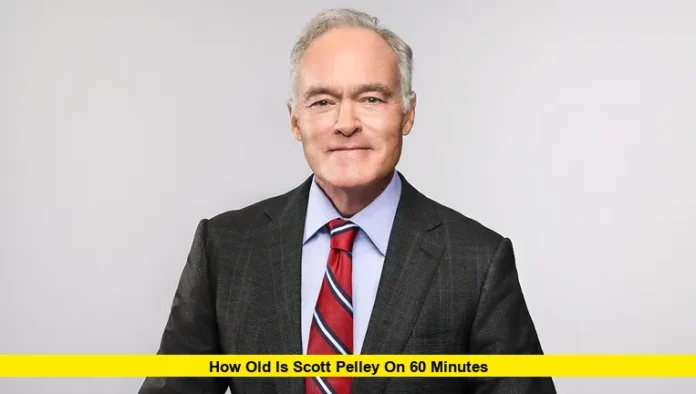

Scott Pelley, one of the most respected and recognized correspondents in American television history, is 68 years old. Born on July 28, 1957, in San Antonio, Texas, he has spent more than five decades building a career that most journalists only dream about. If you’ve ever typed how old is Scott Pelley on 60 Minutes into a search bar, the answer is 68 — but the more interesting question right now is not how old he is. It’s what he’s doing with the time he has left on one of television’s most storied programs, and why his final season is turning into one of the most dramatic exits in broadcast news history.
At 68, Pelley is not fading into the background. He is speaking plainly, pushing back publicly, and leaving on his own terms — or as close to his own terms as the current chaos inside CBS News will allow.
If you care about the future of American journalism, bookmark this page — this story is still developing and you’ll want to follow every update.
A Career That Started When He Was a Teenager
Scott Pelley did not stumble into journalism. He chased it from the time he was fifteen years old, working as a copyboy at a Texas newspaper while most kids his age were thinking about Friday night football games. He went on to study journalism at Texas Tech University in Lubbock and never looked back. By the time he joined CBS News, he already had the instincts of someone who had been doing this work for years — because he had been.
His early career took him through local Texas television stations before CBS News brought him into the fold. Once there, he rose quickly. He covered wars. He sat across from sitting presidents. He reported from disaster zones, conflict regions, and boardrooms where powerful people had something to hide. Long before he became a household name, he was already the kind of journalist that sources trusted and subjects feared.
Two Decades on 60 Minutes
Pelley joined 60 Minutes as a full correspondent in 2004, and the 2024–2025 season marked his 21st year on the broadcast. That is not just a long run — it is a defining one. In more than two decades on the show, he became closely identified with the program’s reputation for tough, uncompromising journalism. He has won more major awards during his time on 60 Minutes than any other correspondent in the show’s history.
His Emmy Award count alone stands at 51, a number that staggers even longtime television news veterans. He has also earned four Alfred I. duPont-Columbia Silver Batons and three George Foster Peabody Awards — two of the most prestigious honors in American journalism. These are not honorary recognitions. Every single one of them was earned through competitive journalism, one story at a time.
His reporting has taken him into active war zones, including Ukraine, Iraq, Afghanistan, Syria, and Sudan. On September 11, 2001, he was reporting from the World Trade Center when the North Tower collapsed around him. In April 2022, he traveled to Kyiv while the city was under active siege to interview Ukrainian President Volodymyr Zelenskyy — a trip that required real physical courage at a moment when the outcome of that conflict was far from certain.
The CBS Evening News Years
Before he returned full-time to 60 Minutes, Pelley served as anchor and managing editor of the CBS Evening News from 2011 to 2017. During that stretch, the broadcast gained more than a million and a half viewers and reached its highest ratings in over a decade. His delivery behind the anchor desk was authoritative and calm — the kind of presence that made viewers feel like they were getting the truth straight, without spin or performance.
When he stepped away from the anchor chair in 2017, he went back to the field, back to 60 Minutes, and back to the work that had made him famous in the first place. He clearly preferred it. The stories he produced after returning to the broadcast confirmed that his best reporting was still ahead of him.
The Storm Inside CBS News
In late 2025 and into 2026, 60 Minutes became the center of a corporate and editorial battle that shook the program to its foundation. Paramount’s merger with Skydance Media, which required federal regulatory approval, set off a chain of events that fundamentally changed the leadership structure of CBS News and directly impacted the editorial independence that 60 Minutes had guarded for more than five decades.
Bill Owens, the executive producer of 60 Minutes and only the third person to hold that role in the show’s 57-year history, resigned in April 2025. His reason was not ambiguous. He said publicly that he no longer had the editorial independence that honest journalism requires. That kind of statement, from someone in his position, about a program like 60 Minutes, landed like a bomb inside American media.
Scott Pelley made sure viewers heard about it. At the end of a 60 Minutes broadcast in late April 2025, he addressed the audience directly — on air, live, in front of millions of people — and said that none of the correspondents were happy about the increased corporate oversight being placed on the show. He acknowledged that no stories had been blocked, but made clear that the pressure being applied to the newsroom was real and that Owens had concluded it was incompatible with the kind of journalism 60 Minutes was built on.
That moment was extraordinary by any standard. It is almost unheard of for a network correspondent to use airtime to publicly criticize the corporate structure of his own employer. Pelley did it anyway.
Speaking Out Even Louder
He did not stop there. In March 2026, at an awards event honoring Bill Owens, Pelley went further. He said directly that CBS’s previous corporate owners had faced political pressure and had crumbled under it. The comment was widely understood as a reference to CBS settling a lawsuit with former President Donald Trump — a settlement many observers interpreted as a way to ease the path for the Paramount-Skydance merger, which needed approval from a federal government operating under the Trump administration.
Pelley named no names in that speech, but the meaning was unmistakable. At 68, with nothing left to prove and a legacy already secured, he was choosing to say the thing that younger or more career-conscious journalists might have kept to themselves.
What’s Next for Pelley at 60 Minutes
Pelley announced he would be leaving 60 Minutes at the end of the current season. The departure brings to a close a 21-year chapter that has produced some of the most watched, most awarded, and most consequential journalism in the program’s long history.
His exit comes amid broader turmoil at the network. A new editor-in-chief installed after the Skydance deal closed has taken a hands-on approach to the show’s editorial process that represents a significant departure from how 60 Minutes has historically operated. Reports in early 2026 indicated that Pelley and at least one other senior correspondent were considered at risk of losing their positions as the new leadership looked to reshape the broadcast. Pelley’s announcement to leave at season’s end resolved that tension in the clearest possible way.
Even in his final stretch on the program, his reporting has not softened. He continued to pursue major investigative work right up to the end, including a significant report on Havana Syndrome and a classified U.S. intelligence mission connected to the mysterious brain injuries suffered by American diplomats and military personnel overseas. At 68, he is reporting with the same drive and seriousness that took him into war zones three decades ago.
What His Legacy Actually Means
It is easy to stack up the awards and the career milestones and call that a legacy. But the real legacy Scott Pelley is leaving behind at 60 Minutes is something harder to quantify. It is the standard he held himself to, story after story, for more than two decades on the most watched newsmagazine in American television history.
He reported from places that were genuinely dangerous. He asked questions that made powerful people uncomfortable. He told his audience the truth even when the truth was difficult, complicated, or politically inconvenient. And in his final season, when the institutional pressure to stay quiet might have been enormous, he used his remaining platform to defend the very principle — editorial independence — that made 60 Minutes worth watching in the first place.
In a 2025 commencement address, Pelley told graduating students that journalism, universities, and free speech are all under sustained attack in America, and called on young people to hold firm to the rule of law and the values of an open society. Those were not the words of someone marking time until retirement. They were the words of a journalist who still believes urgently in what journalism is for.
At 68, Scott Pelley is walking away from the job that defined him. But the values he brought to that job — the curiosity, the toughness, the refusal to look away — those do not retire.
What do you think Scott Pelley’s departure means for the future of 60 Minutes and serious TV journalism in America? Leave your thoughts in the comments below.