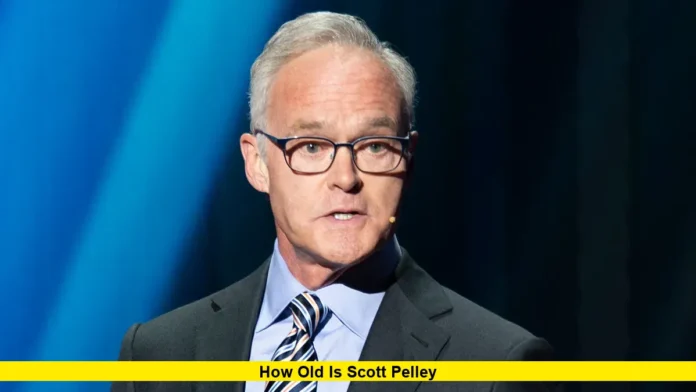

One of the most searched questions in American media right now is a simple one: how old is Scott Pelley? The veteran CBS News journalist and longtime 60 Minutes correspondent was born on July 28, 1957, making him 67 years old as of early 2026, with his 68th birthday arriving this coming July. But his age is only part of the story. At a moment when the future of 60 Minutes hangs in genuine uncertainty, the bigger question is not how old Scott Pelley is — it is what comes next for one of the most decorated journalists in the history of American television.
Whether you are a longtime fan of his work or just catching up on the drama unfolding inside CBS News, here is everything you need to know.
Bookmark this page — the Scott Pelley story is developing fast, and you will not want to miss a single update.
The Basics: Scott Pelley’s Age, Birthday, and Early Life
Scott Cameron Pelley was born on July 28, 1957, in San Antonio, Texas. He grew up in Lubbock, where he showed an early and serious interest in journalism — serious enough that he landed his first job in the industry at just 15 years old, working as a copyboy for a local newspaper. It was the kind of start that foreshadowed everything that came after: driven, hands-on, and rooted in a genuine love of the craft.
He went on to study journalism at Texas Tech University in Lubbock, though he left before completing his degree. Years later, the university recognized him as one of its most distinguished alumni — a full circle moment that speaks to how far a determined teenager with a notebook could go.
At 67, Pelley has been working in broadcast journalism for more than five decades. He joined CBS News in 1989 and has spent the decades since building a career that most journalists can only dream about.
A Career Defined by History
Ask any serious student of American journalism to name the reporters who showed up at the hardest moments, and Scott Pelley’s name comes up quickly. He was at the World Trade Center on September 11, 2001, reporting live when the North Tower collapsed. He traveled to a blacked-out bunker in Kyiv in the spring of 2022 to interview Ukrainian President Volodymyr Zelenskyy while Russian forces had the city under siege. He has covered wars in Afghanistan, Iraq, Syria, Sudan, and Ukraine. He has interviewed American presidents from George H.W. Bush through Joe Biden.
These are not just impressive résumé entries. They represent a career built on a singular commitment: get to the story, no matter how hard or dangerous, and tell it straight.
Pelley joined 60 Minutes as a full-time correspondent in 2004, and the 2024–25 season marks his 21st year on the broadcast. During that time, he has won more major awards than any other correspondent in the show’s history — including more than 50 Emmy Awards, four Alfred I. duPont-Columbia Awards, and three George Foster Peabody Awards. He is, by nearly any measure, the most honored journalist in 60 Minutes history.
From 2011 to 2017, he also served as anchor and managing editor of the CBS Evening News. During his tenure, the program grew by more than 1.5 million viewers — the longest and largest period of audience growth at the broadcast since the era of Walter Cronkite. He was eventually removed from the anchor chair after raising concerns about a hostile work environment at the network, a chapter that offers early context for the kind of journalist he is: not the kind who stays quiet when he thinks something is wrong.
The Man Behind the Microphone: Family and Personal Life
Away from the camera, Scott Pelley has kept a notably private personal life for someone so publicly prominent. He has been married to Jane Boone Pelley since August 1983. Jane is a former television reporter and advertising executive. Together they have two children, a son named Reece and a daughter named Blair.
By all accounts, his marriage has been a steady, grounding presence through a career that has taken him to war zones, disaster sites, and the most consequential news events of the past four decades. He is known among colleagues as someone who takes the work seriously but does not take himself too seriously — a distinction that matters enormously in a profession where ego often gets in the way of good journalism.
Pelley is also an author. His 2019 book, Truth Worth Telling: A Reporter’s Search for Meaning in the Stories of Our Times, profiles people — famous and unknown alike — who found meaning during historic moments. It is, in many ways, a reflection of the philosophy that has guided his entire career: the belief that the best journalism is about human beings, not institutions.
The Storm at CBS: What Is Happening at 60 Minutes Right Now
In 2025 and into 2026, 60 Minutes became the center of one of the most turbulent chapters in the history of American broadcast journalism. The trouble began with a corporate merger between Skydance Media and Paramount, CBS’s parent company — a deal that required approval from the Trump administration. That approval created pressure, and that pressure found its way into the newsroom.
President Donald Trump had filed a lawsuit against CBS News over what he claimed was unfair editing of a Kamala Harris interview during the 2024 presidential election. Despite many legal experts publicly questioning the strength of the case, Paramount settled the lawsuit for $16 million. That decision landed like a bombshell inside the building.
Scott Pelley did not stay silent. In April 2025, during a live broadcast, he addressed the situation directly — telling viewers that Paramount had begun supervising 60 Minutes‘ content in new ways, and that the network’s longtime executive producer, Bill Owens, had resigned because he felt he had lost the editorial independence that honest journalism requires. Pelley praised Owens openly and made clear that the staff had not supported the corporate interference.
Then, as recently as March 2026, Pelley appeared at a journalism awards ceremony honoring Owens and went even further, saying publicly that CBS’s previous owners had “faced political pressure and crumbled.” It was a direct, unambiguous rebuke — the kind that takes real courage to deliver when your own job may be on the line.
Is Scott Pelley About to Lose His Job at 60 Minutes?
That is the question hanging over everything right now. In January 2026, reports emerged suggesting that both Pelley and fellow correspondent Sharyn Alfonsi may be at risk following their public criticism of CBS News’s newly appointed editor-in-chief, Bari Weiss.
Weiss, co-founder of the media outlet The Free Press, was installed at the helm of CBS News in late 2025 by new CEO David Ellison after the Skydance-Paramount merger was finalized. She has faced significant internal resistance since arriving — from staffers who accused her of attempting to appease the Trump administration and from correspondents who objected to her editorial decisions.
One of the flashpoints came when Weiss pulled a completed 60 Minutes segment on El Salvador’s controversial CECOT prison before eventually allowing it to air with changes. Correspondent Sharyn Alfonsi, who reported the story, publicly pushed back in an internal memo. Pelley’s own comments about the network’s editorial direction added further fuel.
Insider accounts described the situation inside CBS as escalating rapidly, with contract negotiations and possible buyouts being discussed. The details of Pelley’s contract have not been made public, so his precise status remains unclear. What is clear is that he has not announced any departure and has continued showing up — on air and at public events — making his views known without apology.
Anderson Cooper, another 60 Minutes stalwart, announced in early 2026 that he would not be renewing his contract and would leave the show at the end of the current season to focus on his work at CNN. His departure has added to the sense that a generational shift is underway at one of television’s most respected programs.
Why Scott Pelley Still Matters
In a media environment where opinion and entertainment increasingly dominate what used to be straight news, Scott Pelley has spent decades trying to hold the line. His style has always been direct, precise, and unbothered by popularity. He does not perform outrage. He reports facts, asks hard questions, and lets the answers speak for themselves.
At 67, he carries a kind of institutional knowledge that cannot be manufactured. He has seen wars up close. He has watched presidents rise and fall. He has covered the September 11 attacks, the financial crisis, the opioid epidemic, multiple presidential elections, and now a corporate takeover of the network where he has spent most of his professional life.
The question of how old Scott Pelley is matters less than what those years represent — decades spent in service of a journalism that takes its obligations seriously, even when doing so creates enemies.
Whatever happens next at CBS, the record he has built is not in dispute. Fifty-plus Emmy Awards. Four duPont-Columbia Awards. Three Peabody Awards. More than two decades on 60 Minutes. A career that started when a teenager in Lubbock talked his way into a newsroom job and never really stopped pushing forward.
At 67 years old and counting, Scott Pelley remains one of the most consequential journalists in the United States. The next chapter of his story is still being written — and it is shaping up to be as dramatic as anything he has ever reported on.
What do you think about the future of 60 Minutes and Scott Pelley’s place in American journalism? Drop your thoughts in the comments below — this conversation is just getting started.