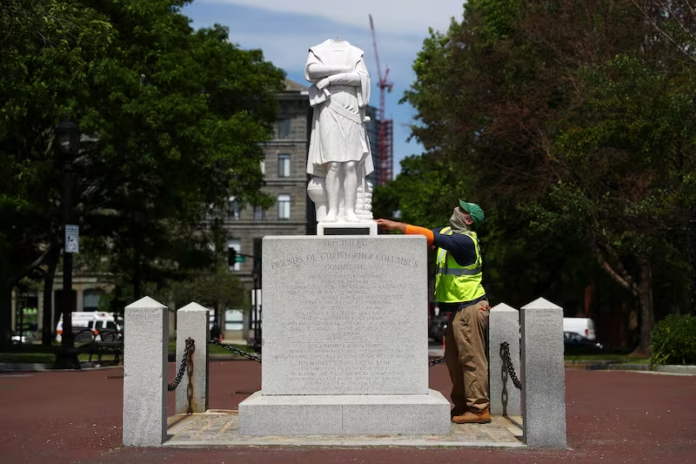

Few names in American history carry as much weight, or ignite as much conflict, as Christopher Columbus. The christopher columbus controversy is not a simple argument about one man and one voyage. It is a deep, emotionally charged national debate about heritage, historical truth, cultural identity, and who holds the power to shape public memory. That debate reached a defining new moment in March 2026, when President Donald Trump installed a 13-foot Columbus statue directly on White House grounds — placing one of the most contested figures in American history at the nation’s most powerful and symbolic address.
The move did not come without context. It was years in the making, shaped by community protests, political realignment, a dramatic statue recovery story, and a culture war that has been intensifying for decades. To understand what just happened at the White House, you need to understand the full arc of the story behind it.
This story is still developing — bookmark this page and return for the latest updates as they happen.
The Man, the Myth, and the Reality
Christopher Columbus was born in Genoa, in what is now Italy, sometime around 1451. He sailed under the Spanish crown and reached the Caribbean in October 1492, making landfall in the Bahamas before exploring Cuba, Hispaniola, and other islands across four separate voyages to the Western Hemisphere over the following decade.
For centuries, Columbus was taught in American classrooms as a figure of heroic vision — a man who changed the course of human history through sheer determination and navigational brilliance. His name was attached to a federal holiday, dozens of American cities and counties, a major river, and the capital of Ohio. Statues of him were erected in public squares across the country throughout the 19th and early 20th centuries, many of them funded by Italian American communities as acts of cultural pride.
But the christopher columbus controversy did not begin with social media or the protests of 2020. It has been building quietly and persistently since at least the 1970s, when Native American scholars, historians, and community leaders began making a sustained public case that the dominant story of Columbus was dangerously incomplete.
Their argument rested on documented historical record, not political opinion. Columbus governed the island of Hispaniola — the first permanent European settlement in the Americas — with methods that included forced labor, violent punishment, and the systematic enslavement of the Taino people who had lived there for generations. Under his direct administration, the Taino population collapsed from several hundred thousand to near extinction within just a few decades of his arrival.
Beyond Hispaniola, the voyages of Columbus inaugurated an era of European colonization across the entire Western Hemisphere during which tens of millions of Indigenous people died from violence, disease, and the deliberate destruction of their societies, languages, and ways of life. Historians have long argued that you cannot honestly celebrate Columbus as a hero without also reckoning with the catastrophic human consequences his arrival set in motion.
Why Italian Americans Defend Columbus So Fiercely
To understand the full christopher columbus controversy, it is essential to understand why Columbus Day carries such deep personal meaning for so many Italian American families — and why that meaning runs far deeper than admiration for a 15th-century explorer.
Italian immigrants who arrived in America in the late 1800s and early 1900s did not receive a warm welcome. They faced widespread discrimination, social exclusion, and outright violence. The 1891 lynching of eleven Italian immigrants in New Orleans remains one of the largest mass lynchings in American history. For decades, Italian Americans were treated as racially suspect and culturally inferior in a country they had come to build a life in.
Columbus Day emerged directly from that painful reality. When the federal government formally established it as a national holiday in 1937, the recognition carried enormous emotional weight for Italian American communities. It was an acknowledgment that an Italian-born man had played a foundational role in the story of the Western Hemisphere — and that Italian Americans, by extension, belonged in the American story.
For generations of Italian American families, the holiday was never really about the historical specifics of a 15th-century voyage. It was about dignity. It was evidence that their ancestors had not come to this country in vain. It was the right to take up space in a nation that had spent decades telling them they did not fully belong.
That history is why efforts to remove or replace Columbus Day land with such force in Italian American communities today. For many families who have celebrated the holiday for three, four, or five generations, the push to displace Columbus from public life feels less like a historical correction and more like a cultural erasure.
The 2020 Protests Changed Everything
The summer of 2020 accelerated the christopher columbus controversy in ways that nobody had fully anticipated. As nationwide protests swept the country following the police killing of George Floyd, demonstrators across America targeted statues, monuments, and public symbols they viewed as celebrations of racism, oppression, and colonial violence. Columbus monuments became among the most visible targets.
Dozens of Columbus statues were pulled down, vandalized, or formally removed by city governments in the weeks and months that followed. In Richmond, Virginia, a Columbus statue was toppled, set on fire, and thrown into a lake. In Saint Paul, Minnesota, demonstrators pulled down a Columbus monument that had stood for 108 years. In cities from New Haven to Los Angeles, local governments either preemptively removed statues or allowed communities to take them down without intervention.
In Baltimore, demonstrators used ropes and chains to tear a Columbus statue from its pedestal in the city’s Little Italy neighborhood and throw it into the Inner Harbor. The statue had stood there since 1984, when President Ronald Reagan formally dedicated it as a tribute to Italian American heritage. Its destruction was caught on video and shared widely, becoming one of the most recognizable images of that summer.
For Baltimore’s Italian American community, the loss was not abstract. The statue had been funded through community contributions over many years and had stood at the heart of the neighborhood as a source of civic pride. Rather than accept its destruction, community leaders organized a recovery mission, pulling fragments from the harbor. A sculptor was brought in to reconstruct the piece using those recovered sections alongside newly carved marble. The project took two years and was completed in 2022. The finished statue carried an inscription marking its original 1984 dedication, its 2020 destruction, and what the community deliberately called its 2022 resurrection.
Trump Enters — and Takes the Loudest Possible Stand
President Trump has made his position on the christopher columbus controversy unmistakably clear throughout his political career, and his return to the White House in 2025 gave him the tools to act on that position in concrete, highly visible ways.
In October 2025, Trump signed a formal presidential proclamation restoring Columbus Day to full federal standing with no accompanying recognition of Indigenous Peoples’ Day. The proclamation described Columbus as the original American hero, praised his 1492 voyage as one of the defining acts of Western civilization, and framed the defense of Columbus Day as an act of patriotic duty. It did not attempt to balance Columbus’s legacy with any acknowledgment of the harm his voyages caused to Indigenous peoples. It was, deliberately and without apology, a celebration.
Trump has been equally forceful in describing those who challenge Columbus’s legacy. He has publicly called critics of the holiday political arsonists who seek to destroy American history and erase the contributions of the Italian American community. At a Cabinet meeting where he signed related orders, he told the room with evident satisfaction, “Columbus Day — we’re back, Italians.”
A Statue From the Harbor to Pennsylvania Avenue
On March 22, 2026, Trump took the christopher columbus controversy to an entirely new level by installing the restored Baltimore statue directly on White House grounds.
The 13-foot monument now stands on a plaza adjacent to the Eisenhower Executive Office Building, visible from Pennsylvania Avenue and 17th Street NW. Security fencing limits close public access, but the statue is clearly visible from the street — an unmistakable and deliberate symbol placed at the most powerful residential address in the world.
The statue was loaned to the federal government by Italian American Organizations United, the Maryland-based group that had overseen its recovery and restoration. The loan runs through January 2029, at which point the next administration will decide whether it remains.
Trump described the installation as an eternal tribute to courage, adventure, and the noblest aspirations of the human spirit. A White House spokesperson stated directly that Columbus is a hero in this administration and that Trump intends to honor that legacy for generations to come.
Indigenous Communities Speak Clearly
The response from Native American communities across the country was immediate and deeply felt. Indigenous advocates described the White House installation as a painful and deliberate act — a government endorsement of a legacy that caused immeasurable suffering to their ancestors and continues to shape the lived realities of Native people today.
The core argument from Indigenous communities is grounded in the same documented history that scholars have been presenting for decades. Columbus’s arrival in 1492 did not mark a discovery. It marked the beginning of a catastrophe for the peoples who were already living across the Americas. Placing a statue honoring the architect of that catastrophe at the seat of American executive power sends a message that Indigenous communities hear loudly and clearly — a message about whose suffering the government considers worth acknowledging and whose it chooses to set aside.
Across the states and cities that have formally recognized Indigenous Peoples’ Day, communities continued celebrating on the second Monday of October regardless of what federal proclamations declared. For many Native Americans, the response to the christopher columbus controversy has been consistent for years: we will honor our own history with or without federal permission.
Where the Country Stands Right Now
As of March 2026, nearly 20 states and more than 200 American cities observe Indigenous Peoples’ Day in some form. The push continues to grow each year. Meanwhile, at the federal level, Columbus Day stands fully restored with no competing recognition, and a 13-foot marble Columbus now overlooks one of Washington’s busiest corridors.
Legislation introduced in Congress would withhold federal funding from any state or local government that chooses to recognize Indigenous Peoples’ Day instead of Columbus Day. It has not passed, and its prospects remain uncertain in a divided legislature.
The christopher columbus controversy has no clean resolution on the horizon. Both sides of this debate carry positions rooted in genuine history and deeply human experience. Both carry real pain — the pain of a community that fought for recognition in a country that once treated them as less than human, and the pain of communities whose ancestors experienced the full force of what Columbus’s arrival set in motion.
The marble figure now standing near Pennsylvania Avenue does not resolve any of that. It simply makes the question impossible to look away from.
What do you think about the Christopher Columbus controversy and the White House statue? Leave your thoughts in the comments below — and keep checking back as this story continues to develop.